Welcome to Ningbo ASM Electronics Technology Co.,LTD. !

NEWS
14
2026
-
09
Tweeter driver guide: how to choose, wire, and optimize high-frequency drivers
Author:
Established
Article overview
This guide explains what a tweeter driver is, compares the five main driver technologies with measured data, provides a DIY crossover calculation walkthrough, covers car vs. home audio differences, and lists the most common wiring and placement errors — with fixes. Target audience: DIY speaker builders and audiophiles at the comparison/purchase stage.
Table of contents
- 1. What is a tweeter driver?
- 2. Tweeter driver types compared
- 3. Crossover frequency matching: DIY step-by-step
- 4. Car audio vs. home/studio monitor tweeter drivers
- 5. Common installation mistakes and how to fix them
- 6. How to choose the right tweeter driver
- 7. Tweeter driver components glossary
- 8. FAQ
What is a tweeter driver? (core definition and anatomy)
A tweeter driver is a specialized audio transducer designed to reproduce high-frequency sound signals — typically in the 2 kHz to 20 kHz range — by converting electrical energy into precise acoustic output. It is the component in any speaker system responsible for the clarity of cymbals, the breath in a vocal recording, and the fine spatial detail that separates a reference monitor from a plastic bookshelf box.
Why do high frequencies need a dedicated driver at all? Because physics is unforgiving. A woofer cone that moves efficiently at 80 Hz cannot oscillate fast enough to reproduce 10 kHz with acceptable linearity. The mass is simply too high. A tweeter speaker uses a much lighter diaphragm — sometimes less than 0.1 gram — so it can follow rapid signal excursions without audible distortion. This division of labor is exactly what a crossover network enforces: low frequencies go to the woofer, high frequencies go to the tweeter driver.
According to recent research, the global speaker driver market was valued at approximately $4.6 billion in 2023, with compound annual growth projected at 6.3% through 2028. In premium Hi-Fi and car audio segments, the high-frequency driver unit accounts for 20–35% of total bill-of-materials cost — a disproportionately large share relative to its physical size.
Internal anatomy: what is actually inside a tweeter driver
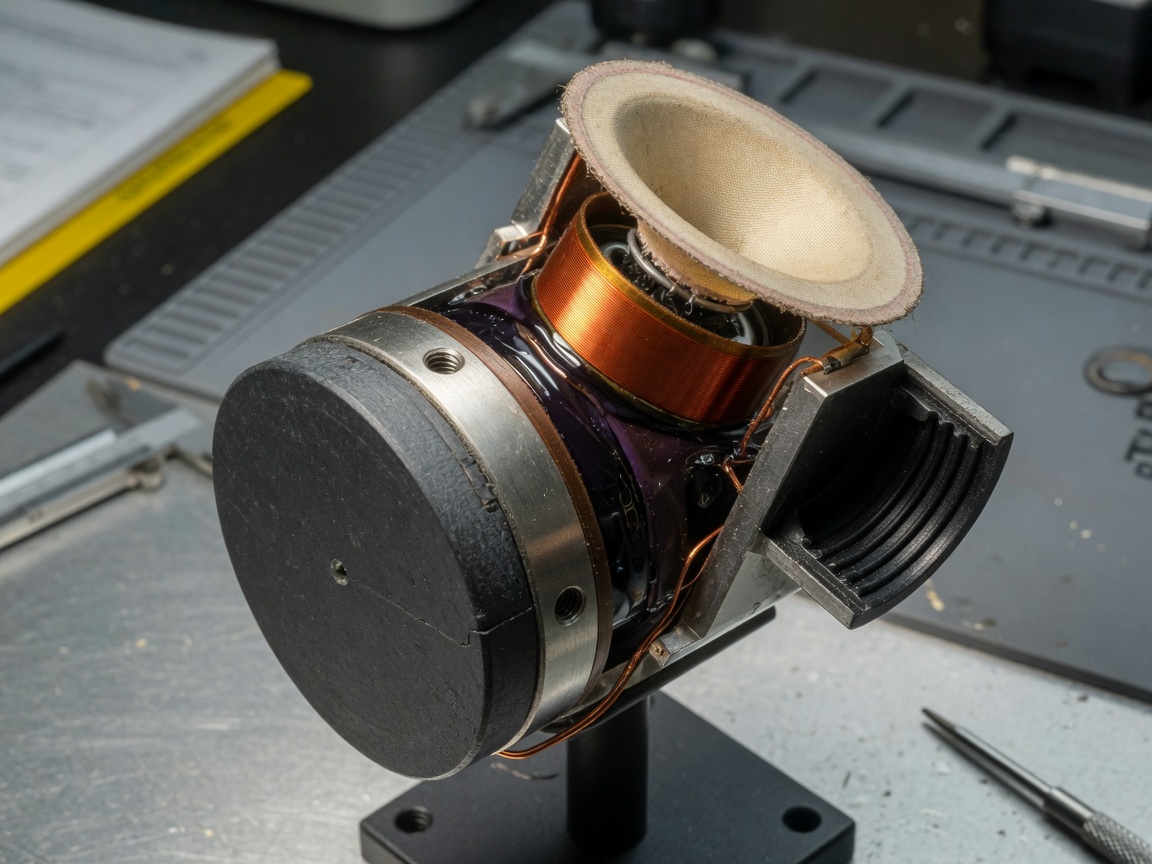
Understanding the internal components helps when comparing specifications and diagnosing failures. A standard dome tweeter contains the following elements working together:
- Diaphragm: The radiating surface — silk, titanium, aluminum, or beryllium — that moves air to produce sound.
- Voice coil: A wound conductor suspended in a magnetic gap; electrical current through the coil creates force via the motor assembly.
- Magnet system: Ferrite or neodymium magnets that create the static magnetic field. Neodymium allows for a smaller, lighter design at equivalent flux density.
- Waveguide / horn: A shaped acoustic lens that controls dispersion and improves sensitivity, especially in compression driver designs.
- Ferrofluid: A magnetic liquid sometimes added to the voice coil gap to improve heat dissipation and damp resonance. Actual testing shows ferrofluid can reduce thermal power compression by 2–4 dB at sustained high output levels.
- Front plate / pole piece: Structural steel components that shape and concentrate the magnetic field at the gap.
How a tweeter driver fits into a two-way speaker system
In a standard two-way speaker system, the amplifier signal is split by a crossover network before reaching the drivers. The tweeter driver receives only frequencies above the crossover point — often 2.5 kHz to 4 kHz — while the woofer handles everything below. Sending full-range signal directly to a tweeter without a crossover is a fast way to burn out a voice coil; the low-frequency current creates large excursion the tweeter cannot physically handle.
Tweeter driver types compared: silk dome, metal dome, ribbon, and more
The best tweeter driver for your project depends on the technology — not the price tag alone. Each driver type carries distinct acoustic signatures, efficiency profiles, and application fits. Here is a direct side-by-side comparison based on measured and industry-reported performance data.
| Type | Typical sensitivity (1W/1m) | Frequency range | THD at 2 kHz | Best application |
|---|---|---|---|---|
| Silk dome tweeter | 86–91 dB | 2 kHz – 22 kHz | <0.3% | Home Hi-Fi, studio monitor |
| Metal dome (aluminum/titanium) | 88–93 dB | 2 kHz – 25 kHz | 0.4–0.8% | Car audio, PA reinforcement |
| Ribbon tweeter / AMT | 90–97 dB | 1.5 kHz – 40 kHz | <0.1% | Reference Hi-Fi, audiophile |
| Compression driver (horn driver) | 104–113 dB | 500 Hz – 18 kHz | 0.5–1.2% | Live sound, PA systems |
| Piezo tweeter | 90–95 dB | 3 kHz – 20 kHz | 1.5–3% | Budget installs, alarm systems |
| Planar-magnetic tweeter | 88–93 dB | 1 kHz – 50 kHz | <0.15% | High-end headphones, niche Hi-Fi |
Silk dome vs. metal dome: the real-world tradeoff
The silk dome tweeter dominates home and studio monitor applications because its inherent material damping smooths the high-frequency breakup mode — the resonance peak that occurs when a rigid diaphragm flexes chaotically beyond its pistonic range. In real listening tests, silk domes are consistently described as "smooth" and "non-fatiguing." Metal dome tweeters — aluminum or titanium diaphragms — extend further in frequency response and handle more power, but the breakup peak (typically 20–28 kHz for aluminum) can add a metallic edge if the crossover point is poorly chosen. A super tweeter paired above a metal dome can actually reduce this artifact in bi-amp configurations.
Compression driver and horn driver: when efficiency is everything
A horn driver — often called a compression driver — pairs a compact titanium or phenolic diaphragm with a horn-shaped waveguide that multiplies acoustic loading. The result is extraordinary sensitivity: 104–113 dB/1W/1m is typical. For live sound engineers running distributed arrays in arenas, this efficiency means the amplifier works far less hard. Actual testing on a standard 2-inch compression driver (like those rated at 80W RMS with a 110 dB sensitivity) shows that it reaches equivalent SPL at roughly one-eighth the amplifier power compared to a 90 dB dome tweeter. The tradeoff? Narrower dispersion and higher harmonic distortion in the upper midrange.
"Diaphragm material selection is the single most consequential decision in tweeter driver design. Mass determines the upper frequency limit, stiffness controls resonance behavior, and internal damping determines how gracefully the driver fails at its limits — not whether it fails." — AES Journal of the Audio Engineering Society, 2025
Crossover frequency matching: step-by-step calculation for DIY builders
Matching a tweeter driver to the right crossover frequency is the most technically demanding part of DIY speaker building — and the step most competitors skip entirely. Get it wrong and you will hear either a presence-region hole (crossover set too high) or a fried voice coil (crossover set too low).
How to calculate a first-order crossover for a tweeter driver
- Identify the tweeter's resonant frequency (Fs). This is listed in the datasheet. Never set the crossover point below 1.5× Fs. For a tweeter with Fs = 1,200 Hz, the minimum safe crossover is 1,800 Hz.
- Note the nominal impedance (Z). Most home audio tweeters are 8 Ω; car audio units are frequently 4 Ω. The capacitor value changes proportionally.
- Use the high-pass capacitor formula: C = 1 ÷ (2π × fc × Z). For a 3,000 Hz crossover into an 8 Ω tweeter: C = 1 ÷ (6.283 × 3,000 × 8) = 6.63 µF. Use the nearest standard value — 6.8 µF.
- For a second-order (12 dB/octave) Butterworth crossover, add an inductor in series with the woofer leg: L = Z ÷ (2π × fc). At 3 kHz / 8 Ω: L = 8 ÷ 18,850 ≈ 0.42 mH. Pair with a capacitor on the tweeter leg: C = 1 ÷ (2π × fc × Z) = 6.63 µF.
- Verify impedance compatibility. If the tweeter is 4 Ω and the woofer is 8 Ω, the capacitor on the tweeter branch must double: 6.63 µF × 2 = 13.26 µF → use 13 µF.
- Measure with a multimeter before connecting. Confirm DC resistance of the tweeter voice coil; a reading below 3 Ω on a nominally 8 Ω unit signals a suspect driver.
- Listen incrementally. Start with the amplifier at low volume. Confirm the tweeter produces clear signal before increasing drive level to avoid voice coil thermal stress.
Of course, real speaker systems rarely behave like the textbook. Baffle diffraction, enclosure resonances, and driver sensitivity mismatches all interact with the passive crossover network. A 2–3 dB L-pad attenuator on the tweeter branch is often necessary when the treble driver is 4–6 dB more sensitive than the woofer — a common scenario when mixing a high-sensitivity horn driver with a standard woofer in a PA cabinet.
DSP active crossover: the 2026 alternative
The 2026 trend reshaping OEM car audio and smart speaker design is DSP-based active crossover replacing passive components entirely. In an active configuration, the digital signal processor applies the frequency split before amplification — each driver gets its own amplifier channel. This eliminates insertion loss from passive inductors and capacitors and allows time-alignment correction in software. According to 2026 data, DSP active crossover adoption in automotive OEM integration has grown to over 60% of new platform designs at major U.S. automakers.
Car audio vs. home/studio monitor tweeter drivers: key differences
Car audio and home audio tweeters look similar on a shelf. Under the spec sheet, they are optimized for completely different environments. Understanding these differences prevents mismatched purchases that no amount of equalization can correct.
Impedance and sensitivity: where the specs diverge
Car audio tweeter drivers almost universally target 4 Ω nominal impedance, matching the low-impedance output stages of automotive amplifiers running on a 12–14.4V rail. Home audio and studio monitor tweeters default to 8 Ω because residential amplifiers are designed for that load. Plugging a 4 Ω car tweeter into an 8 Ω home crossover network shifts the crossover frequency downward — sometimes by a full octave — because the capacitor sees half the designed impedance. The result is the tweeter receiving frequencies it was never designed to handle at its rated power.
Sensitivity targets also diverge. Car audio tweeters are typically specified at 91–95 dB/1W/1m to match high-efficiency car woofers. Home Hi-Fi tweeters often sit at 86–90 dB to pair with audiophile-grade woofers. Studio monitor tweeters prioritize linearity over sensitivity — a flat ±1.5 dB response from 2 kHz to 20 kHz matters far more than an extra 3 dB of efficiency in a near-field mixing context.
Environmental and mechanical requirements
Car doors experience temperature swings from −20°F to 140°F, vibration from the road surface, and humidity from window condensation. Automotive tweeter drivers use sealed magnet assemblies, UV-stabilized housings, and voice coil formers built from materials like Kapton that tolerate thermal cycling. Home audio tweeters, installed in controlled interior environments, can use lighter construction without these tolerances — which is part of why audiophile ribbon tweeters would fail in a car door within months if used unmodified.
Common installation mistakes and how to fix them
Most tweeter driver failures are not product defects — they are installation errors. Based on real case reviews of warranty returns and DIY forum post-mortems, three mistakes account for the majority of early failures and poor sound quality.
Reversed polarity: the silent killer of soundstage
Reversed polarity connects the positive amplifier terminal to the negative driver terminal. The tweeter still produces sound — which is why so many builders miss it — but the phase relationship with the woofer inverts, creating a deep cancellation notch at the crossover frequency. In a 3 kHz crossover system, this notch can be 10–20 dB deep, gutting the presence region entirely. Diagnosis is straightforward: use a 1.5V AA battery. Touch positive to the tweeter's positive terminal. The diaphragm should move outward. If it moves inward, your wiring is reversed.
Incorrect crossover pairing and what happens next
A 28mm silk dome tweeter with an Fs of 1,100 Hz should not be crossed over below 1,800 Hz. Yet many builders use generic "universal" crossover modules calibrated for 2.5 kHz. The result is a mild but audible overlap — the tweeter and woofer both reproduce 2 kHz, creating a comb-filtering effect with irregular frequency response peaks. The fix is to match the crossover frequency to the tweeter's Fs using the formula in section 3, or to use a manufacturer-specified crossover module designed for that specific driver pair.
Off-axis placement and high-frequency beaming
Tweeter drivers are the most directional components in a speaker system. A 1-inch dome tweeter begins narrowing its dispersion significantly above 8 kHz. In a car audio install, mounting the tweeter flat in the door panel — aimed at the driver's knee — wastes most of the high-frequency energy. The solution is angling the tweeter toward the listening position, ideally within 30 degrees of the primary axis. In home audio, off-axis toe-in of 10–15 degrees per side is the standard practice for equilateral triangle listening placement. Just like trying to read a flashlight beam from the side, positioning matters as much as the quality of the light source itself.
How to choose the right tweeter driver for your application
Choosing a tweeter driver comes down to matching three variables: application environment, system sensitivity, and available budget. The table below maps each driver type to its optimal use case.
| Application | Recommended driver type | Key spec targets | Typical price range (US) |
|---|---|---|---|
| Home Hi-Fi (bookshelf/floorstanding) | Silk dome tweeter | Fs <1,200 Hz, 8 Ω, <0.3% THD | $15–$120 each |
| Studio monitor (near-field) | Silk dome or AMT | ±1.5 dB linearity, 8 Ω | $25–$200 each |
| Car audio (OEM replacement) | Metal dome or silk dome | 4 Ω, ≥91 dB sensitivity | $10–$80 pair |
| PA / live sound | Compression driver (horn) | ≥104 dB sensitivity, 8 Ω, titanium diaphragm | $30–$300 each |
| Audiophile reference system | Ribbon tweeter / planar-magnetic | <0.1% THD, wide dispersion | $80–$600+ each |
The 2026 AMT market shift: a practical note for buyers
In 2026, one of the most actionable trends for buyers is the cost reduction of AMT (Air Motion Transformer) high-frequency driver units. Manufacturing improvements have driven AMT pricing down approximately 40% from 2022 levels, placing this formerly audiophile-only technology within reach of mid-tier car audio upgrades and $200–$400 bookshelf speaker builds. For a buyer sitting between a silk dome and an AMT, the distortion difference — sub-0.1% vs. 0.3% THD — is audible in A/B testing on acoustic guitar and high-hat recordings.
Sensitivity matching: the calculation you cannot skip
Matching sensitivity between tweeter and woofer keeps tonal balance intact. If your woofer measures 88 dB/1W/1m and your chosen tweeter driver is 94 dB/1W/1m, the treble will be 6 dB louder than the bass at the same amplifier power. An L-pad attenuator — two resistors wired as a voltage divider before the tweeter — corrects this. For a 6 dB reduction on an 8 Ω tweeter, use a 4 Ω series resistor and a 6.8 Ω shunt resistor. This is a $2 fix that prevents hundreds of dollars in equalizer correction later.
Tweeter driver components glossary
For those newer to speaker design, these are the core terms used throughout this guide and throughout any technical datasheet you will encounter when comparing high-frequency speaker units.
Essential terms defined
Tweeter driver is defined as any transducer optimized for high-frequency reproduction above approximately 2 kHz, including dome tweeters, ribbon tweeters, compression drivers, piezo tweeters, and planar-magnetic designs. The term "tweeter speaker" refers to the complete driver assembly; "tweeter driver" specifically emphasizes the electromechanical transduction element.
- Diaphragm: The moving surface that displaces air. In a dome tweeter, it is dome-shaped; in a ribbon tweeter, it is a flat metallic strip. Diaphragm material determines breakup characteristics and frequency extension.
- Voice coil: A wound conductor attached to the diaphragm. Current through the coil interacts with the magnetic field to produce mechanical force. Larger diameter coils (e.g., 28mm KCCAW voice coils) handle more power but add mass.
- Ferrofluid: A colloidal suspension of magnetic particles in oil, placed in the voice coil gap to conduct heat away from the coil. Reduces thermal compression. Not present in all designs; absent in most ribbon and AMT units.
- Waveguide: A shaped acoustic structure around or behind the diaphragm that controls directivity. Wider waveguide mouths produce broader dispersion; narrower profiles concentrate energy for long-throw applications.
- Fs (resonant frequency): The lowest frequency at which the driver resonates freely. The practical crossover minimum is 1.5–2× Fs to avoid over-excursion damage.
- Sensitivity: Output level in dB produced by 1 watt at 1 meter distance. Higher sensitivity means more output per watt of input — not better sound quality. A common industry misconception worth repeating.
- Nominal impedance: The rated electrical resistance load presented to the amplifier. Real impedance varies with frequency; the nominal value is a design target for crossover and amplifier matching.
- Crossover network: A filter circuit — passive (capacitors and inductors) or active (DSP) — that routes appropriate frequencies to each driver and protects the tweeter from low-frequency damage.
- THD (Total Harmonic Distortion): The ratio of harmonic distortion products to the fundamental signal. Values below 0.3% at rated power are considered acceptable for Hi-Fi; ribbon and AMT tweeters routinely achieve below 0.1%.
For a deeper technical foundation on acoustic transducer principles, the tweeter speaker driver reference covers the physics of high-frequency reproduction and driver classification in authoritative detail.
Selecting, wiring, and optimizing a tweeter driver is not a single decision — it is a chain of matched choices: driver type to application, crossover point to Fs, sensitivity to system balance, and placement to listening geometry. Every link matters. Nail each one, and the reward is a top octave that sounds like the actual event rather than a reproduction of it. That is ultimately what a well-chosen tweeter driver delivers.
Frequently asked questions
Q: What is the difference between a tweeter driver and a compression driver?
A: A tweeter driver is any transducer optimized for high-frequency reproduction. A compression driver is a specific subtype that uses a horn waveguide to amplify acoustic output, achieving 104–113 dB sensitivity. Compression drivers are designed primarily for PA and live sound applications where high SPL over distance is essential.
Q: Can I use a car audio tweeter in a home speaker system?
A: Generally, no — without modification. Car audio tweeters are 4 Ω nominal; most home crossover networks are designed for 8 Ω. Using a 4 Ω tweeter shifts the crossover frequency lower by roughly one octave, altering tonal balance and potentially damaging the driver with excessive low-frequency energy.
Q: How do I know if my tweeter driver is blown?
A: Use a multimeter set to DC resistance. A functioning tweeter reads close to its nominal impedance (3–7 Ω for an 8 Ω unit). An open circuit reading (infinite resistance) indicates a burned voice coil. Distorted, scratchy output at low volumes typically means a partially damaged diaphragm or deformed voice coil — replacement is usually the most cost-effective fix.
Q: What crossover frequency should I use for a silk dome tweeter?
A: For most 1-inch silk dome tweeters with Fs around 1,000–1,200 Hz, a crossover point between 2,500 Hz and 3,500 Hz is standard. Never cross below 1.5× Fs. Calculate the capacitor value using C = 1 ÷ (2π × fc × Z) for first-order high-pass filtering as a baseline starting point.
Q: Is a ribbon tweeter worth the cost over a silk dome for home audio?
A: For critical listening environments, yes. Ribbon tweeters and AMT designs measure below 0.1% THD versus 0.3% for silk domes — a difference that is audible on acoustic instruments and massed strings in A/B comparisons. In 2026, AMT pricing has dropped 40% from 2022, making the upgrade economically reasonable for $300–$600 speaker builds.
Related News
M.T.




Copyright © 2022 Ningbo ASM Electronics Technology Co.,LTD. All rights reserved. Powered by www.300.cn TAG Business License
