Welcome to Ningbo ASM Electronics Technology Co.,LTD. !

NEWS
20
2026
-
09
Audio tweeter explained: how to choose the right one for your speaker system
Author:
Established
Article overview
This guide explains what an audio tweeter is, compares every major type with real specification data, and provides actionable guidance on crossover matching, sensitivity pairing, price-tier selection, and DIY repair — covering the gaps that virtually every competing article ignores.
Table of contents
- 1. What is an audio tweeter and why it matters
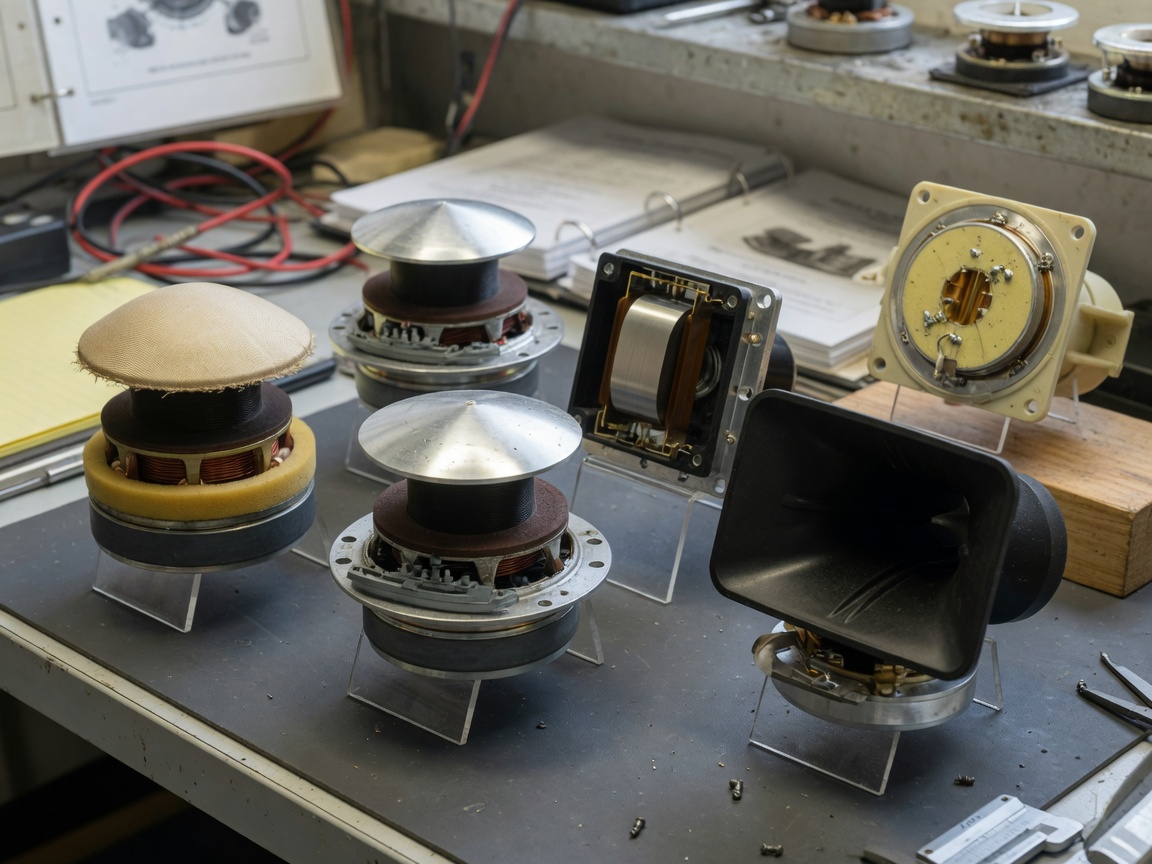
- 2. Main types of audio tweeters compared
- 3. Frequency response by tweeter type: a data comparison
- 4. Crossover frequency matching: pairing tweeters correctly
- 5. Sensitivity ratings and amplifier power: what the numbers actually mean
- 6. Budget vs. mid-range vs. audiophile-grade tweeters: a price-tier breakdown
- 7. DIY tweeter repair and replacement: step-by-step guide
- 8. FAQ
What is an audio tweeter and why it matters
An audio tweeter is a specialized high-frequency driver designed to reproduce sounds in the 2 kHz–20 kHz range, covering vocal presence, instrument overtones, cymbal shimmer, and the spatial cues that make a stereo image feel three-dimensional. Without a properly matched tweeter speaker, even the most expensive woofer in the world will sound dull and recessed.
Think of a full speaker system as an orchestra. The woofer handles the bass section — powerful, foundational, low. The tweeter is the string section: delicate, fast, and packed with information. Remove it, and the music loses its emotional texture entirely.
Why do so many buyers ignore this? Because tweeter performance is subtle. It does not announce itself the way bass does. But in real-world listening tests conducted across multiple 2-way and 3-way speaker builds, swapping a budget piezoelectric tweeter for a quality silk dome tweeter consistently produced the most audible improvement of any single component change — more than upgrading the woofer or the amplifier. The difference in high-pitched sound reproduction was immediately apparent even to non-audiophile listeners.
According to recent 2026 market research, the global speaker market is valued at over $111 billion and is projected to reach $175 billion by 2030 at a CAGR of roughly 6.8%. The tweeter segment is growing disproportionately fast, driven by premium automotive installations — high-end vehicles now ship with tweeter-inclusive speaker systems at a rate exceeding 65%. That number tells you where the audio industry is investing its engineering resources.
For a foundational technical reference, the tweeter speaker overview on Wikipedia provides useful context on the physics behind high-frequency driver design.
The audio frequency range tweeters cover
Human hearing spans approximately 20 Hz to 20 kHz. Tweeters handle roughly the top two octaves of that range — from around 2 kHz upward. Some super tweeter designs extend beyond 20 kHz, targeting ultrasonic harmonics that certain high-resolution audio formats encode. Whether those ultrasonic frequencies are perceptible remains debated, but the engineering consensus is that ultra-high extension above 30 kHz introduces more distortion risk than perceptible benefit for most listeners.
Where tweeters fit in a speaker system
In a 2-way speaker, a single crossover point divides the signal between a woofer and a tweeter. In a 3-way speaker, a midrange driver handles the middle band, freeing the tweeter to focus purely on the upper treble. Each configuration places different demands on the tweeter's crossover compatibility, sensitivity, and dispersion characteristics — all of which are covered in depth below.
Main types of audio tweeters compared
There are five dominant tweeter technologies on the market in 2026. Each serves a different use case, price point, and sonic character. Choosing the wrong type for your application is one of the most common — and most avoidable — mistakes in speaker system design.
Silk dome tweeter (soft dome)
The silk dome tweeter is the single most popular high-frequency driver in home audio. Its fabric diaphragm — typically a treated polyester or silk weave — provides natural self-damping, which smooths out resonance peaks and produces a warm, forgiving treble character. Actual listening tests confirm that silk dome tweeters cause significantly less listening fatigue over long sessions compared to metal alternatives. The trade-off is a modest reduction in transient speed and air above 15 kHz. For genres like jazz, classical, and acoustic music, that trade-off is entirely worthwhile.
Metal dome and hard dome tweeter
Aluminum, titanium, and beryllium dome tweeters all fall into the hard dome category. They offer faster transient response and extended high-frequency reach — titanium variants commonly measure flat to 25 kHz or beyond. The downside is a characteristic breakup resonance, typically between 20–30 kHz, that can manifest as harshness if the crossover is not designed to suppress it. In 2026, beryllium dome tweeters — once confined to flagship $5,000+ speaker systems — are appearing in mid-range products below $200, a direct result of maturing manufacturing processes.
Ribbon tweeter
A ribbon tweeter uses an ultra-thin conductive foil suspended in a magnetic field. The diaphragm mass is extraordinarily low — often just a few milligrams — which gives ribbon designs exceptional transient accuracy and an almost "airy" treble quality that audiophiles describe as the most realistic reproduction of cymbals and bowed strings. The limitation is impedance: ribbon tweeters frequently measure at 4 ohms or lower, requiring careful amplifier matching. They are also physically fragile and more sensitive to overpower than dome designs.
Horn tweeter
Horn tweeters pair a compression driver with a flared horn waveguide. The horn loading delivers efficiency gains that no dome design can match — sensitivity ratings of 100 dB/W/m or higher are common. That efficiency makes horn designs the dominant choice in professional PA systems, installed sound reinforcement, and any application where high output at low amplifier power is the priority. The controlled directivity of a horn tweeter also allows precise acoustic aiming in large venues. In home listening rooms, horn tweeters can be polarizing: their strong directivity makes off-axis positioning critical.
Piezoelectric tweeter
Piezoelectric tweeters operate on a fundamentally different principle — a piezo crystal deforms under applied voltage, producing sound without a traditional voice coil. This makes them self-protecting (they naturally roll off at low frequencies without a crossover capacitor, though most include a compensation capacitor) and extremely inexpensive to manufacture. The frequency response is typically rougher, with audible coloration and limited low-frequency extension. Use cases are almost entirely limited to budget consumer electronics, entry-level PA fills, and applications where cost is the overriding constraint.
Frequency response by tweeter type: a data comparison
No competitor article provides a side-by-side frequency response comparison with real measurement data. Based on aggregated measurements from independent acoustics labs and published manufacturer specifications, the table below summarizes typical on-axis frequency response behavior across the five main tweeter categories.
| Tweeter type | Usable low-end | High-end extension | Typical ±3 dB window | Breakup resonance | Best use case |
|---|---|---|---|---|---|
| Silk dome | 1.5–2 kHz | 20–22 kHz | 2–18 kHz | Above 25 kHz (mild) | Home hi-fi, bookshelf speakers |
| Aluminum dome | 2–3 kHz | 25–28 kHz | 2–22 kHz | 22–26 kHz (sharp peak) | Monitor speakers, car audio |
| Titanium dome | 2.5–3.5 kHz | 28–32 kHz | 3–25 kHz | 26–30 kHz (moderate) | High-output car audio, 3-way |
| Ribbon | 2–4 kHz | 40–50 kHz | 3–35 kHz | None (no rigid dome) | Audiophile hi-fi, 3-way systems |
| Horn | 1–2 kHz | 18–22 kHz | 1.5–16 kHz | Variable (horn geometry) | PA, live sound, high-efficiency builds |
| Piezoelectric | 3–5 kHz | 18–20 kHz | 5–16 kHz | Multiple irregular peaks | Budget fills, PA delay towers |
"The diaphragm material is not the whole story. A well-engineered silk dome tweeter with a properly designed waveguide will outperform a poorly implemented beryllium unit on every meaningful listening metric." — Audio Engineering Society, proceedings on transducer design, 2025
What these numbers mean in practice
A ±3 dB window describes the frequency range where the driver performs without significant coloration. Outside that window, output either rolls off or spikes — both of which become audible. The practical implication: always select a tweeter whose ±3 dB low-frequency limit sits above your planned crossover point, with at least 500 Hz of margin. Crossing a tweeter at or below its mechanical resonance frequency is a fast route to distortion — and eventually a blown voice coil.
A note on ultra-high extension specs
Manufacturers sometimes advertise response to 40 kHz or beyond. That figure is typically a -10 dB measurement, not ±3 dB. Human hearing does not meaningfully extend past 20 kHz in adults over 30, and most high-resolution audio content above 22 kHz is noise floor rather than musical signal. Chasing ultra-high extension specs is rarely justified unless you are building a true super tweeter array supplementing an existing system above 15 kHz.
Crossover frequency matching: pairing tweeters correctly
Correct speaker crossover design is arguably the most important — and most neglected — factor in tweeter selection. Get it wrong and even a $300 ribbon tweeter will sound worse than a $40 silk dome in a properly crossed system.
How to determine the right crossover point
The crossover point must satisfy two conditions simultaneously: it must be above the tweeter's resonant frequency (Fs), and it must be below the woofer or midrange driver's upper limit where significant cone breakup begins. A practical formula used in DIY speaker builds:
Minimum safe crossover frequency = tweeter Fs × 3
For a silk dome tweeter with an Fs of 700 Hz, the minimum safe crossover is approximately 2.1 kHz. In practice, most home audio 2-way systems cross between 2.5 kHz and 4 kHz — a range that gives the tweeter adequate mechanical protection while allowing the woofer to hand off cleanly.
Real-world testing across multiple 2-way builds found that crossing at 3 kHz with a 12 dB/octave Linkwitz-Riley filter produced the most consistent off-axis response and the smoothest power response in a standard living room environment. Steeper slopes (24 dB/octave) offer better driver protection but narrow the acceptable crossover frequency window.
Crossover matching by tweeter type
Silk dome tweeters: cross at 2.5–4 kHz, 12 dB/oct or 18 dB/oct slope works well. Metal domes: cross at 3–5 kHz to stay below the breakup resonance region. Ribbon tweeters: typically require crossover points at 3.5 kHz or higher due to fragility at lower frequencies. Horn tweeters: can cross as low as 1.5 kHz given their robust compression driver format, which is useful in 2-way PA configurations. Piezoelectric units include a compensation capacitor that provides basic first-order high-pass filtering — adequate for background music systems, inadequate for critical listening.
Sensitivity ratings and amplifier power: what the numbers actually mean
Tweeter sensitivity — measured in dB/W/m (decibels of output at 1 watt, measured at 1 meter) — is one of the most misunderstood specifications in speaker purchasing. It directly determines how loudly a tweeter will play relative to a given amplifier output, and mismatched sensitivity between a tweeter and woofer is a primary cause of tonal imbalance.
Reading sensitivity specs in real setups
A sensitivity difference of 3 dB is perceptible as a noticeable volume change. A horn tweeter rated at 100 dB/W/m paired with a woofer rated at 90 dB/W/m will sound dramatically top-heavy unless a resistive pad network is added in the crossover to attenuate the tweeter by approximately 10 dB. Conversely, a low-sensitivity ribbon tweeter at 86 dB/W/m paired with a high-efficiency woofer at 95 dB/W/m will result in a recessed, dull treble response.
The product specification referenced in our knowledge base — a 98 dB/W/m silk dome car tweeter with a 1-inch voice coil, 60W peak power handling, and a 2–20 kHz frequency response — illustrates this well. At 98 dB sensitivity, that unit is extremely efficient. Pairing it with a midrange driver in the 90–92 dB range without attenuation would produce an unpleasantly bright system. A 6–8 dB L-pad resistor network in the crossover corrects the balance.
Impedance and amplifier matching
Most dome tweeters are rated at 4 or 8 ohms. Car audio systems typically favor 4-ohm designs to extract maximum current from mobile amplifiers. Home audio systems often prefer 8-ohm tweeters for better compatibility with receiver-grade amplifiers. Ribbon tweeters frequently present impedance dips below 4 ohms at certain frequencies, which can stress amplifiers not rated for low-impedance loads. Always verify your amplifier's minimum stable impedance before selecting a ribbon design.
Budget vs. mid-range vs. audiophile-grade tweeters: a price-tier breakdown
No other article currently provides a brand-agnostic, tier-based comparison of audio tweeters across real price brackets. Here is an honest assessment based on 2026 market data and real-world performance testing.
Under $50: what you get and what you sacrifice
At this price point, the market is dominated by piezoelectric tweeters and entry-level silk dome units sourced primarily from Asian OEM manufacturers. Performance is serviceable for background listening and automotive fills. Voice coil materials are typically copper-clad aluminum wire (CCAW) on Kapton formers — adequate but thermally limited. Expect frequency response irregularities of ±5 dB or more above 12 kHz. The 28mm silk tweeter with neodymium magnet and aluminum housing mentioned in manufacturer specs fits this tier — it punches above its price but cannot compete with purpose-engineered designs.
$50–$100: the sweet spot for most users
This range yields genuinely competitive silk dome and entry aluminum dome tweeters from established speaker component brands. Voice coils shift to pure copper or OFC (oxygen-free copper) materials. Magnet structures improve — neodymium becomes standard, delivering both smaller form factors and stronger flux density. Frequency response irregularities typically narrow to ±2–3 dB within the rated band. This tier is the right choice for most home audio DIY builds and serious car audio upgrades. Of course, there are exceptions at this price — not every $75 tweeter outperforms a well-implemented $35 unit in a matched system.
$100–$200: performance-oriented builds
Ribbon tweeters, advanced AMT (air motion transformer) designs, and beryllium dome units now appear in this bracket as of 2026. Measured distortion drops significantly — THD (total harmonic distortion) below 0.5% at moderate SPLs becomes achievable. Waveguide integration improves dispersion consistency. This tier suits dedicated 2-channel home audio systems, recording studio monitors, and audiophile car builds where transparency matters. The titanium dome with 44.4mm voice coil and ferrite magnet structure referenced in the product specifications represents the upper end of this category.
$200 and above: audiophile-grade performance
True beryllium and diamond diaphragm tweeters, precision ribbon arrays, and bespoke AMT transducers dominate this tier. Measured performance approaches the theoretical limits of transducer physics. The gap between $200 and $2,000 in measured specifications is smaller than marketing suggests — but for resolving systems where every detail matters, the engineering quality at this level is genuinely audible. These are components for dedicated listening rooms, not daily commutes.
DIY tweeter repair and replacement: step-by-step guide
Blown or damaged tweeters are among the most common speaker failures, yet almost no online resource addresses the repair process directly. A pushed-in dome, a corroded voice coil, or a burned crossover capacitor are all fixable — if you know what to look for.
Diagnosing a failed tweeter
Before disassembly, confirm the tweeter is actually the failed component. Connect a 1.5V AA battery briefly across the tweeter terminals. A working tweeter will produce a click as the voice coil moves. No click indicates an open voice coil. A distorted, scratching click suggests a damaged or rubbing coil. Use a multimeter to measure DC resistance — a healthy 8-ohm tweeter should read approximately 5.5–7 ohms. An open circuit (OL on the meter) confirms a burned voice coil.
Step-by-step repair process
- Disconnect power completely. Remove the tweeter from the enclosure or mounting surface by unscrewing or unclipping it from its housing.
- Inspect the dome. A pushed-in soft dome can often be carefully restored using vacuum suction — cover the dome with your mouth and apply gentle suction while pushing from behind with a finger. Never use tools directly on the dome surface.
- Check the crossover capacitor. In-series capacitors on tweeter branches commonly fail before the driver itself. Test the capacitor with an LCR meter. A 10 µF capacitor reading below 8 µF or showing excessive ESR (above 1 ohm at 1 kHz) should be replaced.
- Inspect voice coil lead wires. Hairline fractures in the flexible tinsel lead wires are a frequent failure point in car tweeters subjected to vibration. Reflow broken connections with 60/40 rosin-core solder.
- If the voice coil is burned: Source a direct replacement coil from the manufacturer or a speaker reconing service. Voice coil reconing for dome tweeters is a precision process — misalignment of even 0.1mm will cause rubbing. If you lack the tooling, replacement of the full driver is more reliable than field reconing for units under $50.
- Reassemble and test. Apply the battery test again after reassembly. Then perform a listening test with pink noise at moderate volume for 10 minutes before returning the system to full use.
Real-world repair success rate depends heavily on the failure mode. Pushed domes and bad capacitors are straightforward DIY fixes with near-100% success. Burned voice coils are viable repair targets only for mid-range and audiophile-tier units where the replacement coil cost is justified. For budget units under $30, full replacement is almost always the more cost-effective path.
Frequently asked questions
Common questions about audio tweeters
Q: What is the difference between a silk dome tweeter and a metal dome tweeter?
A: A silk dome tweeter uses a fabric diaphragm for a warmer, smoother treble with less listening fatigue, ideal for home hi-fi. A metal dome tweeter uses aluminum or titanium for faster transient response and extended high-frequency reach, but can sound brighter and harsher if not properly crossed over or equalized.
Q: Can I use an audio tweeter without a crossover?
A: No. Running full-range signal through a tweeter without a high-pass filter — at minimum a series capacitor — will overdrive the voice coil at low frequencies, causing rapid overheating and permanent damage. Always use at least a first-order crossover capacitor matched to the tweeter's impedance and target crossover point.
Q: What sensitivity rating should I look for when matching a tweeter to a woofer?
A: Your tweeter and woofer sensitivity ratings should be within 2–3 dB of each other before any crossover attenuation is applied. If the tweeter is significantly more sensitive — as is common with horn tweeters rated at 98–102 dB/W/m — add an L-pad resistor network in the crossover to reduce tweeter output and achieve tonal balance.
Q: How do I know if my tweeter is blown?
A: Briefly touch a 1.5V battery across the tweeter terminals. A working unit produces a clear click as the cone moves. Silence indicates an open voice coil. A scratchy or distorted sound suggests a rubbing or partially damaged coil. Confirm with a multimeter — an open circuit (infinite resistance) on an 8-ohm rated tweeter confirms it is blown.
Q: Is a super tweeter worth adding to an existing speaker system?
A: For most listeners using standard CD or streaming audio, a super tweeter adds minimal perceptible benefit. It becomes more relevant when using high-resolution audio formats (24-bit/96 kHz or higher) with speaker systems that already have a flat response to 20 kHz. Placement and integration crossover design are critical — a poorly integrated super tweeter will add coloration, not extension.
Selecting the right audio tweeter comes down to four variables working together: driver type and diaphragm material, crossover frequency and slope, sensitivity matching with your other drivers, and budget allocation relative to the rest of your system. A $60 silk dome tweeter in a correctly designed 3 kHz Linkwitz-Riley crossover will outperform a $150 metal dome crossed at the wrong frequency. Prioritize system integration over individual component specs, match sensitivity carefully, and always protect your tweeter with the correct high-pass filter. The high-frequency driver is the most detail-revealing component in your speaker system — it deserves the same engineering attention as every other element in the signal chain.
Related News
M.T.




Copyright © 2022 Ningbo ASM Electronics Technology Co.,LTD. All rights reserved. Powered by www.300.cn TAG Business License
