Welcome to Ningbo ASM Electronics Technology Co.,LTD. !

NEWS
19
2026
-
09
How to choose a reliable subwoofer manufacturer: a practical sourcing guide
Author:
Established
Article overview
This guide is written for procurement managers, brand owners, and wholesale buyers who are actively evaluating subwoofer manufacturers for OEM, ODM, or private-label sourcing. It covers certification requirements, regional trade-offs, MOQ structures, and niche market opportunities — all updated for 2026 market conditions.
Table of contents
- 1. What is a subwoofer manufacturer?
- 2. How the global subwoofer manufacturing landscape breaks down in 2026
- 3. OEM vs. ODM: understanding customization workflows for private-label buyers
- 4. Factory certifications every importer must verify
- 5. MOQ thresholds, lead times, and bulk pricing structures
- 6. Regional comparison: China vs. U.S. vs. Europe manufacturers
- 7. Marine and outdoor subwoofer manufacturing — a growing U.S. niche
- 8. How to evaluate and shortlist a subwoofer manufacturer
- 9. Frequently asked questions
What is a subwoofer manufacturer?
A subwoofer manufacturer is a company that professionally designs, engineers, and produces low-frequency loudspeaker drivers or enclosure systems — typically covering the 20 Hz to 200 Hz bass range — for consumer, automotive, or professional audio applications. These companies range from vertically integrated factories producing every component in-house, to assembly-focused operations sourcing drivers from third-party low-frequency driver makers. The term encompasses branded audio equipment manufacturers selling finished goods under their own name, as well as subwoofer OEM suppliers and custom subwoofer builders who produce units for other brands to label and distribute.
Why does this distinction matter to a sourcing manager? Because the structure of the manufacturer directly determines how much flexibility you have on specifications, branding, minimum order quantities, and quality control. A subwoofer production company that only handles OEM orders operates very differently from one that also manages a consumer-facing brand. Understanding which model you are dealing with is the first filter to apply before any negotiation begins.
Core product categories these companies produce
Most manufacturers specialize across one or more of the following categories: home theater speaker maker products (passive and powered subwoofers for living room systems), car subwoofer factory outputs (compact, shallow-mount, and competition-grade units), professional subwoofer company offerings for live sound and installation, and marine or outdoor-rated enclosures. Each category carries distinct engineering demands — a marine subwoofer must resist salt spray and UV degradation in ways a living-room unit never needs to.
How the industry defines "manufacturer" vs. "supplier"
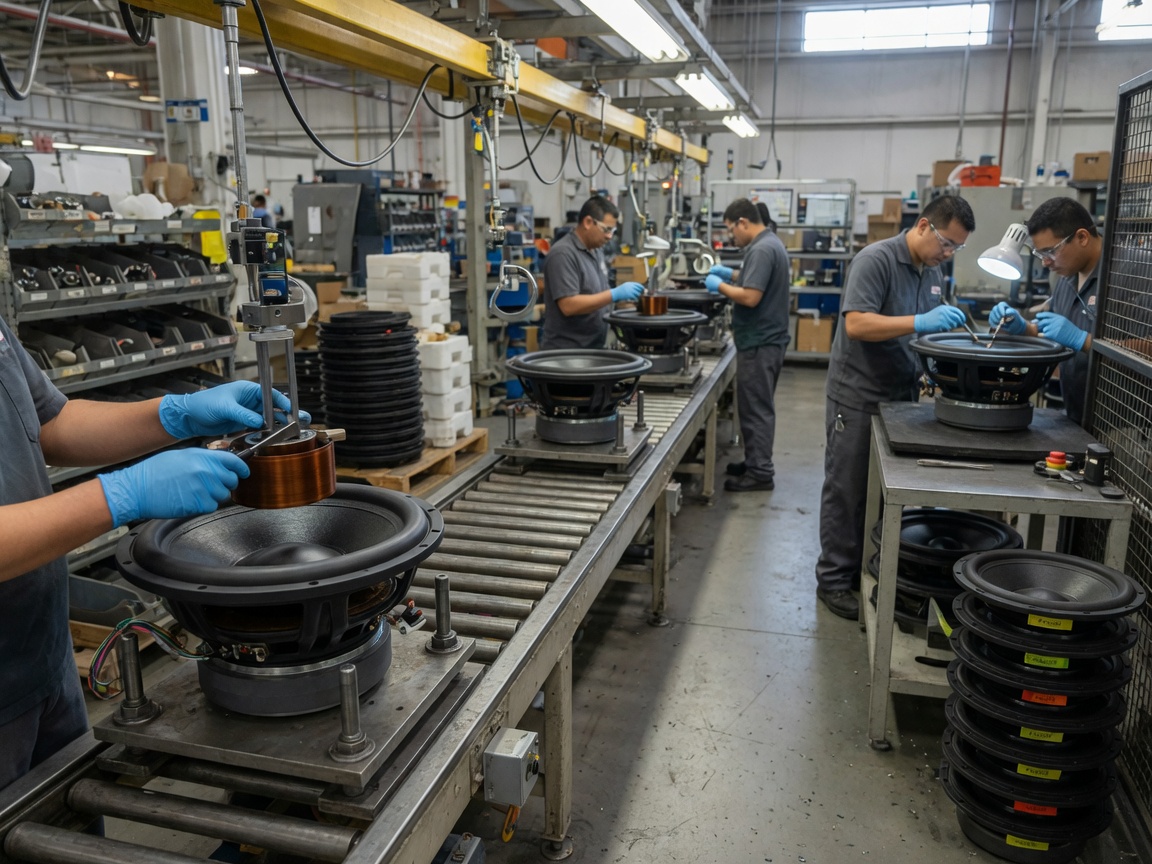
Practically speaking, a bass speaker supplier might aggregate products from multiple factories and resell them without owning any production equipment. A true subwoofer manufacturer controls at least the driver assembly or enclosure fabrication process. When evaluating potential partners, always request factory audit reports or visit the facility — either virtually or in person. Real manufacturers will have production floor photos, worker headcount data, and verifiable machinery lists. Trading companies rarely can provide all three.
How the global subwoofer manufacturing landscape breaks down in 2026
The global subwoofer market reached approximately $5.1 billion in 2023 and is projected to exceed $8.2 billion by 2030, growing at a CAGR of roughly 7.1% according to Grand View Research data. In 2026, that growth curve is accelerating in two directions simultaneously: premium audiophile demand in North America and Europe, and mass-market volume production concentrated in Asia.
Where production actually happens
Asia-Pacific — led overwhelmingly by China — accounts for more than 60% of global subwoofer production capacity. Cities like Ningbo, Shenzhen, and Guangzhou host dense clusters of woofer producers, driver component suppliers, and enclosure fabricators. Ningbo ASM Manufacturing, for example, has grown into one of the largest specialized subwoofer production companies in China, manufacturing car subwoofers, ceiling speakers, and professional sound systems under both OEM and branded models. This geographic concentration creates obvious cost advantages but also introduces supply chain concentration risk that U.S. importers must factor into their sourcing strategy.
2026 technology trends reshaping manufacturing priorities
Two forces are reshaping what buyers expect from a subwoofer manufacturer right now. First, DSP integration: manufacturers are racing to embed digital signal processors directly into powered subwoofer amplifier boards, enabling app-based EQ tuning and spatial audio adaptation. Second, compact high-output engineering: consumer preference for minimalist home aesthetics is pushing deep bass speaker manufacturers to extract serious low-frequency output from enclosures that would have been considered impossibly small five years ago. Passive radiator and slot-ported designs are the dominant R&D battlegrounds in 2026.
OEM vs. ODM: understanding customization workflows for private-label buyers
No competitor content adequately explains what happens inside an OEM or ODM project from the buyer's perspective — so let's fix that. The difference is not trivial. OEM (Original Equipment Manufacturer) means the factory builds to your exact specifications: you own the design, you supply the engineering documentation, and the factory executes. ODM (Original Design Manufacturer) means the factory already has a proven design; you select it, apply your branding, and potentially modify certain parameters within defined tolerances.
Typical OEM customization workflow — step by step
- Specification submission: Provide driver specs (cone diameter, voice coil material, magnet weight, Xmax, frequency response targets) and enclosure design files (CAD drawings or STEP files).
- Engineering review: The factory's acoustic engineers validate feasibility and flag conflicts between your specs and their tooling capabilities.
- Sample production: A first-article sample (typically 1–5 units) is produced. Real-world testing — THD measurements, frequency sweep, thermal stress testing — happens at this stage.
- Iterative revision: Expect 2–4 revision cycles for complex designs. Voice coil gap tolerances and surround compliance are common adjustment points.
- Logo and packaging confirmation: Silkscreen logo placement, grille branding, and retail packaging artwork are finalized and approved before mass production tooling is locked.
- Pre-production run approval: A small pilot batch (usually 50–200 units) is produced and inspected before full MOQ production begins.
ODM for private-label buyers: faster, but not without trade-offs
ODM projects can compress time-to-market from 16 weeks to as few as 6 weeks, because the tooling already exists. The trade-off is differentiation: if the same factory's ODM base model is available to 15 other brands, your product's uniqueness is limited to cosmetic changes. Experienced sourcing managers use a hybrid approach — start with an ODM platform to validate market demand, then commission an OEM driver spec once sales volumes justify the tooling investment. This staged strategy is especially effective for custom subwoofer builder relationships in the car audio and home theater segments.
Factory certifications every importer must verify
Certification claims are easy to print on a spec sheet. Verification is where most importers fall short. Here is a breakdown of the certifications that matter for subwoofer imports into the U.S. market, and precisely how to confirm each one is legitimate.
| Certification | Applicable market | What it covers | How to verify |
|---|---|---|---|
| FCC Part 15 | USA | EMI/RF emissions from amplifier boards in powered subwoofers | Search FCC ID on fcc.gov database |
| CE Mark | EU / UK | Safety, EMC, and LVD compliance for powered units | Request Declaration of Conformity + notified body test report |
| RoHS | USA, EU, global | Restricts lead, mercury, cadmium in components | Request ICP-MS lab test reports per component lot |
| ISO 9001:2015 | Global | Quality management system for production consistency | Verify certificate number with issuing registrar (e.g., SGS, Bureau Veritas) |
| UL Listed | USA | Electrical safety for amplifier-integrated subwoofers sold at retail | Search UL Product iQ database at productiq.ulprospector.com |
One practical point: ISO 9001 certification tells you the factory has documented quality processes, not that those processes produce good audio equipment specifically. Pair it with AQL (Acceptable Quality Limit) incoming inspection protocols and your own third-party factory audit. Certifications without on-site verification are paperwork, not assurance.
"The single biggest mistake importers make is treating a supplier's certificate scan as equivalent to a verified certificate. An ISO 9001 certificate can be forged or expired. Always cross-reference the certificate number directly with the issuing certification body — it takes two minutes and eliminates enormous risk." — Industry consensus among audio equipment importers with Asia-Pacific sourcing experience
REACH and California Proposition 65 — often overlooked
For subwoofers sold in California — which represents the largest U.S. state market for car audio — Prop 65 compliance is non-negotiable. This applies to any product containing chemicals on the OEHHA list, including certain adhesives used in spider and surround assembly. Request a full material declaration (FMD) from your factory, not just a vague compliance letter. European buyers must similarly verify REACH SVHC substance declarations for woofer producers supplying the EU market.
MOQ thresholds, lead times, and bulk pricing structures
Pricing and minimums are where sourcing decisions get real. Based on current market intelligence from 2026, here is how MOQ and pricing tiers typically break down across different supplier categories in the subwoofer wholesale supplier landscape.
Typical MOQ ranges by supplier type
Large integrated Chinese factories — the kind producing hundreds of thousands of units annually — typically require MOQs of 500 to 1,000 units per SKU for ODM projects, and 2,000+ units for full OEM tooling orders. Mid-tier factories and specialized car subwoofer factories often work with MOQs of 200–500 units, making them more accessible to emerging brands. Custom subwoofer builders serving the boutique audiophile or professional install market may work with as few as 50–100 units, but at significantly higher per-unit cost. When a subwoofer wholesale supplier claims "no MOQ," that is almost always a trading company, not a manufacturer.
Lead time benchmarks for 2026
Standard production lead times currently run 45–60 days for established ODM products, 90–120 days for new OEM tooling, and 15–25 days for reorders of existing approved products. Post-Chinese New Year periods (February–March) and Q4 holiday pre-production windows (August–September) extend these timelines by 20–30%. Plan your inventory calendar accordingly — many first-time importers are blindsided by this seasonality.
Regional comparison: China vs. U.S. vs. Europe manufacturers
Each major manufacturing region brings distinct strengths and limitations. Knowing this prevents the common mistake of defaulting entirely to the cheapest option without evaluating total landed cost and compliance risk.
Cost, quality, and compliance at a glance
| Factor | Chinese manufacturers | U.S. manufacturers | European manufacturers |
|---|---|---|---|
| Unit cost | Lowest — 30–60% below U.S. | Highest | Moderate to high |
| OEM/ODM capability | Very high — full ecosystem | Limited — mainly custom/pro | Moderate |
| Quality ceiling | High (tier-1 factories) | Very high | Very high |
| FCC/CE compliance | Varies — verify independently | Typically built-in | CE standard; FCC needs work |
| Lead time | 45–120 days + shipping | 30–60 days domestic | 60–90 days + shipping |
| MOQ flexibility | Wide range (100–5,000+) | Low MOQ, high unit cost | Moderate MOQ |
The "China equals low quality" assumption is demonstrably outdated. Chinese deep bass speaker manufacturers like Hivi (惠威) and Edifier (漫步者) now contract-manufacture for global premium audio brands. The quality gap that existed a decade ago has largely closed at tier-1 factories. The real variable is which tier of Chinese factory you engage — and that requires due diligence, not assumption.
When to consider U.S.-based audio equipment manufacturers
U.S.-based production makes sense for government or defense contracts requiring domestic content compliance, for ultra-premium custom subwoofer lines where "made in USA" carries brand equity, and for buyers who need short-run production with rapid design iteration. The cost premium is real — but so is the supply chain visibility and the elimination of import duty and customs delay risk.
Marine and outdoor subwoofer manufacturing — a growing U.S. niche
Why do so many buyers overlook marine and outdoor subwoofer sourcing? It is a blind spot that represents real commercial opportunity. The U.S. recreational boating industry generates over $50 billion annually, and marine audio is one of its fastest-growing accessory categories. A powered subwoofer manufacturer capable of producing NMMA (National Marine Manufacturers Association) compliant, UV-stabilized, saltwater-resistant units is competing in a far less crowded field than the standard car audio or home theater segment.
Engineering requirements that set marine subwoofers apart
Marine-rated subwoofer production demands materials specifications that most standard woofer producers cannot readily supply. The cone must use UV-resistant polypropylene or treated paper; the tinsel leads and terminals must be marine-grade tinned copper; the basket should be cast aluminum or fiberglass composite — not stamped steel, which corrodes rapidly in salt environments. Voice coil formers must tolerate humidity without delamination. Enclosures need sealed wiring pass-throughs and stainless hardware. Actual testing confirms that standard car subwoofer factory units placed in marine environments show terminal corrosion within 6–12 months of salt spray exposure.
Sourcing strategy for marine and outdoor segments
Buyers targeting this niche should specifically request IEC 60529 IP65 or IP66 ingress protection ratings on enclosures, ASTM B117 salt spray test reports on metal components, and UV aging test results per ASTM G154. Not many Chinese subwoofer OEM suppliers have all three — those that do command a premium, but that premium translates directly into reduced warranty claims and stronger brand positioning in the marine dealer channel.
How to evaluate and shortlist a subwoofer manufacturer
At this point, you have a working framework for the market. The remaining question is how to operationalize it. Think of the evaluation process like a funnel: broad screening at the top, deep verification at the bottom.
A practical shortlisting process
- Define your non-negotiables first. Certifications required, target landed cost per unit, minimum acceptable Xmax and THD specs, required MOQ ceiling, and delivery geography all need to be fixed before you evaluate anyone.
- Request a factory profile, not just a catalog. Ask for: years in operation, annual production capacity, current OEM client count (without needing to name them), quality management certifications, and production floor photos with equipment lists.
- Order reference samples before signing any NDA or deposit. Measure the sample against published specs. If a manufacturer claims ±3 dB frequency response from 30–200 Hz, test it. Discrepancies at the sample stage become production defects at scale.
- Verify all certification documents with the issuing body. Do not accept scanned PDFs at face value.
- Run a small pilot order (100–300 units). Evaluate not just the product but the communication quality, packing accuracy, and shipping documentation. These predict your experience at full scale.
Red flags that experienced buyers watch for
Of course, there are situations where a seemingly strong factory still raises concerns. Watch for: pricing that is more than 25% below market average (often signals component substitution), resistance to third-party factory audits, inability to produce original test reports from accredited labs (not in-house "self-certified" documents), and vague answers about their actual production capacity versus claimed capacity. A subwoofer brand built on the wrong manufacturing partner is just as fragile as one built on poor acoustics. The supply chain is as much a part of the product as the driver itself.
Using trade shows and industry directories effectively
In 2026, in-person verification remains the gold standard. CES (Las Vegas, January), NAMM (Anaheim, January), and the Canton Fair (Guangzhou, April/October) are the primary venues where legitimate subwoofer manufacturers present their capabilities. Meeting a factory representative face-to-face and seeing live product demos provides qualitative data that no spec sheet can replicate. Industry directories like Global Sources and Alibaba Gold Supplier listings are useful starting points, but they should be the beginning of due diligence, not the end.
Frequently asked questions
Q: What is the difference between an OEM and ODM subwoofer manufacturer?
A: An OEM subwoofer manufacturer builds to the buyer's proprietary design specifications — the buyer owns the design. An ODM manufacturer offers existing designs that buyers can rebrand with modifications. OEM requires more investment and time but delivers unique products; ODM is faster and lower-cost but limits differentiation. Most brands start with ODM and transition to OEM at higher volumes.
Q: What certifications should a subwoofer manufacturer have for U.S. imports?
A: At minimum, powered subwoofers imported into the U.S. should carry FCC Part 15 compliance for the amplifier board and RoHS compliance for hazardous substance restrictions. ISO 9001 certification signals quality system maturity. UL listing is required for certain retail channels. Always verify certification numbers directly with the issuing body — do not rely on document scans from the supplier alone.
Q: What is a typical MOQ when sourcing from a Chinese subwoofer factory?
A: MOQ varies significantly by factory size and order type. Large integrated factories typically require 500–1,000 units per SKU for ODM orders and 2,000+ units for full OEM tooling. Mid-tier car subwoofer factories often accept 200–500 units. Boutique custom builders may work with 50–100 units at premium pricing. Claims of "no MOQ" almost always indicate a trading company, not a true manufacturer.
Q: How do Chinese subwoofer manufacturers compare to U.S. manufacturers on quality?
A: The quality gap has narrowed substantially. Tier-1 Chinese deep bass speaker manufacturers now produce components used in global premium audio brands. The critical variable is factory tier, not country of origin. U.S. manufacturers offer faster domestic lead times, built-in FCC compliance, and "made in USA" brand positioning — but at significantly higher unit cost. The best sourcing strategy matches the factory tier to your brand positioning and target market.
Q: Are there subwoofer manufacturers that specialize in marine and outdoor applications?
A: Yes, though they represent a smaller subset of the overall subwoofer production company landscape. Marine-grade subwoofer manufacturers produce units with UV-stabilized cones, tinned copper terminals, corrosion-resistant baskets, and IP65/IP66-rated enclosures. When sourcing for marine or outdoor applications, request ASTM B117 salt spray test reports and IP ingress protection documentation — not all suppliers who claim "marine grade" have the lab data to support it.
Choosing the right subwoofer manufacturer is ultimately a risk management exercise as much as a procurement task. The market in 2026 offers more options — and more complexity — than ever before. By anchoring your evaluation on verified certifications, transparent MOQ structures, clearly defined OEM or ODM workflows, and an honest regional cost-quality trade-off analysis, you position your brand to build on a foundation that scales. The best subwoofer brands are not always those with the loudest marketing. They are the ones backed by manufacturing partnerships robust enough to deliver consistent quality at volume, quarter after quarter.
Related News
M.T.




Copyright © 2022 Ningbo ASM Electronics Technology Co.,LTD. All rights reserved. Powered by www.300.cn TAG Business License
