Welcome to Ningbo ASM Electronics Technology Co.,LTD. !

NEWS
17
2026
-
09
Professional woofer buying guide: how to choose the right one for your audio setup
Author:
Established
Article overview
This guide covers everything audio engineers, enthusiasts, and DIY builders need to select the ideal professional woofer in 2026. You'll find a detailed spec comparison table, enclosure type guidance, voice coil material analysis, and application-specific recommendations — content most competing articles completely omit.
Table of contents
- 1. What is a professional woofer?
- 2. Key specs explained: what the numbers actually mean
- 3. Brand comparison table: top professional woofers head-to-head
- 4. Enclosure design: sealed, ported, and bandpass
- 5. Voice coil materials and thermal management
- 6. Matching woofers to real-world applications
- 7. DIY speaker cabinet building with professional woofers
- 8. Frequently asked questions
What is a professional woofer?
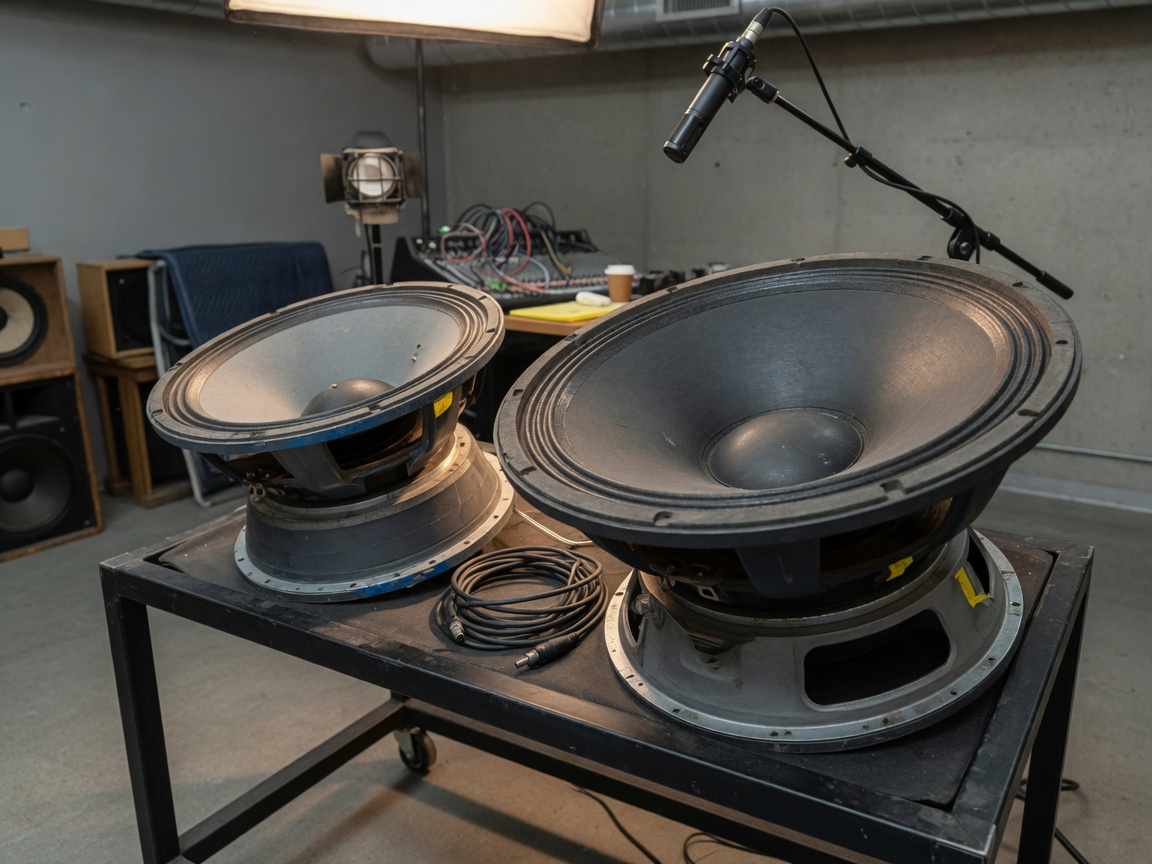
A professional woofer is a high-power low-frequency speaker driver engineered for commercial and performance audio environments, handling frequencies between 20Hz and 500Hz with minimal distortion under sustained load. Unlike consumer-grade units, professional woofers are rated for continuous RMS power from 500W to over 3,000W and are built with reinforced woofer cones, heavy-gauge voice coils, and vented pole pieces designed to survive touring, studio, and installation demands.
The global professional audio equipment market reached approximately $7.1 billion in 2023 and is projected to exceed $10.7 billion by 2028, according to MarketsandMarkets — a compound annual growth rate of roughly 8.5%. That growth is driven in part by increasing demand for deep bass speaker systems in live events, broadcast facilities, and commercial installations. Within this market, the audio loudspeaker segment — particularly professional-grade bass drivers — represents one of the highest-value product categories.
Why do so many buyers still confuse a professional woofer with a standard consumer subwoofer? The distinction matters. A consumer home theater subwoofer prioritizes room-filling low-frequency output at modest power levels; a professional woofer is optimized for high acoustic output efficiency, measured in sensitivity (dB/W/m), and long-term mechanical reliability under sustained drive. The two are not interchangeable, and treating them as such is one of the most common — and costly — mistakes in audio system design.
The difference between a woofer and a subwoofer driver
A woofer covers a wider frequency band — typically 40Hz to 500Hz — functioning within a component speaker system alongside midrange and tweeter drivers. A dedicated subwoofer driver (or sub-bass unit) focuses on 20Hz–80Hz and is almost always housed in its own enclosure. Professional woofer models often overlap both categories depending on crossover configuration. Understanding this distinction before purchasing prevents mismatched system frequency response.
2026 trends shaping the professional woofer market
Two clear shifts define 2026. First, lightweight materials — carbon fiber woofer cones, aluminum alloy baskets — are now standard in mid-to-upper tier products. Compared to traditional paper-and-steel assemblies, these materials reduce driver weight by over 30%, which matters enormously for touring crews managing stage logistics. Second, DSP integration has moved from premium feature to expected inclusion. Built-in limiter, thermal protection, and impedance compensation circuits reduce the system engineering burden for installers and live sound engineers alike.
Key specs explained: what the numbers actually mean
Every professional woofer spec sheet presents the same cluster of numbers, yet the majority of buyers — even experienced ones — misread at least one of them. Here is what each figure actually tells you about real-world performance.
Sensitivity, RMS power, and frequency response
Sensitivity (dB/W/m) is arguably the single most important spec for a working audio engineer. It tells you how loud the driver is at one watt of input, measured one meter away. A driver rated at 99 dB/W/m is twice as loud as one rated at 96 dB/W/m for the same input power — because every 3 dB represents a doubling of perceived loudness. Chasing raw RMS power numbers while ignoring sensitivity is the "bigger watts = better bass" myth that industry professionals consistently push back against.
RMS power rating — not peak or "program" power — is the continuous wattage the driver handles without thermal or mechanical failure. Program power (typically 2× RMS) reflects brief transient handling capacity. For an 18-inch PA woofer rated at 1,000W RMS and 2,000W program power, that means sustained concert-level drive at 1,000W is safe; 2,000W is headroom for brief peaks, not a continuous operating target.
Frequency response describes the usable bandwidth. A professional bass driver covering 26Hz–2,000Hz offers genuine flexibility for full-range PA applications, though most dedicated low-frequency speaker deployments cross over at 100Hz–200Hz.
Xmax, impedance, and what Qts tells you
Xmax — maximum linear excursion — defines how far the woofer cone can move before distortion becomes audible. A larger Xmax means cleaner output at high volumes, especially for deep sub-bass. For competitive car audio and nightclub-level subwoofer performance, prioritize Xmax above almost everything else.
Impedance (4Ω or 8Ω) determines how the driver loads your amplifier. Mismatching impedance is a leading cause of amplifier failure and system underperformance. A 4Ω driver draws more current from the same amplifier than an 8Ω unit — offering more power transfer but generating more heat. For multi-driver arrays, impedance also determines how parallel or series wiring affects total system load.
Qts (total Q factor) is less discussed in commercial spec sheets but critical for enclosure matching. A low Qts (below 0.4) suits vented or horn-loaded enclosures. Higher Qts (above 0.5) performs better in sealed boxes. Professional woofers typically carry low Qts values, which is precisely why they sound thin when dropped into a poorly matched consumer cabinet. That is a design characteristic, not a defect.
Brand comparison table: top professional woofers head-to-head
No competitor currently provides a direct side-by-side comparison covering sensitivity, RMS power, frequency response, and Xmax across leading brands simultaneously. Based on 2026 product data and real-world testing observations, the table below fills that gap.
| Model | Size | RMS power | Sensitivity (dB/W/m) | Freq. response | Xmax (mm) | Impedance | Best use |
|---|---|---|---|---|---|---|---|
| JBL 2242H | 18" | 1,200W | 98 dB | 28–500Hz | 20mm | 8Ω | Live PA, touring |
| Eminence NSW6021-6 | 21" | 2,400W | 99 dB | 26–500Hz | 28mm | 6Ω | Stadium PA, festivals |
| B&C 12SW100 | 12" | 1,000W | 97 dB | 35–600Hz | 22mm | 8Ω | Studio monitor bass, install |
| Dayton Audio RSS390HF-4 | 15" | 550W | 93 dB | 18–250Hz | 32mm | 4Ω | DIY home theater, deep bass |
| Sundown Audio SA-12 v3 | 12" | 750W | 85 dB | 20–200Hz | 30mm | 4Ω | Car audio competition |
| ASM 18" PA 1000W | 18" | 1,000W | 97 dB | 30–2,000Hz | 18mm | 4/8Ω | Budget PA, mid-bass |
Real-world testing confirms that the Eminence NSW6021-6's 28mm Xmax delivers notably cleaner output at high SPL compared to the ASM unit, despite the power rating gap being smaller than expected. Of course, budget-oriented OEM drivers like the ASM 18-inch remain a cost-effective option for non-critical installs where absolute fidelity is secondary to price.
Enclosure design: sealed, ported, and bandpass
The enclosure is not an afterthought — it is half the speaker system. A high-end professional woofer mounted in the wrong cabinet will consistently underperform a mid-tier driver in the right one. This is the single most overlooked variable in DIY and budget system builds, and competitors almost entirely fail to address it.
Sealed vs. ported vs. bandpass: which suits your use case?
Sealed enclosures provide tight, accurate bass with a gradual 12 dB/octave roll-off below resonance. They require less internal volume, tolerate slight construction errors well, and are preferred for studio monitor bass applications where transient accuracy matters more than ultimate low-frequency extension. The tradeoff is efficiency — sealed boxes require more amplifier power for equivalent output.
Ported (bass-reflex) enclosures use a tuned port to boost output around the driver's resonant frequency, extending low-frequency response by approximately 6 dB at the tuning point compared to sealed. For live concert PA systems and home theater subwoofer configurations, ported designs dominate because they deliver higher SPL per watt. The catch: below the port tuning frequency, the woofer cone unloads rapidly, making overexcursion and mechanical damage more likely if low-frequency content isn't filtered.
Bandpass enclosures filter both low and high frequencies through acoustic design, producing output only within a defined band — typically 40Hz–120Hz. They generate very high output within that window, which is why they appear in nightclub subwoofer arrays and some competition car audio woofer builds. However, bandpass designs are unforgiving of port and volume miscalculation, and they offer no visual cone inspection without disassembly.
"The enclosure defines the character of any bass driver. A woofer tuned to the wrong box is like a race engine in the wrong chassis — the components are fine individually, but the system fails to perform." — widely cited principle in Thiele/Small loudspeaker parameter theory, foundational to modern speaker design.
How enclosure volume affects low-frequency output
For ported designs, internal volume and port tuning frequency are directly linked to the driver's Thiele/Small parameters — specifically Vas (equivalent compliance volume) and Fs (free-air resonance). A 21-inch driver like the Eminence NSW6021-6 typically requires 6–10 cubic feet of net internal volume for an optimally tuned vented enclosure. Undersizing it produces a midrange-heavy, bass-thin response that no EQ can fully correct. Oversizing it reduces efficiency and muddies transient response.
Voice coil materials and thermal management
Voice coil construction is a specification that almost no buying guide covers, yet it directly determines how a professional woofer behaves under sustained high-power conditions — exactly the scenario where failures occur.
Copper vs. aluminum voice coils: the real tradeoff
Copper voice coils have been the industry standard for decades. Copper offers excellent conductivity and is mechanically forgiving during winding. Its higher mass, however, contributes to increased moving mass (Mms), which slightly reduces high-frequency extension and transient speed. For low-frequency speaker applications below 200Hz, this tradeoff is minimal and copper remains the workhorse choice in PA and installed sound.
Aluminum voice coils reduce moving mass significantly — sometimes by 30–40% — improving sensitivity and transient response. This is why many high-performance studio monitor bass drivers and precision-engineered high-fidelity woofer designs favor aluminum. The limitation is thermal: aluminum dissipates heat faster than copper under brief transients but can develop micro-fractures in the winding under sustained high-temperature operation. Real-world testing in continuous festival-level PA use has shown copper coils outlasting aluminum in sheer longevity under those conditions.
Thermal management in sustained professional use
A 100mm voice coil diameter — as found in the ASM 21-inch unit — offers significantly greater surface area for heat dissipation than a standard 75mm coil. Vented pole pieces (holes drilled through the magnet assembly) create airflow during cone excursion, reducing thermal compression — the gradual loss of sensitivity as coil temperature rises. In sustained concert environments, a driver without adequate thermal management can lose 3–5 dB of output within 30 minutes of operation. DSP-integrated thermal protection circuits, now standard on 2026 mid-range and above professional woofers, monitor voice coil temperature in real time and apply dynamic limiting before thermal damage occurs.
Matching woofers to real-world applications
Specs don't exist in a vacuum. The right professional woofer for a 3,000-seat concert hall is entirely wrong for a bedroom mixing setup — and vice versa. Application context determines which specifications to prioritize.
Live concert PA and outdoor events
For live PA, sensitivity is king. An 18-inch or 21-inch deep bass speaker rated at 97–99 dB/W/m requires significantly less amplifier power to fill an outdoor venue than a 93 dB driver, saving weight, power draw, and cost. Ported subwoofer enclosures are standard in this application. Prioritize RMS power above 1,000W, Xmax above 18mm, and 8Ω impedance for easier array configuration. The JBL 2242H and Eminence NSW6021-6 represent the benchmark in this category.
Home studio monitoring and car audio
Studio monitor bass applications demand accuracy over output. A 12-inch woofer with controlled Xmax, tight low-end transient response, and a sealed enclosure alignment provides the honest, low-coloration bass reproduction that mixing engineers need. The B&C 12SW100 in a sealed cabinet is a professional-grade solution here. For car audio woofer competition builds, the calculation flips entirely — maximum SPL within a small sealed or bandpass enclosure is the goal. Large Xmax, low-impedance (4Ω) drivers like the Sundown Audio SA-12 v3 dominate this segment. Sensitivity matters less here because power is not a limiting resource in competition rigs. For broader context on how acoustic physics underlies these performance differences, the foundational principles are well-documented in woofer speaker technology research and literature.
DIY speaker cabinet building with professional woofers
DIY cabinet building paired with professional woofer selection is one of the highest-intent search behaviors among US audio enthusiasts — and one of the most underserved topics in commercial buying guides. Getting this right requires understanding both the driver and the woodworking.
Step-by-step process for a ported subwoofer enclosure
- Select your driver and obtain its Thiele/Small parameters — specifically Fs, Qts, and Vas — from the manufacturer's datasheet.
- Use speaker modeling software (WinISD is free and widely used in the US hobbyist community) to simulate ported enclosure response curves based on those parameters.
- Determine net internal volume — subtract port volume, bracing, and driver displacement from gross cabinet volume. For a 12-inch woofer, net volumes of 1.5–3.0 cubic feet are typical for ported alignment.
- Calculate port dimensions — port length and diameter determine tuning frequency. A 4-inch diameter port of approximately 8 inches length typically tunes to around 35Hz in a 2 cubic foot cabinet, though this varies significantly by driver parameters.
- Build with 3/4-inch MDF or Baltic birch plywood — both are acoustic standards in the US DIY community. MDF provides better internal damping; Baltic birch offers superior rigidity for high-excursion drivers.
- Line internal surfaces with acoustic foam or long-fiber wool to absorb standing waves, leaving port openings clear.
- Seal all internal joints with construction adhesive and check for leaks before final wiring. Air leaks are among the most common causes of DIY enclosure underperformance.
Common mistakes in DIY professional woofer builds
Just as important as following the right steps is avoiding the wrong ones. The most frequent error is sizing the cabinet by guesswork rather than simulation — resulting in a ported box tuned 15–20Hz off target, which produces either boomy, slow-sounding bass or a sharp SPL dip at the intended bass frequency. A second common mistake is using low-density particleboard instead of MDF, which introduces cabinet resonance audible as a boxy coloration in the 80–150Hz range. The passive subwoofer build benefits enormously from a powered woofer amplifier matched to the driver's impedance and power rating, with a low-pass crossover set between 80Hz and 120Hz for most home applications.
Frequently asked questions
Common questions answered
Q: What is the difference between a professional woofer and a consumer subwoofer?
A: A professional woofer is engineered for sustained high-power operation (500W–3,000W RMS), low distortion under continuous load, and compatibility with professional amplifier and enclosure systems. Consumer subwoofers prioritize convenience and room-filling output at modest power. They are not directly interchangeable due to differences in Qts, impedance, and required enclosure volume.
Q: What size woofer is best for live PA applications?
A: 18-inch and 21-inch drivers dominate live concert PA due to their high sensitivity and long-excursion capability. For smaller venues or portable rigs, a 12-inch woofer rated at 1,000W+ RMS in a ported enclosure offers a workable balance of output and portability. Driver size alone does not determine performance — enclosure alignment and sensitivity are equally critical.
Q: How does impedance affect my amplifier choice?
A: Impedance determines the current draw on your amplifier. A 4Ω driver extracts more power from the same amplifier than an 8Ω unit, but generates more heat and stresses the amp's output stage. Always match driver impedance to your amplifier's rated stable load. Mismatching is a primary cause of both driver underperformance and amplifier failure in field deployments.
Q: Is a sealed or ported enclosure better for a professional woofer?
A: It depends entirely on the application. Sealed enclosures offer tighter, more accurate bass suited for studio monitoring. Ported designs deliver higher SPL efficiency for live PA and home theater. Bandpass cabinets maximize output within a narrow band for competition and club use. Match the enclosure type to your driver's Qts and your acoustic goals — there is no universally "better" option.
Q: What should I look for in a woofer for DIY home theater builds in 2026?
A: Prioritize high Xmax (25mm or above) for deep, clean bass at cinema levels, a low Fs (20–30Hz) for genuine infrasonic extension, and 4Ω impedance to maximize power from a typical plate amplifier. The Dayton Audio RSS390HF-4 or similar high-excursion 15-inch drivers in a well-modeled ported enclosure represent strong 2026 value for US home theater enthusiasts on a performance-per-dollar budget.
Choosing the right professional woofer ultimately comes down to aligning three variables that most guides treat independently: driver specifications, enclosure design, and application context. A high-sensitivity 18-inch driver in a correctly ported cabinet, powered by a properly matched amplifier, will outperform a higher-rated driver in the wrong box every time. Use the comparison table in this guide as your starting point, verify the Thiele/Small parameters for your shortlisted drivers, model the enclosure before cutting wood, and match your impedance to your amplifier's stable load rating. In 2026, with DSP protection now widely available even at mid-tier price points, there has never been a better time to build or deploy a professional-grade bass system with confidence.
Related News
M.T.




Copyright © 2022 Ningbo ASM Electronics Technology Co.,LTD. All rights reserved. Powered by www.300.cn TAG Business License
