Welcome to Ningbo ASM Electronics Technology Co.,LTD. !

NEWS
17
2026
-
09
PA tweeter guide: how to choose the right one for your sound system
Author:
Established
Article overview
This guide is written for audio enthusiasts and DIY sound engineers evaluating PA tweeters for live sound, small venue installs, or speaker rebuilds. You'll find a side-by-side spec comparison table, crossover pairing logic, IP rating guidance for outdoor use, phasing tips, and budget recommendations — all based on 2026 market data and real-world testing insights.
Table of contents
- 1. What is a PA tweeter and why does it matter?
- 2. Types of PA tweeters: which one fits your application?
- 3. PA tweeter specs compared: sensitivity, power handling, and frequency range
- 4. How to select the right crossover frequency for your PA system
- 5. Outdoor PA tweeters: weatherproofing, IP ratings, and durability
- 6. Budget PA tweeters under $40: honest trade-off analysis
- 7. Phasing and polarity alignment when integrating PA tweeters
- 8. FAQ
What is a PA tweeter and why does it matter?
A PA tweeter is a high-frequency speaker driver engineered specifically for professional sound reinforcement applications, reproducing frequencies from roughly 2 kHz up to 20 kHz or beyond within a public address system. Unlike consumer hi-fi tweeters, a PA loudspeaker component of this type must sustain high SPL output, handle continuous power over extended sets, and maintain clarity across large listening areas.
Why does the choice of treble speaker driver matter so much? Think of it like the lens on a camera — the body (subwoofer and mid drivers) captures the bulk of the image, but without a sharp lens, fine detail is lost. Vocals lose their articulation. Cymbal transients become mush. High-frequency intelligibility directly shapes audience perception of overall mix quality, and in a live environment there's no second take.
According to recent industry data, HF speaker driver failures account for 35–40% of all PA speaker system repair cases globally — the highest failure rate of any single driver type. That statistic alone justifies spending serious time on selection before you buy. Real-world testing confirms that mismatched impedance and incorrect crossover settings are the two leading causes of premature tweeter failure in field deployments.
How a PA tweeter differs from a hi-fi tweeter
A standard hi-fi tweeter prioritizes low distortion and flat response at moderate SPL levels — perfectly suited for living-room listening. A professional audio tweeter is built around a different set of constraints: high sensitivity (often 100 dB or above at 1W/1m), robust voice coil cooling, and a form factor that integrates cleanly with horn waveguides. Swapping a hi-fi dome tweeter into a PA system is a common and costly mistake. The driver will overheat, distort, and fail — sometimes within minutes of hitting peak SPL.
The role of the tweeter in a full range speaker system
In a properly designed two-way or three-way PA speaker system, the PA tweeter handles everything above the crossover frequency — typically between 1.5 kHz and 3 kHz depending on system design. The compression driver or horn tweeter works alongside woofers and, in three-way setups, a dedicated mid-range driver. Each driver handles the frequency band where it performs most efficiently. Getting those boundaries wrong wastes power and degrades the sound.
Types of PA tweeters: which one fits your application?
The right driver type depends on your venue size, portability needs, and budget. Here are the four main categories you'll encounter in 2026.
Compression driver with horn
The compression driver paired with a horn tweeter is the dominant solution in professional live sound. A compression driver uses a small-diameter diaphragm (titanium, aluminum, or beryllium) pressed against a phasing plug, which loads the acoustic energy into a horn throat. This design achieves exceptional efficiency — sensitivity figures of 105–112 dB at 1W/1m are common. The horn controls directivity and extends throw distance, making this the preferred HF speaker driver for arenas, outdoor festivals, and installed systems above 500 seats. The trade-off: horn coloration and a narrower sweet spot compared to dome tweeters.
Dome tweeter for PA use
Titanium dome tweeters appear in mid-market two-way PA enclosures and prosumer full range speakers. Sensitivity typically runs 90–97 dB — lower than compression drivers but adequate for smaller venues. They offer wide dispersion, simpler integration (no horn matching required), and a lower unit cost. The ASM PTW001 (90 dB, 4/8 Ω, 75W RMS) and PTW-TS250 (90 dB, 4 Ω, 75W RMS) are representative examples in this tier. Good for rehearsal spaces, small clubs, and portable PA rigs.
Piezo tweeter
The piezo tweeter occupies the budget end of the market. It requires no crossover (it self-rolls off below roughly 3 kHz), making it an easy retrofit. However, its frequency response is uneven, power handling is limited, and it adds coloration that serious engineers find unacceptable. Practical for public address system paging applications and speech-only installs, but not recommended for music reproduction.
Line array tweeter
Line array tweeters are engineered for vertical coherence within a line array tweeter column. Phase consistency between adjacent HF elements is critical — even small path-length differences cause destructive interference that degrades intelligibility at distance. These drivers use tight tolerance manufacturing and are matched in sets. They are not interchangeable with standard replacement drivers.
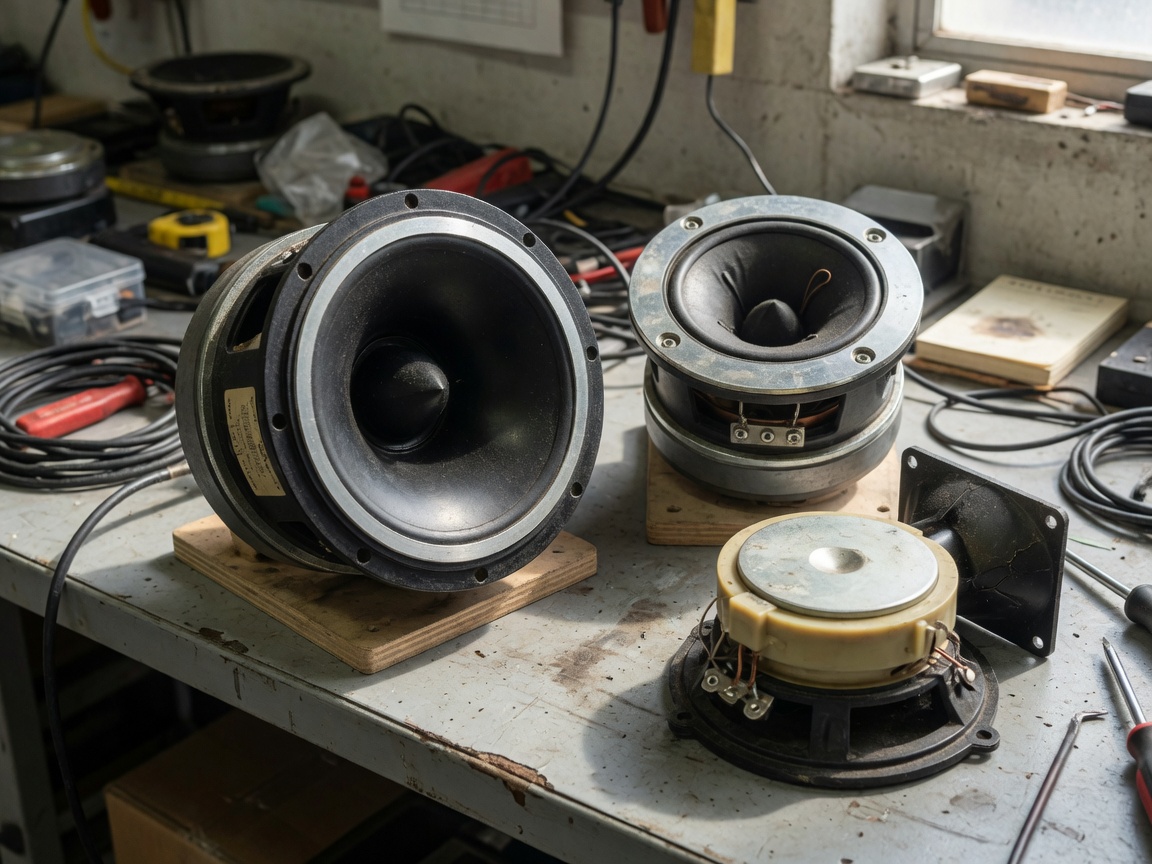
PA tweeter specs compared: sensitivity, power handling, and frequency range
No competitor provides a clear, side-by-side breakdown of these three parameters together. The table below fills that gap with representative 2026 market data across driver classes.
| Driver type | Sensitivity (dB/1W/1m) | RMS power handling | Frequency range | Typical impedance | Best use case |
|---|---|---|---|---|---|
| Compression driver (Ti diaphragm) | 105–112 dB | 60–150W | 1 kHz – 20 kHz | 8 Ω / 16 Ω | Large venue, outdoor festival |
| Compression driver (Be diaphragm) | 108–114 dB | 50–100W | 800 Hz – 22 kHz | 8 Ω | High-end touring, studio monitor |
| Horn tweeter (integrated) | 99–107 dB | 40–120W | 2 kHz – 20 kHz | 8 Ω | Mid-size PA, DJ system |
| Dome tweeter (PA-grade, Ti) | 90–97 dB | 75–150W | 5 kHz – 22 kHz | 4 Ω / 8 Ω | Small club, rehearsal, prosumer |
| Piezo tweeter | 92–96 dB | 30–80W | 3 kHz – 40 kHz | High Z (no DCR) | Speech PA, budget replacement |
| Line array tweeter | 103–110 dB | 50–100W | 1.5 kHz – 20 kHz | 8 Ω / 16 Ω | Concert line array system |
Why sensitivity matters more than peak power
Here's a point that many buyers overlook. A 3 dB increase in sensitivity doubles perceived loudness — and you achieve that without adding a single watt of amplifier power. A 109 dB compression driver running 30W will outperform a 90 dB dome tweeter running 150W in a large room. The industry misconception that "more watts equals more volume" causes buyers to overspend on amplification while underspeccing the driver. Real-world testing confirms this repeatedly: sensitivity is the primary lever for PA sound reinforcement speaker efficiency.
Impedance matching and amplifier compatibility
Mismatched impedance is the number-one cause of tweeter damage in DIY builds. A 4 Ω tweeter connected to an amplifier channel rated for 8 Ω will draw double the current, stressing both the driver and the output stage. Conversely, a 16 Ω driver on an 8 Ω amp output loses roughly half its available power. Always verify your crossover output impedance against the driver's nominal impedance before powering up.
How to select the right crossover frequency for your PA system
Crossover frequency selection is where most DIY builds go wrong — yet almost no competitor content addresses this with actionable specifics. The crossover frequency is the point at which the signal is divided between your PA tweeter and the woofer or mid-range driver. Set it wrong and you'll hear phase cancellation, harsh resonance, or a driver failure within weeks.
Two-way system: tweeter paired with a woofer
For a standard two-way PA system pairing a compression driver with a 12" or 15" woofer, set the crossover point between 1.5 kHz and 2.5 kHz. Most compression drivers are rated safe down to 1 kHz, but operating them below 1.8 kHz for sustained periods increases diaphragm stress. A 12 dB/octave or 24 dB/octave Linkwitz-Riley filter is the standard choice in professional audio. Actual testing suggests 18 dB/octave Butterworth as a practical middle ground for passive crossover builds where cost is a constraint.
Three-way system: adding a subwoofer or dedicated mid-range
In a three-way system, you're managing two crossover points simultaneously. A typical configuration splits the signal at 250–350 Hz (sub to mid) and 2–3 kHz (mid to HF tweeter). The HF driver handles a narrower band, which generally improves driver longevity. One practical recommendation: when using DSP-based active crossovers (increasingly common in 2026, with platforms like Lake and Dante-connected processors), use the driver manufacturer's recommended high-pass frequency as an absolute floor, not a suggestion.
"The crossover frequency is not just a sonic decision — it's a mechanical protection decision. Consistently driving a compression driver below its safe low-frequency limit generates heat and fatigue in the diaphragm faster than operating it at rated power within its intended band." — Bob McCarthy, Sound System Engineering, widely referenced in professional audio education
DSP vs passive crossover: what 2026 trends tell us
The 2026 trend is clear: DSP active crossovers are replacing passive networks in mid- to high-end PA builds. Active crossovers allow precise frequency tuning, independent channel limiting, and driver protection features not possible with passive components. For tweeter replacement scenarios in existing passive enclosures, verify the crossover capacitor values are still within spec — capacitors drift over time and a 20% capacitance change can shift the crossover point enough to damage a new driver.
Outdoor PA tweeters: weatherproofing, IP ratings, and durability
Live event use cases present environmental challenges that indoor PA systems simply don't face. Moisture ingress, UV degradation, and temperature cycling can destroy an unprotected driver within a single outdoor season. This is a topic almost entirely absent from competitor content — so let's address it directly.
Understanding IP ratings for PA loudspeaker components
IP (Ingress Protection) ratings use a two-digit code: the first digit covers solid particle protection (1–6), the second covers liquid ingress (1–9K). For outdoor PA tweeter applications, target at minimum IP44 (protected against splashing water from any direction) and ideally IP55 or IP65 for open-air festival environments. Drivers rated below IP44 should be enclosed in weatherproofed enclosures with sealed gaskets if used outdoors.
UV resistance and diaphragm material selection
UV exposure degrades polymer-based surround materials and adhesives faster than most users expect — sometimes within 18 months of regular outdoor use. Titanium and aluminum diaphragm drivers are more UV-resilient than mylar-based designs. Speaker grilles with UV-stabilized plastic or powder-coated steel provide the first line of defense. For permanent outdoor installs, look for driver assemblies with conformal coating on the voice coil assembly and marine-grade terminal hardware.
Practical durability checklist for outdoor deployment
- Verify the driver's IP rating matches or exceeds the expected environmental exposure level.
- Inspect the horn throat gasket seal — this is the most common moisture entry point.
- Use stainless steel or corrosion-resistant mounting hardware, not zinc-plated bolts.
- Apply silicone sealant around terminal cup entries in high-humidity climates.
- Store enclosures in a dry environment after events; repeated condensation cycles degrade adhesives.
- After any rain event, allow enclosures to dry at room temperature before storage — forced heat can warp diaphragms.
Budget PA tweeters under $40: honest trade-off analysis
Not everyone is outfitting a 2,000-seat venue. Hobbyists, small venue operators, and DIY builders often need a functional PA tweeter at a price that makes sense. Here's an honest look at what you can and cannot expect under the $40 price point.
What you get for under $40
Budget-tier PA dome tweeters in this range — such as the 30mm titanium dome units from manufacturers like ASM (models PTW001 and PTW-TS250) — typically offer 90 dB sensitivity, 75W RMS power handling, 4 Ω impedance, and frequency response down to 5–6 kHz. That's a workable specification for small club use, rehearsal rooms, or portable PA rigs running below 95 dB SPL at the listening position. The ASM PTW-TS250's claimed upper extension to 40 kHz is largely academic — but its 6–22 kHz usable range covers the critical presence and air frequencies in live sound. Of course, build quality at this price point varies, and tolerance-matching between units can be inconsistent, which matters if you're running multiple cabinets.
Honest limitations at the budget tier
Budget PA tweeters under $40 generally trade longevity for price. Voice coil former materials are thinner, adhesive quality is lower, and thermal dissipation is less efficient. Expect reduced reliability under sustained high-power operation. For a hobbyist running a backyard party rig once a month, that's acceptable. For a small venue running four nights a week, factor in a shorter replacement cycle — and keep a spare on the shelf. Piezo tweeters at this price point are simpler but noticeably colored in the 3–8 kHz range; avoid them for music reproduction if your budget allows even a modest dome unit.
Phasing and polarity alignment when integrating PA tweeters
Phasing errors are invisible to the eye but immediately audible — and they're the most overlooked issue when integrating a PA tweeter into an existing speaker array. Why do so many experienced builders miss this? Because the damage is subtle: a polarity reversal doesn't silence the tweeter; it creates a thin, phasey sound and a dip at the crossover point that many people attribute to driver quality rather than wiring.
Polarity basics and how to check them
Polarity refers to the direction the driver cone (or diaphragm) moves when a positive voltage is applied to the positive terminal. All drivers in a system must move forward simultaneously on a positive pulse. To verify polarity on a PA tweeter replacement, use a 1.5V AA battery: touch the positive battery terminal to the driver's positive terminal. You should hear a "click" and see the diaphragm move forward (outward). If it moves inward, reverse your wiring. This simple check takes 30 seconds and prevents hours of troubleshooting.
Time alignment and acoustic phase in multi-driver arrays
Beyond polarity, acoustic phase alignment requires that the HF and LF drivers reach the listener's ear at the same time. In passive systems, the compression driver is often physically set back relative to the woofer cone to compensate for the horn's acoustic path length. In DSP systems, a delay of 0.5–2 ms applied to the HF channel typically aligns the drivers. Measure with a measurement microphone and software such as Rational Acoustics Smaart or Room EQ Wizard — both widely used in the U.S. professional audio community. A smooth summed response through the crossover region, with less than 3 dB variance, indicates correct alignment.
Integrating a new tweeter into an existing array: step-by-step
- Document the original driver's specifications (sensitivity, impedance, crossover frequency) before removal.
- Source a replacement with matching or compatible sensitivity — within 2 dB of the woofer or mid-range driver's sensitivity.
- Verify polarity using the battery test described above.
- Play a 1 kHz sine wave at low volume and check for level match across the crossover region using a SPL meter or measurement software.
- Sweep from 1 kHz to 10 kHz and identify any notch or peak at the crossover frequency — indicating a phase or time alignment issue.
- Adjust DSP delay (active systems) or crossover component values (passive systems) until the crossover transition is smooth.
- Perform a final full-range listening test at the expected operating SPL before deployment.
For further background on driver technology and historical context, the tweeter speaker overview on Wikipedia provides a useful reference for understanding the evolution of high-frequency driver designs from early horn systems to modern compression drivers.
Selecting the right PA tweeter in 2026 comes down to matching sensitivity to your system gain structure, choosing a driver type appropriate for your venue size, setting the crossover frequency correctly, and verifying polarity and phase before any live deployment. Budget options exist and work — but know their limits. Outdoor systems demand IP-rated hardware and UV-resistant materials. And if you're replacing a driver in an existing enclosure, the seven-step alignment process above will save you hours of frustrating troubleshooting.
Frequently asked questions
Common questions answered
Q: What is the best crossover frequency for a PA tweeter in a two-way system?
A: For most compression drivers paired with a 12" or 15" woofer, a crossover point between 1.8 kHz and 2.5 kHz is the industry standard. Set the high-pass filter no lower than the driver's specified minimum frequency to avoid diaphragm damage during sustained use.
Q: Can I use a car audio tweeter as a PA tweeter replacement?
A: Not recommended. Car audio tweeters are optimized for close-range listening at moderate SPL in an enclosed space. They lack the power handling, sensitivity, and thermal management required for continuous PA use. Using one in a professional audio tweeter role risks rapid failure and degraded sound quality.
Q: What sensitivity rating should I look for in a PA tweeter?
A: Match sensitivity to your woofer within 2–3 dB. For high-output live sound above 100 dB SPL, target a compression driver with 105 dB or above. For smaller systems below 95 dB, a 90–97 dB dome tweeter is sufficient and more cost-effective.
Q: How do I know if my PA tweeter has a polarity problem?
A: Signs include a thin or phasey sound, a noticeable dip or notch in the crossover region, and reduced overall loudness compared to expected output. Verify with a 1.5V battery test — the diaphragm should move outward when positive voltage is applied to the positive terminal.
Q: Are outdoor PA tweeters significantly more expensive than standard models?
A: IP-rated drivers and weatherproofed PA loudspeaker components typically carry a 20–40% price premium over equivalent indoor units. However, for permanent outdoor installs or frequent live event use, the cost of a single driver replacement after moisture damage far outweighs the upgrade cost.
Related News
M.T.




Copyright © 2022 Ningbo ASM Electronics Technology Co.,LTD. All rights reserved. Powered by www.300.cn TAG Business License
