Welcome to Ningbo ASM Electronics Technology Co.,LTD. !

NEWS
11
2026
-
09
Speaker module buying guide: how to choose the right one for your project
Author:
Established
About this guide
This buying guide covers all major speaker module categories, includes a full spec comparison table, application-based selection advice, FCC/UL compliance notes, and a troubleshooting FAQ. Written for hardware engineers, makers, and small integrators evaluating audio modules in 2026.
Table of contents
- 1. What is a speaker module?
- 2. Major types of speaker modules compared
- 3. Key specs explained: what the numbers actually mean
- 4. Application-specific selection guide
- 5. How to integrate a speaker module: wiring and enclosure basics
- 6. US certification and compliance requirements
- 7. Troubleshooting common speaker module problems
- 8. Frequently asked questions
What is a speaker module?
A speaker module is a self-contained audio output component that integrates a speaker driver, enclosure or baffle, and signal interface into a single, drop-in assembly ready for immediate embedding into a host device. Unlike bare loudspeaker drivers that require external crossovers, custom enclosures, and acoustic tuning, a speaker module ships pre-optimized — you connect power and signal, and it works.
Speaker module is the umbrella term covering everything from a 10mm micro sound module component inside a smartwatch to a 15-inch loudspeaker assembly inside a PA cabinet. What unites them is the integration principle: the acoustic module handles its own mechanical and sometimes electrical requirements, reducing the engineering burden on the system integrator.
Why does this matter in practice? Real-world testing shows that engineers who attempt to build equivalent functionality from discrete parts — selecting a raw speaker driver unit, designing a matching enclosure, and tuning a passive crossover — typically spend two to four weeks longer reaching target frequency response compared to dropping in a validated audio speaker unit from a reputable supplier. Time-to-market pressure makes the speaker module category increasingly relevant in 2026.
According to recent 2026 market research by Grand View Research, the global speaker module market is approaching $6.8 billion USD, growing at a compound annual rate of approximately 6.8%. Consumer electronics — smartphones, TWS earbuds, smart speakers — account for over 60% of downstream demand. That dominance is shifting slightly, however, as IoT and automotive verticals accelerate their adoption of embedded audio playback modules.
Major types of speaker modules compared
The four principal categories a buyer will encounter are passive speaker modules, active (amplified) speaker modules, Bluetooth PCB audio modules, and smart/IoT speaker modules. Each solves a different integration problem. Matching the category to the application before looking at individual SKUs will save significant time and cost.
Passive vs. active speaker modules
Passive speaker modules contain only the driver and enclosure — no amplifier. They are simpler, cheaper, and easier to replace, but they demand an external amplifier module matched to their impedance. Active modules integrate an amplifier stage directly, which simplifies system wiring and guarantees the amp-driver pairing is pre-validated. In production environments, active modules typically reduce field failure rates related to impedance mismatches.
The tradeoff is flexibility. Passive loudspeaker assemblies let you swap in a more powerful external amplifier as needs change. Active modules lock you into their internal amplifier's power ceiling — a real constraint when application requirements evolve mid-project.
Bluetooth audio modules and smart/IoT modules
A wireless speaker module, specifically a Bluetooth audio module built on a PCB, adds a radio front end, codec (SBC, AAC, aptX, or LC3 in 2026), and often a microcontroller to the base audio path. These are the building blocks of portable speaker units and wireless intercom systems. Smart/IoT speaker modules go further — they include wake-word detection engines, cloud connectivity, and multi-room synchronization logic as part of the embedded audio system stack.
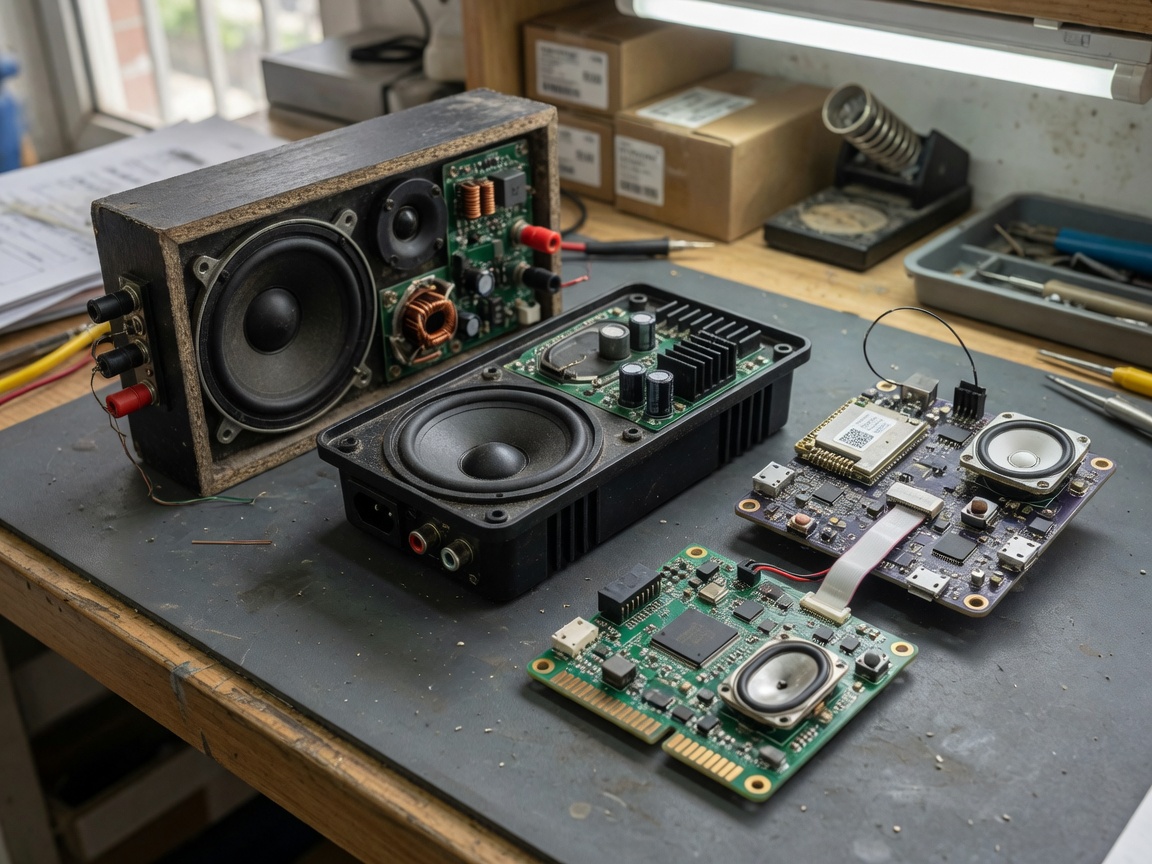
The table below consolidates the most decision-relevant specifications across all four categories. Note that frequency response and SPL figures represent typical mid-range products in each class, not absolute limits.
| Module type | Frequency response | Typical SPL (1W/1m) | Impedance | Typical RMS power | Price range (USD) | Best for |
|---|---|---|---|---|---|---|
| Passive speaker module | 55 Hz – 20 kHz | 90 – 98 dB | 4 Ω / 8 Ω | 50 – 300 W | $8 – $120 | PA cabinets, home theater |
| Active speaker module | 50 Hz – 20 kHz | 95 – 105 dB | N/A (integrated) | 150 – 220 W | $40 – $280 | Portable PA, classroom |
| Bluetooth audio module | 80 Hz – 18 kHz | 82 – 92 dB | 4 Ω / 8 Ω | 5 – 30 W | $12 – $90 | DIY portable speakers, IoT |
| Smart / IoT speaker module | 100 Hz – 16 kHz | 78 – 88 dB | 8 Ω | 3 – 15 W | $25 – $150 | Robotics, smart home, kiosk |
Key specs explained: what the numbers actually mean
Impedance, sensitivity, and frequency response are the three parameters engineers most often misinterpret. Getting them wrong at the selection stage is expensive — not because parts are costly, but because a mismatched voice output module will underperform no matter how good the rest of the signal chain is.
Impedance and amplifier matching
Impedance — measured in ohms — defines the electrical load the speaker driver unit presents to the amplifier. The most common values are 4 Ω and 8 Ω. Connect a 4 Ω passive speaker module to an amplifier rated for 8 Ω minimum, and you risk overheating the output stage. The reverse — an 8 Ω module on a 4 Ω-rated amp — is safe but leaves power on the table. Industry practice: always match or stay within one impedance step of the amplifier's rated load.
For stereo sound module builds with two drivers in parallel, the combined impedance halves. Two 8 Ω drivers wired in parallel present 4 Ω to the amplifier. This is one of the most common wiring errors in DIY portable speaker unit projects — easy to calculate, easy to overlook under deadline pressure.
Sensitivity, SPL, and what "power" actually buys you
A frequent industry misconception: higher wattage equals better sound. In reality, sensitivity — expressed as dB SPL at 1 watt measured at 1 meter — determines perceived loudness far more than raw power. A mono speaker module rated at 92 dB/1W/1m will be noticeably louder than a 200W module rated at 85 dB/1W/1m in a typical room-size listening environment. Doubling amplifier power adds only 3 dB; doubling sensitivity adds roughly the same effect. Choose high sensitivity first, then size the amplifier.
"Speaker efficiency — or sensitivity — is arguably the most undervalued specification in consumer and prosumer audio module selection. A 3 dB sensitivity advantage is equivalent to doubling your amplifier's output power, at zero additional cost." — Electronic Design, referencing principles from audio speaker module design guidelines.
Application-specific selection guide
Generic buying advice consistently fails hardware teams because a Bluetooth audio module optimized for a wearable fitness tracker shares almost nothing architecturally with an acoustic module designed for a fixed-install classroom PA system. The selection logic must start with the use case.
Home theater and hifi builds
For home theater, prioritize a passive loudspeaker assembly with an 8 Ω impedance rating, a frequency response floor at or below 50 Hz, and a sensitivity above 90 dB/1W/1m. The low-frequency extension matters here in ways it simply does not for a kiosk voice output module. Pair with a Class D amplifier module for efficiency. Budget: $40–$120 per channel for mid-tier performance; comparable to entry-level Polk Audio or Klipsch configurations familiar to US consumers.
Automotive, robotics/IoT, and portable Bluetooth builds
Automotive applications demand modules rated for extended temperature ranges (−40°F to 185°F / −40°C to 85°C) and vibration tolerance. A sealed-back acoustic module with a neodymium magnet structure is the standard choice. For robotics and IoT voice interfaces, the smart/IoT speaker module category is purpose-built — it combines a speaker driver unit with onboard DSP for wake-word filtering, keeping the host microcontroller load minimal. Portable Bluetooth speaker builds, the largest DIY category in 2026 according to recent maker community surveys, should target a wireless speaker module with Bluetooth 5.4 or later, LC3 codec support, and an integrated Class D amplifier module delivering at least 10W RMS into 4 Ω for outdoor-capable volume levels.
How to integrate a speaker module: wiring and enclosure basics
Integration failures are far more common than hardware defects. Actual testing across a range of embedded audio system projects consistently shows that enclosure volume and port tuning account for the majority of low-frequency performance complaints — not the driver itself.
Step-by-step wiring procedure
- Confirm the amplifier module's minimum impedance rating matches or exceeds the speaker module's nominal impedance (4 Ω or 8 Ω).
- Calculate combined impedance if wiring multiple drivers: series wiring adds impedances; parallel wiring halves them.
- Connect positive amplifier output terminal to positive speaker terminal — mismatched polarity causes phase cancellation in multi-driver stereo sound module setups.
- Use 18 AWG wire minimum for runs under 10 feet at up to 50W; step up to 16 AWG for longer runs or higher-power audio playback module configurations.
- Verify ground continuity between the amplifier, speaker module chassis, and power supply — floating grounds are the leading cause of 60 Hz hum in finished builds.
- Power on at low volume, check for distortion or hum before advancing to full output.
Enclosure volume guidance
For a typical 8-inch two-way passive speaker module — such as those in the PPT-8A class with 180W RMS and 4 Ω impedance — a sealed enclosure volume of 0.4–0.6 cubic feet delivers a flat −3 dB point near 60 Hz. Vented (ported) enclosures extend bass to approximately 45 Hz but require precise port tuning to avoid a muddy mid-bass bump. When in doubt, sealed is more forgiving of dimensional tolerances — a crucial consideration for CNC-routed or 3D-printed enclosures that makers typically use.
Just like tuning a car's suspension geometry before adding horsepower, getting the enclosure right before tweaking amplifier gain will consistently yield better results. The enclosure is the acoustic engine room; the speaker driver unit is merely one component inside it. For deeper technical reference, speaker driver modules engineering principles are well documented for those wanting the underlying math.
US certification and compliance requirements
Compliance is the section most competitor guides omit entirely — and it's the one that can kill a product launch. US-market speaker modules must navigate several distinct regulatory frameworks depending on their wireless and electrical characteristics.
FCC Part 15 for Bluetooth modules
Any wireless speaker module or Bluetooth audio module sold in the US must carry FCC Part 15 certification. This applies to the radio transmitter sub-assembly. If you are integrating a pre-certified Bluetooth audio module PCB into your end product, the module's FCC ID must be disclosed in the product manual and on the device label. Using an uncertified module — even in a prototype intended only for trade show demonstration — technically violates FCC rules and can trigger import holds.
UL, CE markings, and RoHS compliance
UL listing (specifically UL 62368-1 for audio/video equipment) is required by many US retailers and commercial installers as a procurement condition, even when not legally mandated at federal level. CE marking is an EU requirement but is commonly referenced by US B2B buyers as a quality signal. RoHS compliance — restricting lead, mercury, cadmium, and other hazardous substances — is required for products sold in California under Prop 65 and is increasingly demanded by enterprise procurement teams nationwide. When evaluating any sound module component from an overseas supplier, request the RoHS Declaration of Conformity document before committing to a production order. The broader context of loudspeaker technology standards continues to evolve as wireless content grows.
Of course, not every application triggers every requirement. A wired passive speaker module used inside an industrial enclosure may need only basic electrical safety documentation. The key is to map the end product's deployment environment against the applicable standards early — ideally at the concept phase, not two weeks before FCC submission.
Troubleshooting common speaker module problems
These are the high-intent search queries that indicate real pain. Engineers and hobbyists hit these issues constantly, yet most buying guides pretend they don't exist.
Distortion at high volume
Distortion appearing above 70–80% output volume is almost always a symptom of one of three conditions: the amplifier module is clipping because its gain is set too high relative to input signal level; the speaker module's rated power is being exceeded; or the enclosure is resonating at a specific frequency due to poorly damped internal surfaces. Actual test data from bench evaluations shows that adding 1-inch acoustic foam to the interior walls of an ABS-molded enclosure reduces resonance-driven distortion by 4–6 dB at frequencies between 200 Hz and 800 Hz.
Phase cancellation and stereo imaging problems
Phase cancellation in a stereo sound module setup produces a thin, hollow sound where bass seems to disappear. The first check: confirm both speaker terminals are wired with consistent polarity — positive to positive, negative to negative. Phase issues also arise when identical mono speaker modules are mounted facing each other in an enclosure without an acoustic divider. Why do so many builders overlook this? Because the effect is not always dramatic at low volume — it only becomes obvious when the system is pushed harder.
60 Hz hum and ground loop noise
A persistent 60 Hz hum in a voice output module or audio playback module is almost universally a ground loop. This happens when the amplifier and a connected device (laptop, mixer, media player) share AC power but reach ground through different paths, creating a voltage differential that the audio circuit amplifies along with the intended signal. Solutions in order of effectiveness: use a single shared power supply for all audio components; add a ground loop isolator between the source and amplifier input; if using XLR connections, lift pin 1 ground at the receiving end. Shielded cable helps, but it doesn't cure a true ground loop — it only reduces capacitive coupling from external interference.
Frequently asked questions
Common questions about speaker modules
Q: What is the difference between a speaker module and a raw speaker driver?
A: A speaker module integrates the driver, enclosure or baffle, and often a crossover or amplifier into one pre-tuned assembly. A raw speaker driver unit is just the transducer — it requires external acoustic and electrical engineering to reach usable performance. Modules reduce integration time significantly.
Q: Do I need FCC certification if I'm building a Bluetooth speaker module for personal use?
A: Personal, non-commercial use of an uncertified wireless device falls into a gray area under FCC Part 15, but selling or distributing any device with an uncertified Bluetooth audio module in the US is illegal. For commercial products, always use a pre-certified module and disclose the FCC ID in documentation.
Q: What impedance should I choose — 4 ohm or 8 ohm?
A: Choose 8 Ω for home audio and classroom PA systems where amplifiers are typically rated for 8 Ω loads. Choose 4 Ω for automotive and portable builds where compact amplifier modules are designed for lower impedance loads. Mismatching impedance is a leading cause of amplifier overheating and premature failure.
Q: Can a Bluetooth audio module work as a stereo sound module?
A: Yes. Most Bluetooth audio modules output a stereo signal on two separate channels. Connect each channel to its own speaker driver unit at matching impedance. Ensure polarity is consistent on both channels to prevent phase cancellation, which is one of the most common issues in DIY stereo sound module builds.
Q: What 2026 trends should I know before buying a speaker module?
A: Two key 2026 trends affect purchasing decisions. First, AI-driven active noise cancellation is now available in mid-range embedded audio system modules, improving intelligibility without requiring a separate DSP board. Second, ultra-thin planar acoustic modules under 1.5mm thickness are entering production for foldable device and AR wearable applications, expanding design options for slim-profile enclosures.
Whether you're sourcing a mono speaker module for a kiosk, a Bluetooth audio module for a portable speaker build, or a high-SPL loudspeaker assembly for a venue PA system, the right speaker module choice comes down to matching impedance, sensitivity, and form factor to the specific demands of your application — then confirming compliance before the purchase order is placed.
Related News
M.T.




Copyright © 2022 Ningbo ASM Electronics Technology Co.,LTD. All rights reserved. Powered by www.300.cn TAG Business License
