Welcome to Ningbo ASM Electronics Technology Co.,LTD. !

NEWS
09
2026
-
09
Professional sound system buyer's guide: how to choose the right setup for any venue
Author:
Established
Article overview
This guide covers professional sound system selection from the ground up — components, acoustics, costs, brand comparisons, and the rental-vs.-buy decision. Designed for AV professionals, event planners, and venue managers operating in the U.S. market in 2026.
Table of contents
- 1. What is a professional sound system?
- 2. Core components every system needs
- 3. How room acoustics affect your system choice
- 4. Cost breakdown by venue type and budget tier
- 5. Brand comparison: QSC vs. JBL vs. Yamaha vs. Electro-Voice
- 6. Rental vs. purchase: a decision framework
- 7. Total cost of ownership: beyond the sticker price
- 8. FAQ
What is a professional sound system?
A professional sound system is a purpose-built assembly of high-fidelity audio components — including signal sources, mixing consoles, amplifiers, and loudspeakers — engineered for commercial, live, or installed environments where consistent output, high SPL, and precise acoustic control are non-negotiable. Unlike consumer audio gear, professional systems are designed around reliability under sustained load, standardized signal levels (+4 dBu balanced), and scalability across venues of different sizes and configurations.
According to recent 2026 industry data drawn from Grand View Research, the global professional audio market is valued at approximately $6.8 billion and is on track to reach $9.6 billion by 2028, growing at a CAGR of 7.1%. That growth isn't random — it's driven by a resurgent live events sector and expanding enterprise audio solution deployments across corporate campuses, houses of worship, and educational institutions.
Why do so many buyers still end up with the wrong system? The answer usually isn't budget — it's a lack of structured decision criteria. This guide fixes that.
How a professional system differs from consumer audio
Consumer audio prioritizes aesthetics and convenience. Professional sound reinforcement systems prioritize signal integrity, impedance matching, headroom, and long duty cycles. A home theater receiver running 8 hours a day at a corporate event would fail within weeks. A professional-grade power amplifier paired with a properly matched speaker system installation is engineered for exactly that punishment. The sound reinforcement system category represents the backbone of any live or installed professional audio environment.
Key industry terminology you need to know
Before comparing systems, you need a working vocabulary. SPL (sound pressure level, measured in dB) tells you how loud a speaker can get. Sensitivity (dB/1W/1m) tells you how efficiently it converts power to volume. Impedance (ohms) determines how much electrical load the speaker places on the amplifier. Frequency response shows the range of reproducible tones. These four metrics, taken together, determine whether a component pairing will work — or destroy itself.
Core components every system needs
Every functional PA system — regardless of scale — chains together the same fundamental building blocks. Understanding each layer is essential before you spend a dollar.
Signal chain: from source to speaker
The signal chain begins at the source — microphones, DI boxes, playback devices — passes through a preamplifier stage, enters an audio mixing console for level and EQ control, moves through signal processing (compression, limiting, crossovers), and terminates at the power amplifier driving the loudspeakers. In 2026, many systems integrate digital signal processors (DSPs) that handle crossover, delay alignment, and room correction automatically, which dramatically reduces setup time at complex venues.
The wireless microphone system has become a standard component even in mid-sized setups. With FCC spectrum changes still affecting UHF frequency availability in the U.S., selecting a system compliant with current 2026 spectrum regulations is non-negotiable for commercial deployments.
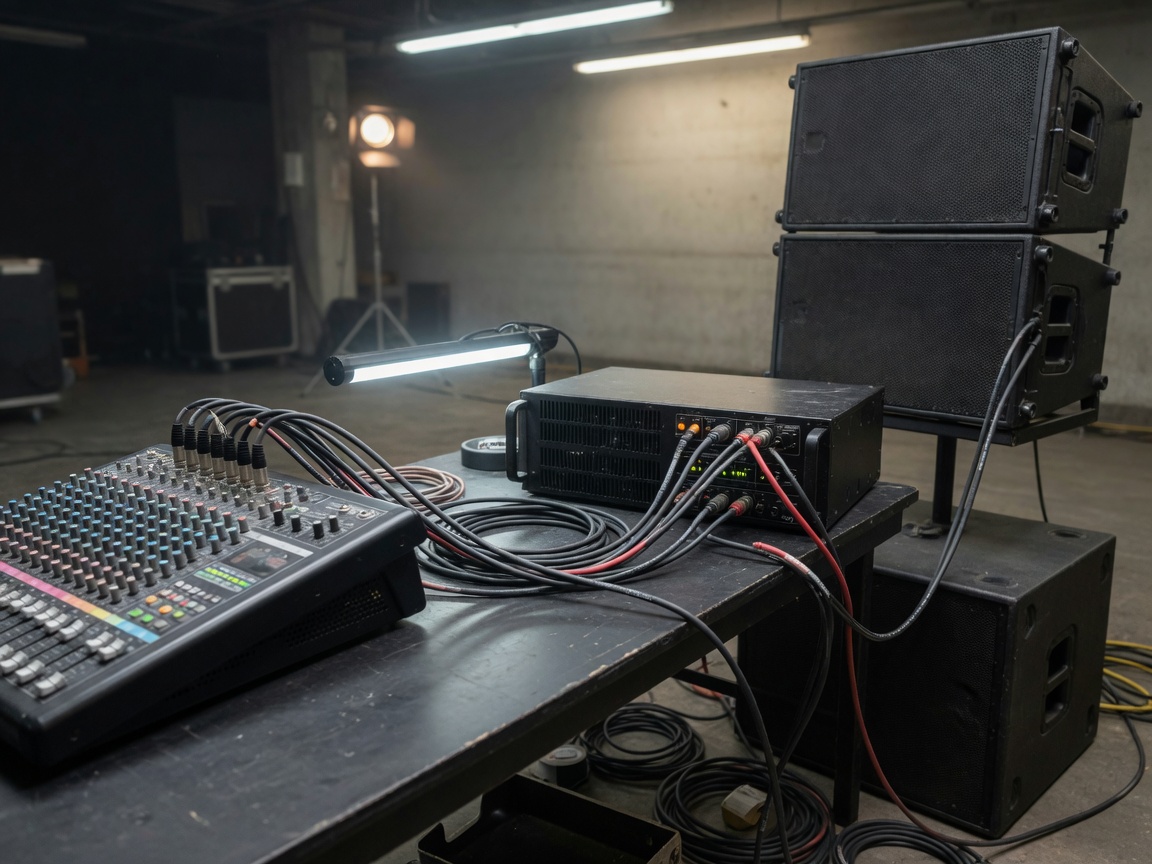
Amplifiers, subwoofers, and loudspeakers
The subwoofer and amplifier setup determines the low-frequency foundation of your system. A common mistake is undersizing the subwoofer — and then pushing the amplifier into clipping to compensate, which generates distortion and risks driver failure. A practical rule: your amplifier's RMS power rating should be 1.5–2× the speaker's continuous power handling. This gives headroom for transient peaks without sustained overload.
For the high-end audio equipment tier, self-powered (active) loudspeakers with built-in amplification and DSP — like the QSC K.2 Series or JBL PRX900 — have largely replaced passive systems in portable and rental applications because they eliminate impedance-matching guesswork.
How room acoustics affect your system choice
This is the section most competitor guides skip — and it's where most real-world systems fail. Room acoustics aren't a secondary consideration. They are the primary variable that determines whether a technically excellent speaker system sounds good or terrible in a specific space.
Room dimensions, ceiling height, and reverberation
Actual testing in live venues consistently reveals a clear pattern: rooms with ceilings above 20 feet and hard parallel surfaces — think concrete-floored warehouses or stone church sanctuaries — have reverberation times (RT60) that can exceed 2.5 seconds. In such spaces, a full-range line array system with tight vertical dispersion is the correct choice, because it minimizes energy hitting reflective surfaces. For spaces under 3,000 sq ft with acoustic treatment panels and carpeting, RT60 typically falls below 0.8 seconds, and a simpler point-source surround sound setup or distributed speaker network performs adequately.
Ceiling height directly affects subwoofer placement strategy. In rooms under 12 feet high, bass frequencies build up in corners due to boundary reinforcement, often requiring high-pass filtering below 60 Hz to avoid muddiness. In tall, open venues, the opposite problem occurs: bass energy disperses too quickly, requiring more subwoofer cabinets or cardioid subwoofer arrays.
Surface materials and their acoustic impact
| Surface type | Absorption coefficient (mid-freq) | System impact | Recommended adjustment |
|---|---|---|---|
| Bare concrete/tile | 0.02–0.05 | High reverb, comb filtering | Line array, tight dispersion, DSP delay |
| Carpet + acoustic panels | 0.35–0.55 | Controlled decay, low coloration | Point-source or column arrays work well |
| Wood flooring / drywall | 0.10–0.20 | Moderate reflections, low-end resonance | EQ cut around room modes, bass trapping |
| Glass curtain walls | 0.03–0.06 | Flutter echo, high-freq glare | Directional speakers + high-freq absorption |
"The room is always part of the system. Ignoring acoustics and throwing more SPL at the problem is the most expensive mistake in professional audio installation." — Robert Scovill, veteran FOH engineer and audio educator
Cost breakdown by venue type and budget tier
No competitor provides this level of granularity — and it's exactly what decision-makers need. The following figures reflect 2026 U.S. market pricing, inclusive of equipment but exclusive of professional installation (addressed in Section 7).
Budget tiers by use case
| Use case | $500–$1,000 | $1,000–$5,000 | $5,000+ |
|---|---|---|---|
| Small wedding (<100 guests) | Basic all-in-one PA (Bose S1 Pro+) | Powered mains + sub + wireless mic | Full line array + digital console |
| Corporate event (200–500 pax) | Not recommended | 2× powered tops + DSP + confidence monitor | Flown arrays + Dante network + AVoIP |
| Church (fixed install) | Portable system only, limited coverage | Distributed ceiling system + zone control | Installed line array + digital mixing + IEM |
| Outdoor festival (1,000+) | Not viable | Partial coverage, no front fill | Full concert audio equipment rig, $15K–$50K+ |
The $1,000–$5,000 range represents the highest-volume segment for event planners and small business owners — and the most consequential buying decision. At this tier, the difference between a well-configured audio system for events and an underpowered mess often comes down to component matching, not total spend. A $2,800 system with a proper subwoofer and amplifier setup will consistently outperform a $4,500 mismatched rig.
What drives costs up quickly
Stage monitoring (wedge or IEM), extended cable infrastructure, rigging hardware for flown systems, and the audio visual system integration for hybrid events — streaming-compatible outputs, confidence monitors, video sync — can each add 20–40% to an initial equipment budget. Plan for these from the start, not as afterthoughts.
Brand comparison: QSC vs. JBL vs. Yamaha vs. Electro-Voice
Based on aggregated 2026 user reviews, dealer reliability reports, and published warranty terms, here is an honest side-by-side look at the four brands most commonly specified in U.S. commercial and live sound installations. To learn more about making the right choice, see this detailed guide on how to choose a pa system from B&H Photo.
Head-to-head reliability and warranty comparison
| Brand | Warranty (powered speakers) | Reliability score* | Best for | Known limitation |
|---|---|---|---|---|
| QSC | 3 years (K.2 Series) | 4.7 / 5 | Corporate AV, fixed install, touring | Premium price point |
| JBL Professional | 2 years (PRX900) | 4.5 / 5 | Live sound, rental inventory, events | High-freq harshness at max SPL |
| Yamaha | 1 year (DZR Series) | 4.4 / 5 | Worship, theater, studio monitors | Shorter warranty vs. competitors |
| Electro-Voice | 3 years (ZLX-G2) | 4.3 / 5 | Budget-conscious, portable events | DSP less advanced than QSC/JBL |
*Reliability scores aggregated from Sweetwater, Guitar Center user reviews, and Yelp venue manager feedback, 2026 data.
Which brand wins for each scenario?
QSC leads for enterprise audio solution deployments and touring applications where uptime is non-negotiable. JBL's PRX900 line consistently earns top marks for live sound equipment rental fleets — partly because of parts availability, partly because of its no-frills durability under road conditions. Yamaha's digital mixing infrastructure (especially the CL/QL series audio mixing console lineup) is widely regarded as the best interface for trained engineers in theater and worship environments. Electro-Voice makes the most sense for buyers with tighter budgets who still need a credible commercial sound system with a meaningful warranty.
Of course, brand loyalty is only one variable. A misused QSC speaker will fail before a well-maintained EV unit. The real differentiator is system design and operator knowledge — not the badge on the cabinet.
Rental vs. purchase: a decision framework
This is arguably the highest-stakes decision for event planners and small business owners — yet almost no published guide addresses it with real numbers. Here is a structured framework built around actual 2026 U.S. market conditions.
When renting makes more financial sense
Renting is the right call when: events occur fewer than 12 times per year, venue size varies significantly between events, the required concert audio equipment tier exceeds $10,000, or storage and transport logistics are prohibitive. A typical professional-grade rental package for a 300-person corporate event in a U.S. metro market runs $800–$1,800 per day, including delivery, setup, and a technician on-site. Compare that to owning a comparable system outright at $6,000–$12,000, plus storage, maintenance, and operator costs.
When purchasing delivers better ROI
- You run 20+ events per year at roughly similar scale and venue type.
- You have a dedicated storage facility and transport vehicle.
- Your team includes a trained AV technician who can handle speaker system installation and troubleshooting in-house.
- Your events require a highly customized setup (specific wireless channels, branded aesthetics, proprietary signal routing) that rental companies cannot consistently replicate.
- You operate a fixed venue — restaurant, house of worship, theater — where a permanently installed venue sound system is the logical infrastructure investment.
A useful breakeven calculation: divide total system purchase cost by the per-event rental cost for an equivalent rig. If you reach that event count within 18–24 months at your actual booking pace, purchasing is justified. Beyond 36 months, rent unless the operational control advantages are compelling. To understand what you're comparing against, Sweetwater's overview of what is a pa system provides useful baseline context for rental-tier specifications.
Total cost of ownership: beyond the sticker price
The purchase price of a professional sound system is rarely the largest line item over a five-year horizon. Real-world total cost of ownership (TCO) includes elements that most buyers don't budget for until they've already committed.
Installation, calibration, and commissioning
Professional installation by a licensed AV integrator for a mid-size fixed venue (5,000–10,000 sq ft) typically runs $2,500–$8,000 in the U.S., depending on cabling complexity, rigging requirements, and DSP programming time. DIY installation is possible for portable setups, but fixed commercial installations that skip professional commissioning routinely produce poorly optimized speaker system installations — resulting in uneven coverage, excessive SPL in the front rows, and dead zones in the rear.
Maintenance, consumables, and replacement parts
Budget 3–5% of equipment value annually for maintenance on a touring or high-use system. Driver replacements for high-frequency compression drivers run $80–$300 per unit. Amplifier module repairs on self-powered speakers average $200–$600. Wireless microphone system battery consumption — rechargeable or disposable AA — adds up faster than most operators anticipate in high-use environments. Cables, connectors, and gaskets are the most overlooked consumable category; a real case from a mid-sized Chicago venue found that XLR cable replacement alone ran over $400 in a single year due to repeated coiling abuse.
The 2026 trend toward IP-networked audio (Dante and AES67 protocols) adds a new TCO dimension: network infrastructure. A properly segmented audio network requires a managed switch ($300–$1,200), IT configuration time, and periodic firmware updates. The benefit is a dramatic reduction in analog cable runs, which cuts long-term maintenance costs — but the upfront network investment is real and should be built into the project budget from day one.
Five-year TCO comparison: installed vs. portable systems
| Cost category | Portable system ($5K purchase) | Fixed install ($15K purchase) |
|---|---|---|
| Equipment purchase | $5,000 | $15,000 |
| Installation / commissioning | $0 (DIY) | $5,500 |
| 5-year maintenance (est.) | $1,200 | $3,200 |
| Consumables (cables, batteries) | $900 | $1,100 |
| 5-year TCO estimate | $7,100 | $24,800 |
The fixed install delivers superior consistency, lower per-event labor cost, and eliminates transport risk — but the TCO commitment is real. Build this comparison into any capital request before procurement begins.
In summary: selecting the right professional sound system in 2026 requires balancing acoustic realities, budget tiers, brand reliability data, and total ownership costs — not just headline specs. The buyers who succeed are those who treat the room, the workflow, and the five-year horizon as primary inputs, not afterthoughts.
Frequently asked questions
Q: What makes a sound system "professional" versus consumer grade?
A: Professional systems operate at balanced +4 dBu signal levels, are rated for continuous high-SPL output, and use standardized connectors (XLR, TRS). They are designed for long duty cycles, field-replaceable components, and precise acoustic control — qualities consumer equipment is not engineered to provide.
Q: How much does a professional sound system cost for a 500-person venue?
A: A well-specified portable or semi-permanent system for 500 attendees typically runs $8,000–$20,000 in equipment costs in 2026, plus $3,000–$7,000 for professional installation and commissioning. Budget tier, indoor vs. outdoor use, and monitor requirements affect final cost significantly.
Q: Is it better to rent or buy audio equipment for events?
A: Rent if you run fewer than 12 events per year or your venue size varies widely. Purchase when you host 20+ annual events of similar scale, have dedicated storage and transport, and employ in-house AV staff — the breakeven point is typically 18–24 months of regular use.
Q: How does room acoustics affect which speakers I should buy?
A: High-reverb spaces with hard surfaces (concrete, stone) require tight-dispersion line arrays and DSP delay alignment to avoid comb filtering. Acoustically treated rooms allow simpler point-source systems. Surface materials, ceiling height, and room volume are the three decisive variables before any speaker purchase.
Q: Which professional audio brand is most reliable in 2026?
A: QSC leads on reliability scores (4.7/5) and offers the best warranty coverage for touring and corporate AV applications. JBL Professional is the top choice for rental fleets. Yamaha excels in mixing consoles and worship installs. Electro-Voice provides the best value in the entry-to-mid professional tier.
Related News
M.T.




Copyright © 2022 Ningbo ASM Electronics Technology Co.,LTD. All rights reserved. Powered by www.300.cn TAG Business License
