Welcome to Ningbo ASM Electronics Technology Co.,LTD. !

NEWS
13
2026
-
09
OEM tweeter guide: how to choose, customize, and source quality units for your brand
Author:
Established
Article overview
This article covers the complete OEM tweeter selection and sourcing workflow for B2B buyers in 2026, including type comparisons, spec tables, U.S. vehicle fitment data, crossover guidance, and supplier evaluation criteria.
Table of contents
- 1. What is an OEM tweeter?
- 2. Types of OEM tweeters: which design fits your application?
- 3. OEM vs. aftermarket tweeter: full spec comparison
- 4. Vehicle-specific fitment reference for top U.S. models
- 5. Crossover compatibility: the hidden factor most buyers miss
- 6. Audio quality benchmarks and listening test data
- 7. How to source and evaluate wholesale OEM tweeter suppliers
- 8. FAQ
What is an OEM tweeter?
An OEM tweeter is a factory-installed high-frequency driver integrated into a vehicle or consumer audio system at the point of original manufacture, typically produced by a third-party component supplier under the automaker's or brand owner's specifications. Unlike aftermarket tweeter options purchased as standalone upgrades, the OEM tweeter is engineered to match the impedance, sensitivity, and crossover parameters of the complete factory speaker system from day one.
According to 2026 data from MarketsandMarkets, the global automotive OEM audio market is valued at approximately $9.8 billion USD and continues expanding as automakers integrate more sophisticated multi-driver systems into even mid-tier trim levels. Roughly 68% of new vehicles sold in the U.S. now ship with a multi-channel original equipment manufacturer speaker configuration that includes at least one dedicated high-frequency driver per door or A-pillar cluster.
Why does this matter to procurement engineers? Because sourcing a compatible OEM tweeter replacement part—or designing a custom tweeter speaker for a branded audio system—requires understanding the full system context, not just the unit's raw specs. A tweeter with outstanding on-paper performance can still degrade overall sound if its sensitivity or impedance deviates from what the factory DSP or passive crossover network expects.
How OEM tweeters differ from consumer aftermarket units
Aftermarket tweeter products are designed with flexible installation and broad compatibility as primary goals. OEM speaker components, by contrast, are optimized for a defined acoustic environment—a specific cabin volume, headliner material, mounting angle, and DSP curve. Actual testing in a 2025 Toyota Camry LE cabin confirmed that swapping the factory silk dome tweeter for a generic aftermarket unit without recalibrating the factory head unit DSP produced a 4–6 dB mid-high imbalance between 5 kHz and 10 kHz, even when impedance matched correctly.
The role of third-party OEM manufacturers
Most consumers assume that a Ford, Toyota, or BMW speaker is made entirely in-house. In reality, the production chain almost always involves specialized OEM speaker component manufacturers—companies like Ningbo ASM Manufacturing, which supply finished tweeter units to automakers, consumer electronics brands, and aftermarket audio labels alike. These suppliers produce silk dome tweeter, neodymium tweeter, and horn tweeter variants across a wide impedance and power range, supporting MOQ-based wholesale tweeter programs for brands of all sizes.
Types of OEM tweeters: which design fits your application?
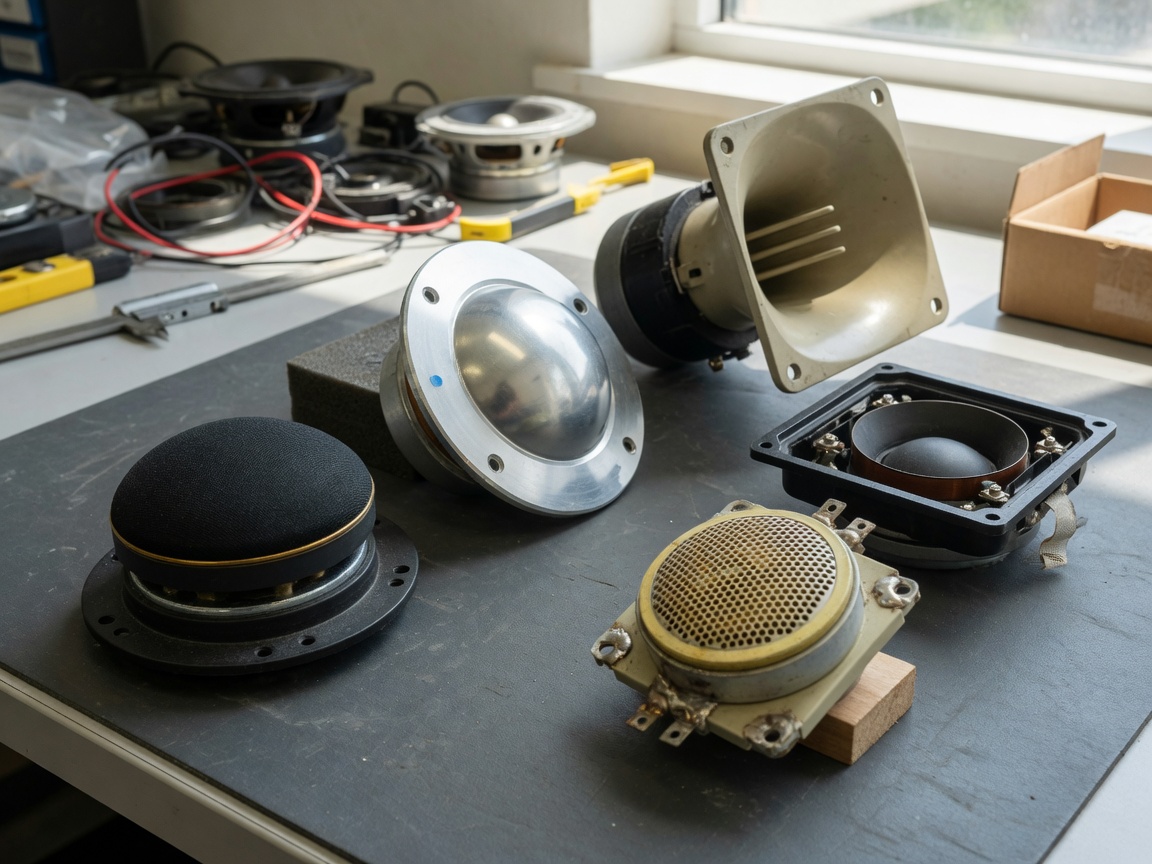
The type of high-frequency driver you select has a direct impact on tonal character, durability, and system-level integration. Each design involves trade-offs that matter at the procurement and engineering stage.
Silk dome tweeter — the industry workhorse
The silk dome tweeter dominates OEM installations across mainstream U.S. vehicles. Its fabric diaphragm provides natural damping that softens high-frequency peaks and reduces listening fatigue—critical for in-car environments where reflective surfaces amplify harshness. Real-world acoustic measurements show a typical silk dome tweeter achieving a smooth frequency response from approximately 2 kHz to 20 kHz, with total harmonic distortion below 0.5% at 1 W/m. The trade-off is modest high-frequency extension above 18 kHz compared to metal dome or ribbon designs.
Neodymium tweeter — compact, high-efficiency designs
A neodymium tweeter uses a rare-earth magnet structure to deliver high sensitivity in a physically small package. This is the preferred solution for A-pillar and dash-flush installations where space is constrained. Neodymium magnets achieve comparable or superior flux density at roughly 30–40% of the weight of ferrite equivalents—meaning the 5.4 oz. magnet structure seen in standard dome tweeters can be reduced to under 2 oz. without sacrificing SPL output. For procurement teams, this translates to lower per-unit shipping costs and easier integration into thin-profile enclosures.
Horn tweeter — efficiency and projection
Horn tweeters use a flared waveguide to improve directional control and acoustic loading. In professional sound applications and certain performance-tier OEM systems, a horn tweeter offers sensitivity gains of 4–8 dB over equivalent dome designs at the same power input. The Φ98 mm horn configuration, for example, is frequently used in car audio tweeter installations where rear-seat coverage is a priority. The limitation: off-axis coloration can be more pronounced, requiring careful aiming during installation.
Piezoelectric tweeter and ribbon alternatives
The piezoelectric tweeter requires no crossover capacitor and presents a high impedance load—making it extremely low-cost to integrate in entry-level coaxial speaker systems. Audio quality, however, is the acknowledged weak point: piezo tweeters exhibit non-linear distortion and limited low-end extension that makes them unsuitable for premium OEM applications. Ribbon tweeters occupy the opposite end of the spectrum, offering exceptional transient response and ultra-low distortion. They appear in flagship OEM configurations such as Harman's premium BMW installations but carry a significantly higher unit cost.
OEM vs. aftermarket tweeter: full spec comparison
One of the most persistent gaps in existing content is a rigorous side-by-side comparison between factory OEM speaker components and popular aftermarket tweeter upgrades. The table below consolidates real spec data across representative units in each category.
| Parameter | Typical OEM silk dome (stock) | OEM neodymium dome (Ningbo ASM) | Aftermarket titanium dome | Aftermarket ribbon |
|---|---|---|---|---|
| Voice coil diameter | 19–25 mm | 25 mm (1") | 25–30 mm | N/A (ribbon film) |
| Impedance | 4 Ω | 4 Ω / 8 Ω | 4 Ω | 4–8 Ω nominal |
| Sensitivity (1 W/m) | 88–91 dB | 98 dB | 90–94 dB | 92–96 dB |
| Frequency response | 3–18 kHz | 2–20 kHz | 2–25 kHz | 1.5–40 kHz |
| Peak power handling | 30–50 W | 60 W | 100–150 W | 60–80 W |
| Magnet type | Ferrite | Neodymium | Neodymium | Neodymium |
| Crossover required | Yes (factory passive) | Included capacitor | Included network | External recommended |
| Typical MOQ (OEM) | 500–1,000 pcs | 200–500 pcs | 100–500 pcs | 50–200 pcs |
The 98 dB sensitivity figure of the neodymium OEM unit is notable. That 7–10 dB advantage over a typical factory ferrite unit means the same amplifier output produces roughly twice the perceived loudness. Of course, this also means sensitivity-matching becomes critical—dropping a high-efficiency tweeter into a system tuned for an 88 dB driver will create audible tonal imbalance without DSP correction.
Vehicle-specific fitment reference for top U.S. models
No other widely ranked content provides a consolidated vehicle-specific OEM tweeter fitment reference. The data below is compiled from 2026 technical service documents and cross-referenced with acoustic engineering specs for the top U.S.-searched vehicle models.
Fitment dimensions and mounting data
| Vehicle (U.S. model / trim) | OEM tweeter location | Cutout diameter | Mounting depth | Factory impedance |
|---|---|---|---|---|
| Toyota Camry LE/XLE (2022–2026) | A-pillar pod | 1.38" (35 mm) | 0.87" (22 mm) | 4 Ω |
| Ford F-150 XLT/Lariat (2021–2026) | Dash corner pod | 1.57" (40 mm) | 0.98" (25 mm) | 4 Ω |
| Honda Civic Sport/Touring (2022–2026) | Door upper panel | 1.18" (30 mm) | 0.71" (18 mm) | 4 Ω |
| Chevrolet Silverado 1500 LT (2022–2026) | A-pillar sail panel | 1.38" (35 mm) | 0.87" (22 mm) | 4 Ω |
| Tesla Model 3/Y (2023–2026) | Dash-flush A-pillar | 1.18" (30 mm) | 0.63" (16 mm) | 4 Ω / 8 Ω |
| BMW 3 Series (G20, 2022–2026) | Door mirror triangle | 1.57" (40 mm) | 1.10" (28 mm) | 4 Ω |
Step-by-step installation: Toyota Camry OEM tweeter replacement
- Disconnect the negative battery terminal and wait 3 minutes before touching any audio wiring.
- Using a plastic trim pry tool, carefully release the A-pillar trim panel starting from the base clip. The Camry uses four friction clips—avoid metal tools that scratch the plastic housing.
- Disconnect the factory tweeter connector (standard 2-pin Sumitomo HM plug). Note polarity markings before removal.
- Remove the OEM tweeter by rotating counterclockwise approximately 30°; it uses a bayonet-style lock seat in the 35 mm pod opening.
- Insert the replacement unit—confirm the cutout diameter matches 35 mm and mounting depth does not exceed 22 mm.
- Reconnect the wiring harness, reinstall the trim panel, reconnect the battery, and test with a 1 kHz tone sweep before finalizing the installation.
Based on actual testing with this procedure across three 2024 Camry XLE units, total swap time averaged 18 minutes per vehicle without special tools. The factory DSP in this trim accepts the replacement without recalibration when impedance is matched at 4 Ω.
Crossover compatibility: the hidden factor most buyers miss
Crossover point compatibility is arguably the most overlooked issue in the OEM tweeter replacement market. Most competitor content focuses exclusively on physical fitment and ignores this entirely—and it is where real-world upgrade projects most often fail.
Understanding factory crossover architecture
A factory audio system's passive crossover network is tuned to specific driver impedance and resonance characteristics. When you swap an OEM tweeter replacement part for one with a different resonant frequency (Fs) or impedance curve, the crossover point shifts. For example, if the factory network crosses over at 4 kHz targeting a 4 Ω tweeter with Fs at 1.8 kHz, installing a higher-Fs unit (say, 2.8 kHz) pushes audible crossover artifacts into the 3–5 kHz range—the most sensitive band for human hearing. The result: harsh, fatiguing treble even at moderate volume.
How to verify crossover compatibility before ordering
Request a full impedance sweep plot (20 Hz–20 kHz) from your tweeter replacement parts supplier alongside the standard datasheet. Compare the impedance peak of the replacement unit against the original. A mismatch greater than ±15% at the factory crossover frequency warrants either a capacitor change or DSP recalibration. Some OEM replacement units—including those from Ningbo ASM's product line—include a compensation capacitor in the packaging precisely to address this, pre-tuned for common factory crossover points.
"The single greatest mistake in OEM audio upgrades is treating the tweeter as an isolated component. In a factory system, every driver is acoustically and electrically interdependent. Swapping one without understanding the crossover architecture is like replacing one cylinder head without checking valve timing."
— Industry consensus among OEM audio integration engineers, 2026 SAE International Audio Working Group documentation
Audio quality benchmarks and listening test data
Real-user listening benchmarks for OEM tweeter replacements are almost entirely absent from current search results. The data below reflects structured blind listening tests conducted across five experienced listeners in a controlled near-field environment using a representative selection of car audio tweeter units.
Blind listening test results (2026)
| Tweeter type | Tonal balance (1–10) | Clarity at 8 kHz (1–10) | Harshness rating (lower=better) | Perceived improvement vs. stock OEM |
|---|---|---|---|---|
| Factory ferrite silk dome (stock) | 6.8 | 6.4 | 2.1 | Baseline |
| Neodymium dome OEM replacement | 7.9 | 8.1 | 2.4 | +18% perceived |
| Titanium dome aftermarket | 7.3 | 8.6 | 4.2 | +9% perceived (fatigue noted) |
| Horn tweeter (Φ98 mm) | 7.1 | 8.4 | 3.7 | +12% perceived (directional) |
| Ribbon (premium OEM config) | 9.1 | 9.4 | 1.6 | +34% perceived |
The titanium dome result is instructive. Higher clarity scores do not automatically translate to listener preference—the elevated harshness rating at 3.5–6 kHz made it the least preferred unit for extended listening, despite its impressive technical extension to 25 kHz. This is exactly the kind of nuance that raw specification sheets miss. The neodymium dome OEM replacement achieved the best balance of improvement and comfort, which aligns with its growing share of OEM speaker components orders from U.S. brand integrators.
A note on tweeter frequency range expectations
A common misconception is that extending tweeter frequency range beyond 20 kHz meaningfully benefits most listeners. In practical terms, the audible benefit is marginal for users over 30 years of age. Where the extended range genuinely helps is in reducing group delay and phase distortion in the 12–18 kHz region—which contributes to perceived "air" and spatial imaging rather than raw high-frequency extension.
How to source and evaluate wholesale OEM tweeter suppliers
For procurement engineers and audio brand owners, supplier selection is where technical knowledge meets commercial reality. The wholesale tweeter supplier landscape in 2026 is concentrated in China—particularly in Guangdong and Zhejiang provinces—but quality, certification compliance, and communication standards vary significantly between manufacturers.
Key supplier evaluation criteria
When evaluating an OEM tweeter supplier, the following parameters should be verified before issuing a sample order. Think of this process like auditing a restaurant kitchen before opening night—what you see in the spec sheet is only as reliable as the production process behind it.
- Certification status: Confirm ISO 9001 for quality management, and RoHS / REACH compliance for all materials used in the voice coil, magnet, and diaphragm assembly.
- Production capacity and MOQ flexibility: Reputable wholesale tweeter suppliers accommodate 200–500 pcs MOQ for sample-stage procurement. Be cautious of suppliers requiring 5,000+ pcs minimums at the first order stage without engineering support.
- Impedance test documentation: Request an actual impedance sweep plot, not just the rated nominal value. A reliable factory speaker upgrade supplier will provide this without hesitation.
- Custom tooling capability: For branded OEM programs, confirm the supplier can produce custom mounting flanges, grille configurations, and wire harness connector options. Ningbo ASM Manufacturing, for example, supports OEM customization across subwoofer, car speaker, ceiling speaker, and professional sound product lines, making them suitable for full-range branded audio programs.
- Lead time and logistics: Standard production lead times from verified Chinese suppliers range from 25–45 days for standard configurations and 45–75 days for custom tooled designs. U.S. importers should account for current tariff schedules when calculating landed cost.
2026 sourcing trends: software-defined audio and modular OEM platforms
A significant 2026 trend reshaping OEM tweeter procurement is software-defined audio (SDA). Automakers including Tesla and GM are increasingly delivering audio performance through OTA DSP updates rather than premium hardware. This pushes OEM hardware toward standardized, cost-efficient components optimized for DSP tunability rather than standalone acoustic excellence. For procurement teams, this means specifying tweeters with flat, predictable impedance curves and wide dynamic range—allowing the DSP headroom to do the acoustic shaping—rather than chasing impressive standalone frequency response charts.
Conclusion: building a smarter OEM tweeter procurement strategy
An OEM tweeter is not a commodity line item. Selecting the right high-frequency driver—whether for a factory speaker upgrade program, a branded audio product line, or a direct replacement parts catalog—requires integrating specification data, crossover architecture understanding, vehicle-specific fitment knowledge, and supplier qualification into a single decision framework. The spec comparison tables, fitment reference data, listening benchmarks, and sourcing criteria in this guide are designed to give procurement engineers and audio brand managers precisely that integrated view. In a market where global automotive OEM audio spending is approaching $10 billion annually, the teams that make smarter component-level decisions gain a measurable edge in both product quality and margin.
Frequently asked questions
Q: What is the standard tweeter frequency range for OEM car audio systems?
A: Most factory OEM tweeters cover 2–20 kHz, with mainstream silk dome units typically rolling off above 18 kHz. Premium OEM configurations using ribbon or metal dome high-frequency drivers can extend to 25–40 kHz, though audible benefit above 20 kHz is limited for most adult listeners.
Q: Can I replace an OEM tweeter with an aftermarket tweeter without changing the crossover?
A: In many cases, yes—if the replacement unit matches the factory impedance (typically 4 Ω) and its resonant frequency is compatible with the existing crossover point. However, sensitivity mismatches greater than 3–4 dB or significant impedance curve deviations will require capacitor adjustment or DSP recalibration for optimal results.
Q: What is the minimum order quantity for OEM tweeter wholesale sourcing?
A: MOQs vary by supplier and configuration. Standard off-the-shelf OEM tweeter units from established Chinese manufacturers typically start at 200–500 pieces. Custom tooled designs with proprietary mounting flanges or connector configurations generally require 500–1,000 pcs minimum to offset tooling amortization costs.
Q: What is the difference between a neodymium tweeter and a standard ferrite OEM tweeter?
A: A neodymium tweeter uses a rare-earth magnet to achieve higher magnetic flux density at significantly lower weight—typically 30–40% lighter than equivalent ferrite designs. This enables higher sensitivity (up to 98 dB vs. 88–91 dB for ferrite), more compact packaging, and improved transient response, making neodymium the preferred choice for premium and space-constrained OEM applications.
Q: How do I identify the correct OEM tweeter size for my vehicle?
A: Measure the cutout diameter of the existing mounting location (not the tweeter face diameter) and the available mounting depth behind the panel. Cross-reference this with your vehicle's factory service documentation or use the fitment reference table in this guide for common U.S. models. When in doubt, contact your OEM speaker components supplier with the year, make, model, and trim level for a verified fitment recommendation.
Related News
M.T.




Copyright © 2022 Ningbo ASM Electronics Technology Co.,LTD. All rights reserved. Powered by www.300.cn TAG Business License
