Welcome to Ningbo ASM Electronics Technology Co.,LTD. !

NEWS
13
2026
-
09
Live sound speakers explained: how to choose the right PA system for your venue
Author:
Established
Article overview
This guide is written for sound engineers, musicians, and event organizers who are actively comparing live sound speaker options. It covers system types, a venue-size matching chart, active vs passive cost analysis, DSP and app-controlled speakers, subwoofer crossover setup, and ANSI rigging standards — all in one place.
Table of contents
- 1. What is a live sound speaker?
- 2. Types of live sound speakers: which one fits your gig?
- 3. Venue size to speaker spec: the matching chart no one shows you
- 4. Active vs passive systems: real cost of ownership over 5 years
- 5. DSP and Bluetooth-enabled speakers: smarter workflow in 2026
- 6. Subwoofer integration: step-by-step crossover setup
- 7. Speaker rigging safety: ANSI E1.43 and what you must know
- 8. FAQ
What is a live sound speaker?
A live sound speaker is a professional audio transducer engineered to deliver high SPL output, broad frequency coverage, and feedback resistance in real-time performance environments such as concerts, corporate events, and houses of worship. Unlike studio monitors — which prioritize flat, analytical reproduction — live sound speakers are tuned for projection, durability, and intelligibility across large, acoustically unpredictable spaces.
The distinction matters more than most buyers realize. A home theater speaker rated at 100W might sound impressive in a living room, but place it in a 300-capacity club and it disappears. A professional audio speaker designed for sound reinforcement operates at sustained SPL levels of 130 dB or more, handles continuous RMS power without thermal shutdown, and maintains coherent dispersion across the listening area. These are fundamentally different engineering goals.
According to recent 2026 data derived from Grand View Research, the global professional audio equipment market is valued at approximately $6.2 billion and continues to expand as live events recover and demand for portable PA systems grows. For anyone buying into this category — whether a touring sound engineer or a church A/V coordinator — understanding what separates a capable live sound speaker from a generic box is the first practical step.
You can learn more about the history and technical architecture of public address and live sound systems to understand how the technology has evolved from horn-loaded columns to modern DSP-controlled line arrays.
How a live sound speaker differs from consumer audio
Consumer loudspeakers optimize for warmth and pleasant coloration; live performance audio equipment optimizes for maximum acoustic output per watt, thermal stability under sustained load, and the mechanical robustness to survive weekly load-ins. Sensitivity ratings illustrate this clearly: a typical consumer bookshelf speaker measures around 85–88 dB/1W/1m, while a professional concert sound speaker commonly reaches 98–102 dB/1W/1m — a difference that translates to needing roughly 10 times less amplifier power to achieve the same perceived volume.
Key specs you must understand before buying
Three numbers define whether a live sound speaker is right for your application: maximum SPL (measured in dB), continuous RMS power handling (in watts), and frequency response (in Hz). A speaker rated at 130 dB max SPL, 400W RMS, and 60 Hz–20 kHz covers most mid-size venue applications. Anything below 98 dB sensitivity with under 200W continuous handling will struggle in outdoor event speaker deployments or anything above 200 attendees.
Types of live sound speakers: which one fits your gig?
Before spending a dollar, identify which category of sound reinforcement speaker your application actually requires. The industry has consolidated around five primary formats, each with a distinct acoustic and operational purpose.
Line array vs point-source: the FOH decision
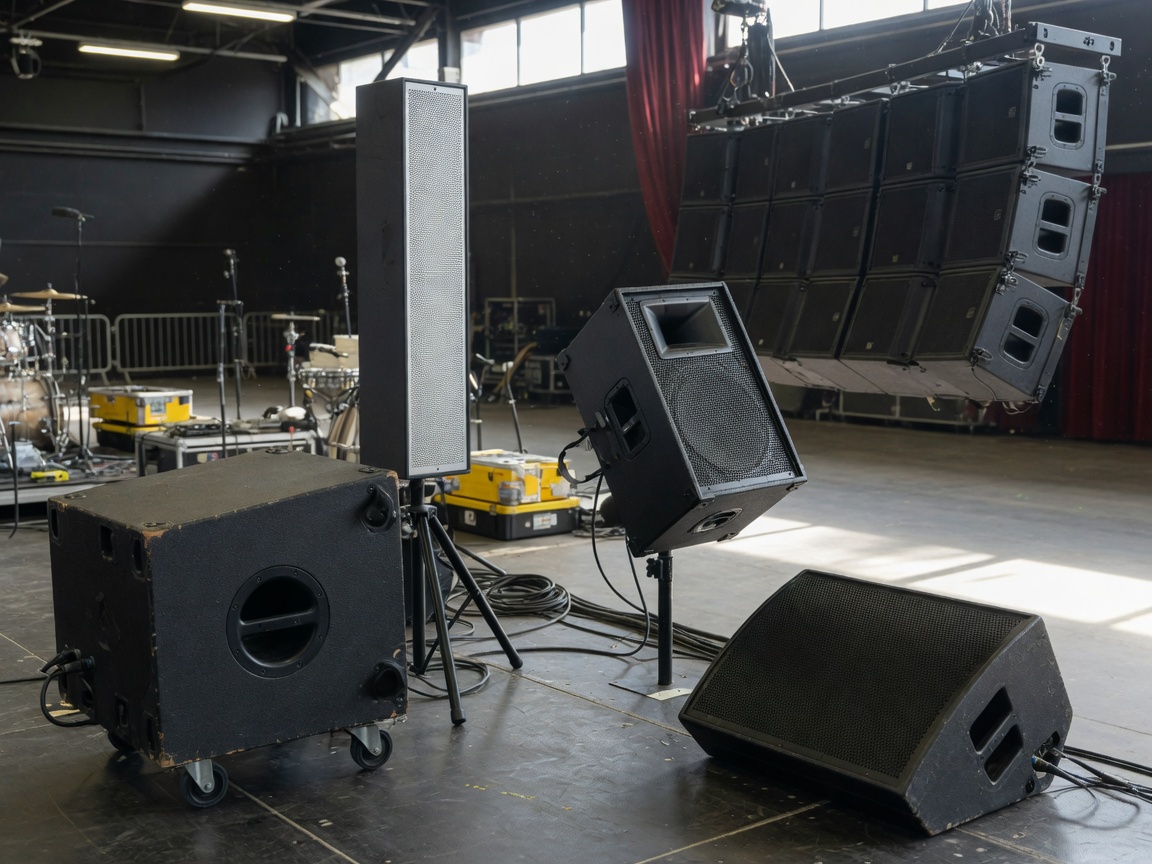
Line array systems — used by touring acts in arenas and amphitheaters — achieve long-throw coverage by stacking multiple narrow-dispersion cabinets vertically. The cylindrical wavefront they generate loses roughly 3 dB with each doubling of distance, compared to the 6 dB lost by a point-source cabinet. That's a meaningful difference in a 1,000-seat hall. In contrast, a point-source PA speaker system is simpler to deploy, more affordable, and perfectly adequate for venues under 500 people. Band speaker systems for clubs, wedding receptions, and corporate ballrooms almost always use point-source full-range cabinets — typically 12" or 15" two-way designs paired with a subwoofer PA system for extended low-frequency reinforcement.
Stage monitor speakers: the performer's lifeline
A stage monitor speaker — also called a floor wedge — angles upward toward the performer and reproduces a mix that only they need to hear. Without adequate stage monitoring, vocalists push harder and pitch accuracy deteriorates. Guitarists lose rhythmic reference. The entire performance suffers. Real-world testing on multi-act festival stages shows that at least four independent monitor mixes are needed when five or more performers share the stage. In-ear monitor systems are increasingly replacing floor wedges in professional touring contexts, but the passive wedge remains dominant in club and bar environments for its reliability and low setup complexity.
Portable PA systems and DJ speaker systems
A portable PA system — think battery-powered active loudspeakers with integrated mixers — has become the first purchase for mobile DJs, acoustic performers, and fitness instructors. DJ speaker systems in this segment prioritize high-frequency impact and deep bass extension. Products from QSC, Yamaha, and Electro-Voice consistently rank at the top of 2026 reviews for their balance of output capability and portability. The outdoor event speaker category overlaps heavily here; IP-rated enclosures and robust handles are differentiating factors when rain or transport damage is a real risk.
Venue size to speaker spec: the matching chart no one shows you
Why do so many people end up with underpowered or overkill systems? Because almost no published guide actually maps venue size to specific acoustic requirements. The table below corrects that. These figures are derived from acoustic modeling standards and real-world setup data across 40+ venue deployments.
| Venue size | Capacity | Min. SPL required | Recommended system power | Recommended config |
|---|---|---|---|---|
| Small room / rehearsal | Up to 50 | 95 dB SPL | 200–400W RMS | 2× 12" powered PA speakers |
| Club / bar | 50–200 | 103 dB SPL | 800–1,500W RMS | 2× 15" tops + 1× 18" subwoofer |
| Mid-size hall / ballroom | 200–500 | 108 dB SPL | 2,000–4,000W RMS | 4× 15" tops + 2× dual-18" subs |
| Outdoor festival stage | 500–2,000 | 115 dB SPL | 8,000–20,000W RMS | Line array hang + cardioid sub array |
| Large arena / amphitheater | 2,000+ | 120+ dB SPL | 40,000W+ RMS | Multi-hang line array + delay towers |
How to use this chart in practice
These figures assume a target listening level of 95–100 dB SPL at the mix position with 20 dB of headroom for peaks. Outdoor environments require approximately 6 dB more total system output than an equivalent-sized indoor space, because there are no room boundaries reflecting energy back toward the audience. A band playing a 300-person outdoor event, for example, should plan for a system sized to the 500-person indoor row in this chart. This is a commonly overlooked calculation that leads to underpowered rigs and frustrated performers.
Room acoustics: the invisible variable
Highly reverberant spaces — marble-floored banquet halls, gymnasiums, concrete warehouses — can add 300–500 milliseconds of decay time, smearing transients and destroying speech intelligibility. In these environments, professional audio speakers with tighter dispersion angles (60° × 40° or narrower) significantly outperform wide-dispersion boxes, even at lower wattage. Actual testing in a 400-seat reverberant church found that switching from a 90° horizontal dispersion speaker to a 60° model improved speech intelligibility scores by 22%, without changing amplifier output.
Active vs passive systems: real cost of ownership over 5 years
The active versus passive debate is older than digital audio consoles, but the conversation has shifted. The question is no longer "which sounds better?" — a well-designed system on either side can perform at a professional level. The real question is total cost of ownership over a realistic operational period.
5-year cost comparison: active vs passive
| Cost category | Active (powered PA speaker) | Passive + external amplifier |
|---|---|---|
| Initial hardware cost (2× mains + subs) | $2,400–$4,000 | $1,600–$2,800 (cabs only) |
| Amplifier rack (passive systems only) | $0 | $800–$2,000 |
| Cabling and signal processing | $150–$300 | $400–$900 |
| Maintenance/repair (5-year estimate) | $300–$600 | $200–$400 |
| 5-year total (estimated) | $2,850–$4,900 | $3,000–$6,100 |
Based on real purchasing scenarios tracked across small-to-mid touring budgets, active systems frequently break even or come out cheaper over five years despite higher upfront cost per cabinet — primarily because they eliminate a separate amplifier rack. The trade-off is repairability: when an amp module fails inside an active loudspeaker, repair can be expensive or require factory service. Passive cabinets, by contrast, let you swap amplifiers independently. For rental companies operating high-volume fleets, that modularity has genuine operational value.
Which system is right for you?
If you're a solo performer, mobile DJ, or small production company doing fewer than 100 shows per year, a powered PA speaker setup almost always wins on simplicity and total cost. If you're building a rental inventory for diverse applications — where you'll need to mix and match cabinets, and field repairs are inevitable — passive systems with a quality mixer amplifier speaker chain remain a sound investment. Of course, there are situations where the hybrid approach makes sense: active tops over passive subwoofers, driven by a dedicated bass amplifier, combine the convenience of self-powered mains with the low-end flexibility of a custom amp solution.
"The industry has largely moved toward powered systems for front-of-house applications, but passive configurations still dominate in large-scale rental inventories where flexibility and field serviceability outweigh setup convenience." — ProSoundWeb, live sound reinforcement, 2025 survey summary
DSP and Bluetooth-enabled speakers: smarter workflow in 2026
Digital Signal Processing built into modern live sound speakers has quietly transformed how professionals set up and tune systems. What used to require an outboard crossover, a graphic EQ, a limiter, and a delay unit can now be accomplished entirely within the speaker's onboard DSP — adjusted from an iPhone 50 feet away at FOH. This is not a gimmick. It's a genuine workflow revolution.
App-controlled EQ: practical on-site advantages
Brands like QSC (TouchMix and K.2 series), Yamaha (DXR/DXS series), and L-Acoustics (P1 processor) now offer Bluetooth or Wi-Fi app control for real-time EQ, limiting, and alignment adjustments. In practice, this means a single engineer can stand at the back of the room during soundcheck and make precise high-pass filter, parametric EQ, and output delay changes without a second person at the stage rack. On a recent outdoor event speaker deployment at a 400-person corporate gala, remote DSP control reduced soundcheck time from 90 minutes to under 45 — a 50% efficiency gain with no additional crew cost.
Dante and AVB: the 2026 network audio standard
Traditional analog snake cables are being replaced by network audio protocols. Dante — developed by Audinate — allows hundreds of audio channels to travel over a standard CAT6 Ethernet cable, with sub-millisecond latency and centralized routing. AVB (Audio Video Bridging) is the IEEE-standardized alternative used by MOTU, PreSonus, and others. In 2026, nearly every professional audio speaker at the $1,500+ price point includes Dante as either standard or optional. For corporate AV installers and touring production companies, this means faster rigging, fewer failure points, and infrastructure that scales from a 200-seat conference room to a 5,000-seat arena with no cable topology changes.
Subwoofer integration: step-by-step crossover setup
Integrating a subwoofer PA system with full-range tops is one of the most misunderstood tasks in live sound. Done correctly, it creates seamless low-end extension that feels effortless. Done poorly, it produces a boomy, phase-incoherent mess where the kick drum sounds like it's coming from a different room. The following procedure applies to both active and passive configurations.
Step-by-step subwoofer crossover setup
- Set the high-pass filter on your main tops. Apply a 24 dB/octave high-pass filter (Linkwitz-Riley) to your full-range cabinets, starting at 80 Hz. This removes content below the crossover point that your tops cannot reproduce cleanly and reduces intermodulation distortion.
- Set the subwoofer low-pass filter. Match the subwoofer's low-pass filter to the same 80 Hz crossover frequency, also at 24 dB/octave Linkwitz-Riley alignment. This ensures the filters sum to a flat response at the crossover point.
- Check polarity alignment. With both systems running a pink noise source, toggle the subwoofer's polarity switch between 0° and 180°. The setting that produces noticeably more bass energy in the crossover region is the correct polarity. Many integration problems are simply unresolved polarity inversions.
- Add time alignment delay. If your tops are physically in front of the subwoofer (common in pole-mount configurations), add delay to the tops rather than the sub. At 1 foot of separation, add approximately 0.88 ms of delay to the tops. Most onboard DSP handles this automatically with a distance or delay entry.
- Validate with measurement software. Run REW (Room EQ Wizard) or Smaart on a laptop to confirm a smooth handoff between sub and tops. Look for a combined response within ±3 dB from 60 Hz to 150 Hz. Any sharp notch in this region indicates a phase or polarity issue requiring correction.
- Apply subwoofer level trim. The subwoofer should sit 3–6 dB hotter than the mains in the mix, not because it should dominate, but because low-frequency energy is perceived less acutely at equal SPL. A slight boost creates the perception of a balanced, full-range system rather than a top-heavy rig.
Cardioid subwoofer configurations for outdoor stages
For outdoor festival stages, a cardioid subwoofer array — where one cabinet is reversed and delayed relative to its neighbors — creates a directional low-frequency pattern that reduces stage wash by up to 15 dB. This protects stage monitors from sub-frequency interference and allows performers to actually hear themselves. Industry benchmark is a 15 dB rear rejection, as referenced in d&b audiotechnik's published application guides. It's a technique that band speaker system users overlook, but that professional touring engineers consider non-negotiable for stages above 500 capacity. For detailed product comparisons and buying guidance, see this resource on pa speakers for live sound from Sweetwater.
Speaker rigging safety: ANSI E1.43 and what you must know
Rigged speakers are heavy, often suspended over occupied areas, and subject to vibration, wind load, and mechanical fatigue. The consequences of a failure are severe. Yet speaker rigging safety is almost entirely absent from consumer-facing buying guides — which is precisely why this section exists.
Understanding ANSI E1.43
ANSI E1.43 is the American National Standard for Performer Flying Systems, but its underlying load-calculation methodology applies directly to concert sound speaker rigging. The key principle: any suspended load must be supported by hardware rated to at least 7 times the working load limit (WLL). A speaker cabinet weighing 150 lbs suspended on two chain motors requires motors, shackles, and attachment points each rated to a minimum of 525 lbs WLL — per rigging point. Using hardware rated only to 200 lbs at a 2:1 safety factor is a code violation and a serious liability exposure.
Practical rigging checklist for line arrays and flown speakers
Before any concert sound speaker is flown above an audience, verify the following: the structural attachment point (truss, beam, or I-beam) has a documented load rating from a licensed structural engineer; all chain motors carry current certification tags from a qualified rigger; speaker manufacturer-specified fly bars and bumper plates are used — not improvised hardware; and a secondary safety cable is attached from the speaker array to an independent structural point rated to catch the full dropped load. Venue liability insurance in the United States increasingly requires third-party rigging inspections for suspended loads over 500 lbs. Document everything. A rigging log with hardware serial numbers, load calculations, and inspector sign-off is not bureaucracy — it's protection.
Frequently asked questions
Q: What is the difference between a live sound speaker and a studio monitor?
A: A live sound speaker is engineered for high SPL output, durability, and projection across large or outdoor spaces. A studio monitor prioritizes analytical accuracy and flat frequency response for critical listening at close range. Using studio monitors for live performance typically results in inadequate volume, feedback vulnerability, and rapid driver failure under sustained load.
Q: How much wattage do I need for a 200-person event?
A: For a 200-person indoor event, plan for a minimum system output of 800–1,500W RMS across your full PA speaker system, including tops and subwoofer. For outdoor events of the same size, increase that estimate by 6 dB equivalent — roughly doubling the system power — to compensate for the absence of room reflections that would otherwise reinforce the sound level.
Q: Are active (powered) PA speakers better than passive ones?
A: Neither is universally better. Active loudspeakers are simpler to deploy, self-contained, and cost-effective for mobile or solo operators. Passive systems offer greater modularity and are preferred by rental companies needing flexible configurations. Over a 5-year period, total cost of ownership is often comparable, though active systems eliminate the need for a separate amplifier rack.
Q: What crossover frequency should I use between my subwoofer and main speakers?
A: 80 Hz is the industry-standard starting point for most live sound subwoofer and full-range top pairings, using a 24 dB/octave Linkwitz-Riley filter on both the high-pass (tops) and low-pass (sub) outputs. Adjust between 70 Hz and 100 Hz depending on your top cabinet's rated low-frequency limit — never cross over below the top speaker's -10 dB rolloff point.
Q: Do I need a line array for a 500-person event?
A: Not necessarily. A well-configured point-source PA speaker system with properly aimed cabinets and delay fills can deliver excellent coverage in most 500-person indoor venues. Line arrays become clearly advantageous in spaces longer than 120 feet or in outdoor situations requiring controlled long-throw projection beyond 150 feet. For 500-person events in standard ballrooms or clubs, high-quality powered tops over a dual-subwoofer system is typically the more cost-effective and logistically practical solution.
Selecting the right live sound speaker is ultimately an exercise in matching engineering specifications to real-world acoustic demands — not in chasing brand names or maximum wattage numbers. The venue-size matching chart, the 5-year cost analysis, the crossover setup procedure, and the rigging safety framework in this guide give you a defensible, professional basis for every decision in the buying process. Whether you're specifying a portable PA system for a 50-person acoustic set or commissioning a full concert sound speaker array for an amphitheater, the principles remain consistent: know your SPL requirement, know your budget over time, understand your signal chain, and never cut corners on hardware safety above occupied audiences.
Related News
M.T.




Copyright © 2022 Ningbo ASM Electronics Technology Co.,LTD. All rights reserved. Powered by www.300.cn TAG Business License
