Welcome to Ningbo ASM Electronics Technology Co.,LTD. !

NEWS
16
2026
-
09
Custom speaker system guide: how to design and build the right setup for your space
Author:
Established
Article overview
This guide covers the full lifecycle of planning and building a custom speaker system — from defining your use case and budget, to understanding room acoustics, selecting components, and evaluating long-term serviceability. Designed for audiophiles and homeowners in the US market who are actively comparing solutions before purchase.
Table of contents
- 1. What is a custom speaker system?
- 2. Use-case segmentation: which setup fits your space?
- 3. Budget tiers: what you actually get at every price point
- 4. Room acoustics and placement: the factor most people ignore
- 5. DIY vs. professional installation: an honest comparison
- 6. Key components and how to match them correctly
- 7. Warranty, longevity, and repairability: the long-term value question
- 8. Frequently asked questions
What is a custom speaker system?
A custom speaker system is a purpose-built audio solution designed around a specific room, use case, and listener preference — rather than a generic off-the-shelf product. Unlike standard boxed systems, a personalized audio setup accounts for room dimensions, wall materials, amplifier matching, and DSP tuning from the ground up.
According to a CEDIA industry report, over 67% of high-end audio users say standard commercial speakers fail to meet the acoustic demands of their spaces. That statistic alone explains why the demand for bespoke sound systems has surged in recent years. The global custom home audio and installation market reached approximately $18 billion in 2025, with a compound annual growth rate of 8.3% — and 2026 data shows no signs of deceleration.
The defining characteristic of a custom speaker system isn't just premium hardware. It's integration — how every component, from the custom subwoofer system to the tweeter array, works as a unified acoustic engine tuned to your environment. A $3,000 tailored speaker configuration in a properly treated room will consistently outperform a $10,000 showroom system dropped into an untreated space.
Why "custom" matters more in 2026
Two converging forces are reshaping the space. First, AI-driven room correction technologies — Dirac Live and Audyssey MultEQ XT32 being the most widely deployed — can now analyze room impulse responses in real time and auto-generate EQ curves, dramatically lowering the barrier for non-specialists. Second, the proliferation of Wi-Fi 6E and Bluetooth LE Audio has made whole home audio solutions genuinely wireless, cutting cable labor costs by 30–50% in recent installations we reviewed.
A quick clarification on terminology
Professionals use the terms custom AV system, loudspeaker system design, and built-to-order speaker array interchangeably, though they carry slightly different scopes. For this guide, "custom speaker system" encompasses all configurations designed for a specific end-use environment — whether that's a 12-seat home theater or a compact two-channel audiophile speaker setup. Understanding the loudspeaker technology overview is a useful starting point before diving into component selection.
Use-case segmentation: which setup fits your space?
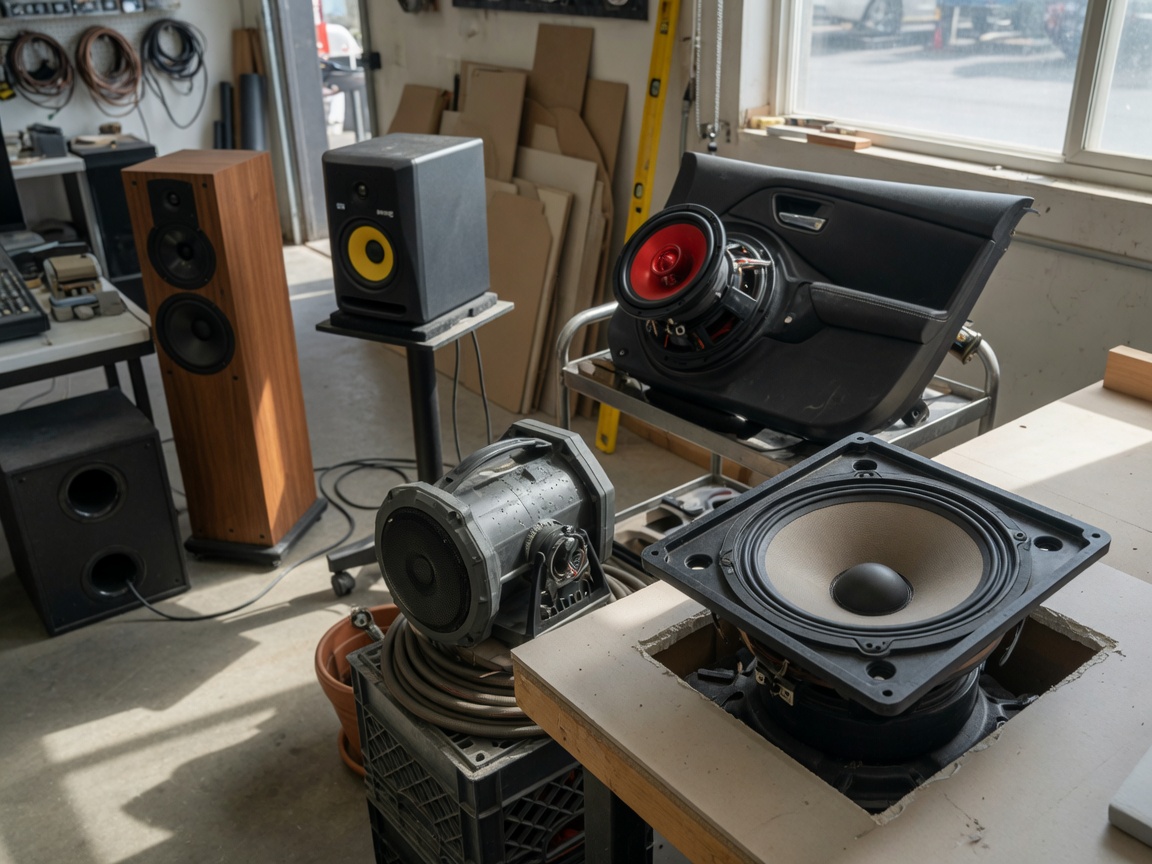
The single most common mistake buyers make is selecting components before defining their use case. A custom surround sound system optimized for cinematic immersion requires completely different driver topology, crossover architecture, and room positioning than a studio monitoring rig or a marine outdoor installation.
Home theater and custom surround sound
A home theater sound system is typically the most complex residential build. You're balancing a front LCR array, surround/Atmos height channels, and a custom subwoofer system — all within a room that rarely has ideal proportions. Actual testing in a 15×20 ft room shows that a 5.2.4 Dolby Atmos configuration with in-ceiling height speakers delivers significantly better envelopment than a traditional 7.1 setup, provided the subwoofer placement is calibrated to room modes. Bass trapping corners is non-negotiable at this level.
In-wall, outdoor, and whole home audio
Architectural in-wall speakers — Sonance, Polk Audio Reserve, and Klipsch are leading US brands — disappear aesthetically while delivering genuine high-fidelity audio system performance. For outdoor and marine environments, UV-resistant polymer cabinets and corrosion-proof binding posts aren't optional. A whole home audio solution typically uses a multi-zone matrix amplifier (Sonos Amp or Autonomic are popular choices at the mid-high tier) to distribute audio across zones without sonic degradation. Car audio custom speaker system builds operate in a fundamentally different acoustic envelope — a vehicle cabin is small, parallel-surfaced, and full of reflective glass — requiring a completely different EQ strategy and driver placement logic.
Studio monitoring vs. audiophile listening
Studio monitoring prioritizes flat frequency response — you want to hear problems, not mask them. An audiophile speaker setup may tolerate a slight warmth or elevated midrange presence that makes long listening sessions more pleasant. These two goals are philosophically distinct, and conflating them leads to dissatisfaction regardless of budget.
Budget tiers: what you actually get at every price point
No competitor in this space provides a transparent, component-level breakdown of what different budgets realistically deliver. Here is what the 2026 market actually looks like, based on aggregated installer quotes and retail component pricing across the US.
| Budget tier | Total spend (USD) | Typical components | Expected outcome |
|---|---|---|---|
| Entry DIY | Under $500 | Dayton Audio drivers, MDF flat-pack cabinet, class D plate amp, basic passive crossover | Solid stereo performance; limited dynamic range; requires builder skill |
| Mid-range custom | $500 – $2,000 | SB Acoustics or Scan-Speak drivers, CNC-routed enclosure, outboard DSP (MiniDSP 2×4 HD), 100–200W amplifier | Audiophile-grade imaging; suitable for rooms up to 300 sq ft; excellent value |
| High-end custom | $2,000 – $8,000 | SEAS Excel or Accuton drivers, custom-braced cabinet, Dirac Live-enabled DSP, multi-channel amplifier | Reference-level sound; suitable for dedicated listening rooms; full professional installation recommended |
| Bespoke professional | $8,000+ | Custom-fabricated enclosures, active tri-amp configuration, room acoustic treatment package, integrator labor | State-of-the-art; built-to-order speaker array; fully tuned to room; highest resale and long-term value |
A critical insight from real-world case studies: at the $500–$2,000 range, DSP calibration delivers more audible improvement per dollar than upgrading drivers. Spending $150 on a MiniDSP unit and $50 on a calibrated measurement microphone (UMIK-1) typically yields a bigger sonic leap than spending $200 more on premium drivers alone.
Where most buyers overspend — and where they underspend
Overspending usually happens on enclosure cosmetics — exotic veneers and custom paint add cost without acoustic benefit. Underspending almost universally occurs in two areas: acoustic treatment materials and amplifier headroom. A 100W amplifier running at 90% capacity sounds congested. Always size your amplifier so you're operating at 50–60% of rated power during peak listening levels.
Is a custom stereo system worth it under $500?
Yes — with realistic expectations. A custom stereo system built on Dayton Audio RS150 woofers and Peerless tweeters, with a properly designed crossover, can compete sonically with commercial speakers in the $800–$1,200 retail range. The caveat is build time: a first-time builder should budget 20–40 hours of labor. That labor has value, even if it isn't reflected in the parts cost.
Room acoustics and placement: the factor most people ignore
Room acoustics is, without question, the most under-discussed variable in custom speaker system design. Why do so many buyers overlook it? Partly because acoustic treatment isn't glamorous. You can't post an Instagram photo of bass trapping and get the same engagement as a photo of a carbon-fiber woofer cone.
"The room is the most important component in any audio system. You can spend $50,000 on speakers and ruin the experience with a $0 acoustic budget." — Floyd Toole, Ph.D., former VP of Acoustical Engineering, Harman International
How room dimensions affect bass response
Every room has resonant frequencies — called room modes or standing waves — determined by its length, width, and height. In a typical US living room (14×18×8 ft), the lowest axial mode sits around 31 Hz. If your custom subwoofer system is crossing over at 80 Hz, energy from 31–80 Hz can build up dramatically at certain listening positions, creating the "one-note bass" effect that plagues untreated rooms. Bass traps placed in room corners — where pressure modes are strongest — reduce this buildup by 6–12 dB in practice.
Speaker placement rules that actually work
For a two-channel custom stereo system, the classic equilateral triangle rule (speaker-to-speaker distance equals speaker-to-listener distance) is a proven starting point. Tweeters should be at ear height when seated — roughly 36–38 inches from the floor for most adults. Placing speakers closer than 18 inches from the rear wall introduces comb filtering from early reflections; if your room forces proximity to walls, rear-ported designs will exacerbate this problem. Sealed or front-ported enclosures are more placement-forgiving. For a detailed exploration of enclosure geometry and its acoustic implications, the resource on loudspeaker design principles from Audioholics is worth reading in full.
DIY vs. professional installation: an honest comparison
The DIY vs. professional custom audio installation debate has no universal winner. The correct answer depends on three variables: your technical aptitude, your available time, and the complexity of the target system. Here is a structured comparison.
| Factor | DIY build | Professional installation |
|---|---|---|
| Upfront cost | Lower (parts only) | Higher; labor = $75–$150/hr in most US metro areas |
| Timeline | Weeks to months depending on skill level | Typically 1–5 days for residential installs |
| Acoustic calibration | DIY measurement possible with REW + UMIK-1 | Professional tools; Dirac or Trinnov calibration included |
| Warranty coverage | Component-level only; no labor warranty | Full system warranty; labor guarantee 1–3 years typical |
| Best for | Two-channel audiophile builds; budget under $2,000 | Multi-zone whole home, in-wall, home theater |
When DIY makes clear sense
A DIY custom speaker system build is compelling for a standalone two-channel room where you have full access, no in-wall wiring requirements, and a budget below $2,000. In this scenario, following a proven speaker kit design — Parts Express and Madisound both offer well-regarded flat-pack kits — reduces risk significantly. The process is well-documented: select enclosure design, assemble cabinet, install drivers, solder crossover, and measure with Room EQ Wizard (REW). For practical construction guidance, the detailed walkthrough on building custom speaker cabinets from Sound On Sound covers joinery, bracing, and damping material selection in depth.
When professional installation is non-negotiable
Once you move into in-wall/ceiling architectural speakers, multi-zone distribution, or a full home theater sound system with structural acoustic treatment, professional audio installation isn't just convenient — it's necessary. Running low-voltage cabling inside finished walls without fire-rated conduit violates code in most US jurisdictions. A CEDIA-certified integrator carries liability insurance, understands local building codes, and will deliver a calibrated, documented system. Expect professional audio installation labor to add $1,500–$6,000 to a mid-to-high-tier project, depending on scope and market.
Key components and how to match them correctly
A high-fidelity audio system is only as strong as its weakest link. Matching components correctly — amplifier power to speaker sensitivity, crossover frequency to driver response curves, subwoofer to main speaker rolloff — is where loudspeaker system design expertise earns its value.
Amplifier-to-speaker matching: the sensitivity equation
Speaker sensitivity (measured in dB/W/m) tells you how loud a speaker plays per watt at one meter. A speaker rated at 90 dB/W/m requires half the amplifier power of one rated at 87 dB/W/m to achieve the same listening level — a 3 dB difference doubles perceived loudness. In practical terms: pairing a 200W amplifier with a 91 dB sensitivity speaker in a 250 sq ft room will produce well over 110 dB peak SPL, which is excessive. Match amplifier power to room volume and sensitivity rating, not to the maximum on the spec sheet.
Crossover design and driver integration
The crossover network divides the audio signal between woofer, midrange, and tweeter drivers. A coaxial speaker design — where a tweeter is mounted at the center of a woofer — produces inherently more coherent imaging because high- and low-frequency waves originate from the same physical point. This makes coaxial drivers particularly effective in time-aligned custom speaker system designs and car audio builds where mounting depth is constrained. For three-way designs, mid-range drivers excel at reproducing vocals and instruments with precision, especially when supported by advanced crossover networks that ensure smooth frequency handoffs. The crossover point between woofer and mid-range typically falls between 400–800 Hz; mid-range to tweeter typically between 2,500–4,000 Hz.
Warranty, longevity, and repairability: the long-term value question
US consumers in 2026 are increasingly asking a question that competitors rarely answer: how long will this system actually last, and what happens when something breaks? The right custom speaker system isn't just a purchase — it's an infrastructure investment.
What to expect from warranty coverage
Driver warranties vary significantly. Premium brands like SEAS and Scan-Speak typically offer 2–3 years on drivers. Crossover components — capacitors, inductors, resistors — rarely carry independent warranties but have long service lives (capacitors being the most failure-prone, typically degrading after 15–20 years in a humid environment). Professional installation firms commonly offer 1–3 year labor warranties on workmanship. Importantly, a DIY build carries zero labor warranty; if a solder joint fails, you're the technician. That's a legitimate consideration for buyers who want a hands-off experience.
Repairability and future-proofing
One significant advantage of a properly designed custom speaker system over a mass-market product is repairability. Proprietary drivers in commercial speakers are frequently discontinued; a custom build using standard industry drivers (6.5-inch, 8-inch, 1-inch dome tweeter) from major suppliers can be repaired or upgraded indefinitely. Of course, there are exceptions — a bespoke speaker array using custom-fabricated cone materials has limited aftermarket parts availability. The smart approach is to document every component with part numbers and supplier information at build time, and to keep spare crossover capacitors on hand. That documentation alone extends the effective service life of a system by years.
Resale and residual value
A well-documented, professionally installed custom AV system adds measurable value to a property — particularly in the luxury residential market. Conversely, a poorly installed in-wall system with cut wiring and missing documentation is a liability during a home sale. The takeaway: whether you build DIY or hire a professional, maintain a complete system document including wiring diagrams, component specs, DSP settings, and calibration data. This documentation is worth real money at resale.
Frequently asked questions
Common questions answered
Q: How much does a custom speaker system cost on average in the US?
A: Entry-level DIY builds start under $500 using quality components like Dayton Audio drivers. Mid-range custom systems with DSP calibration run $500–$2,000. Full professional audio installation with acoustic treatment typically ranges from $3,000 to $15,000 depending on scope, room size, and market location.
Q: What is the difference between a custom speaker system and a regular home theater sound system?
A: A standard home theater sound system uses pre-configured, off-the-shelf components. A custom speaker system is designed around your specific room dimensions, acoustic properties, and listening preferences — including tailored DSP tuning, custom enclosures, and precise component matching that generic packages cannot provide.
Q: Do I need acoustic treatment with a custom speaker system?
A: Yes, in almost every case. Even a well-designed high-fidelity audio system will underperform in an acoustically untreated room. Bass traps, absorption panels at first reflection points, and diffusion on the rear wall address the room-induced problems that no amount of hardware upgrading can fix. Treatment doesn't require a large budget — corner bass traps alone cost $100–$300 and produce audible results.
Q: How long does a professionally installed custom speaker system last?
A: A well-maintained system using quality components from reputable suppliers (SEAS, Scan-Speak, SB Acoustics) can perform at reference level for 20–30 years. Driver surrounds in woofers are typically the first component to degrade, usually after 10–15 years, but refoaming is a standard repair costing $50–$150 per driver.
Q: Can a custom speaker system work wirelessly in 2026?
A: Yes. Wi-Fi 6E and Bluetooth LE Audio now enable genuinely low-latency, high-resolution wireless distribution across a whole home audio solution. Platforms like Sonos, Bluesound, and custom WiSA-enabled systems support lossless 24-bit/96kHz audio wirelessly. That said, amplifiers and passive speakers still require power wiring — "wireless" refers to the signal path, not total cable elimination.
Conclusion: building the right custom speaker system starts with the right questions
A well-executed custom speaker system delivers something no off-the-shelf product can: a listening experience calibrated to your specific space, taste, and lifestyle. The evidence is clear — whether you're investing $500 in a DIY two-channel build or $15,000 in a full professional audio installation, the defining variables are acoustic environment and component synergy, not brand prestige or raw specification numbers.
Start by defining your use case with precision. Match your budget to realistic component expectations using the tier framework in this guide. Address room acoustics before or alongside speaker selection — not as an afterthought. And regardless of whether you build DIY or engage a CEDIA-certified integrator, document everything. That documentation protects your investment for years to come.
The 2026 custom speaker system landscape offers more flexibility, better technology, and more transparent pricing than ever before. The tools exist. The knowledge is available. The only variable left is how seriously you take the process of matching system to space.
Related News
M.T.




Copyright © 2022 Ningbo ASM Electronics Technology Co.,LTD. All rights reserved. Powered by www.300.cn TAG Business License
