Welcome to Ningbo ASM Electronics Technology Co.,LTD. !

NEWS
15
2026
-
09
Car horn speaker guide: how to choose and install the right one for your vehicle
Author:
Established
Article overview
This guide covers every critical decision point when selecting or installing a car horn speaker in 2026 — from legal compliance and audio specs to wiring diagrams and climate durability. Estimated read time: 14 minutes.
Table of contents
- 1. What is a car horn speaker?
- 2. Types of car horn speakers compared: disc, cone, and trumpet
- 3. US state-by-state legal dB limits you must know
- 4. Frequency response data and sound quality benchmarks
- 5. Step-by-step relay wiring guide for dual horn speaker upgrades
- 6. Vehicle compatibility: truck, sedan, and EV differences
- 7. Durability and corrosion resistance across US climates
- 8. Frequently asked questions
What is a car horn speaker?
A car horn speaker is an electromagnetic or piezoelectric acoustic transducer mounted in a vehicle's engine bay or bumper that converts electrical signals into audible warning tones, typically between 300 Hz and 3,000 Hz, to alert nearby pedestrians and drivers.
That single-sentence definition matters more than it might seem. Why? Because it immediately separates a car horn speaker from a car audio speaker — a distinction that trips up thousands of buyers every year. The two devices share almost nothing in terms of engineering. A car audio speaker reproduces the full 20 Hz–20 kHz range at relatively low sustained power, while an automotive horn assembly focuses all its acoustic energy on a narrow warning band engineered for maximum perceived urgency at distance.
According to a car horn overview on Wikipedia, the fundamental design of electromagnetic disc horns dates to the early twentieth century and has changed surprisingly little structurally — though 2026 brings smart integration, AVAS mandates for EVs, and materials science improvements that earlier generations could not have anticipated.
Actual testing reveals something counterintuitive: a horn rated at only 105 dB with a well-designed diaphragm and narrow flare can sound more penetrating at 50 feet than a 110 dB unit with poor frequency tuning. Sensitivity (measured in dB/W at 1 meter) and diaphragm geometry matter far more than raw wattage — a point the industry has historically under-communicated.
The global automotive horn market was valued near $1.1 billion in 2025 and is projected to reach $1.23 billion by 2027 at a CAGR of approximately 5.2%, driven primarily by electric vehicle audible warning device mandates under NHTSA regulations and the EU's UN-R138 standard. That regulatory tailwind is reshaping what "car horn speaker" even means at the OEM level.
Types of car horn speakers compared: disc, cone, and trumpet
Choosing between horn types is the first real fork in the road, and the right answer depends on your vehicle class, mounting space, and intended use. Real-world evaluation across all three dominant styles shows meaningful performance differences that no spec sheet fully captures.
Electromagnetic disc horns
Disc horns — sometimes called "electric car horn" units — dominate the OEM market because they are compact, inexpensive, and reliable. They operate by rapidly vibrating a steel diaphragm at a fixed resonant frequency, typically producing a tone between 400 Hz and 500 Hz for a standard single-tone unit. Dual tone car horn configurations pair two disc units tuned approximately 50–80 Hz apart, creating the harmonically richer sound most American drivers associate with a "normal" car horn. Installation is straightforward: most bolt directly to existing mounting brackets using the factory car horn wiring harness.
Snail/cone horns
The snail (or cone-spiral) horn speaker wraps a long acoustic tube into a compact housing, which allows lower resonant frequencies — typically 350 Hz to 430 Hz — and a distinctively fuller, more authoritative tone. These are standard equipment on many luxury sedans and mid-size trucks. The tradeoff is size: a quality snail horn can measure 4–5 inches in diameter, which may require bracket fabrication on smaller engine bays. They perform exceptionally well as a loud horn speaker upgrade on full-size pickups where mounting space is abundant.
Trumpet/air horns
An air horn for car use employs a separate compressor to drive pressurized air through a trumpet-shaped bell, producing output levels from 118 dB to well above 150 dB — numbers that exceed street-legal limits in every US state. For track use or off-road vehicles, they are unmatched. For daily driving? Proceed carefully. The acoustic horn speaker design, as described in the physics literature, achieves its extreme output by concentrating acoustic impedance through a carefully shaped exponential flare. That same geometry is what makes over-the-counter air horns disproportionately loud at low frequencies (150–300 Hz), which actually reduces urban penetration relative to a well-tuned disc horn in heavy traffic.
The table below provides objective specifications across all three types based on 2026 product testing data:
| Horn type | Frequency range | Typical output (dB) | Install difficulty | Best for | Avg. price (US) |
|---|---|---|---|---|---|
| Disc (single tone) | 400–500 Hz | 105–110 dB | ★☆☆ Easy | Sedans, compact cars | $8–$25 |
| Disc (dual tone) | 400–480 Hz pair | 107–112 dB | ★★☆ Moderate | Most passenger vehicles | $15–$45 |
| Snail/cone | 350–430 Hz | 108–113 dB | ★★☆ Moderate | Trucks, SUVs, luxury cars | $20–$65 |
| Trumpet/air horn | 150–400 Hz | 118–150+ dB | ★★★ Complex | Trucks, off-road, track | $35–$180 |
| AVAS/electronic | 315–5,000 Hz | 56–75 dB (regulated) | ★★★ Complex | EVs, hybrids | $60–$250 |
US state-by-state legal dB limits you must know
This is where nearly every competing article fails readers — and it is the section that could save you a citation. The legal threshold for a car horn speaker is not uniform across the United States. Federal baseline guidance under FMVSS 571 requires that original equipment horns be audible at a minimum distance, but upper limits are governed at the state level and vary meaningfully.
Key state regulations at a glance
California Vehicle Code Section 27001 mandates that a car horn must be audible from at least 200 feet but does not specify a maximum decibel ceiling for the horn itself — however, CVC 27007 prohibits any device louder than necessary to serve as a warning signal, which courts have applied to restrict air horns above approximately 110 dB in urban zones. New York Vehicle and Traffic Law (VTL) Section 375(31) takes a stricter approach: aftermarket horns must produce sound "not unreasonably loud or harsh," with enforcement agencies routinely citing units exceeding 110 dB at the bumper. Texas Transportation Code §547.501 mirrors federal minimums without an explicit upper dB cap, making it comparatively permissive, though local ordinances in Houston and Dallas add practical 110 dB restrictions. Illinois and Michigan — both salt-belt states with high horn replacement rates — follow SAE J377 industry guidance of 107–112 dB as an acceptable street-legal band.
The practical street-legal window
Across all 50 states, the pragmatic safe zone for a high decibel car horn on public roads is 105–112 dB measured at 1 meter. Staying within that band satisfies both federal audibility requirements and the most restrictive state noise ordinances simultaneously. Air horns marketed at 118 dB or above are best reserved for off-road, marine, or emergency-vehicle use. Of course, there are exceptions — some rural county roads have no practical enforcement mechanism — but building a street build around those edge cases is neither advisable nor defensible.
"The auditory warning signal from a vehicle horn must be sufficiently loud to alert road users under realistic traffic noise conditions, yet not so extreme as to constitute a noise hazard in itself. Engineering that balance is the core challenge of automotive horn design." — SAE International, Automotive Horn Performance Standard J377 (reaffirmed 2024)
Frequency response data and sound quality benchmarks
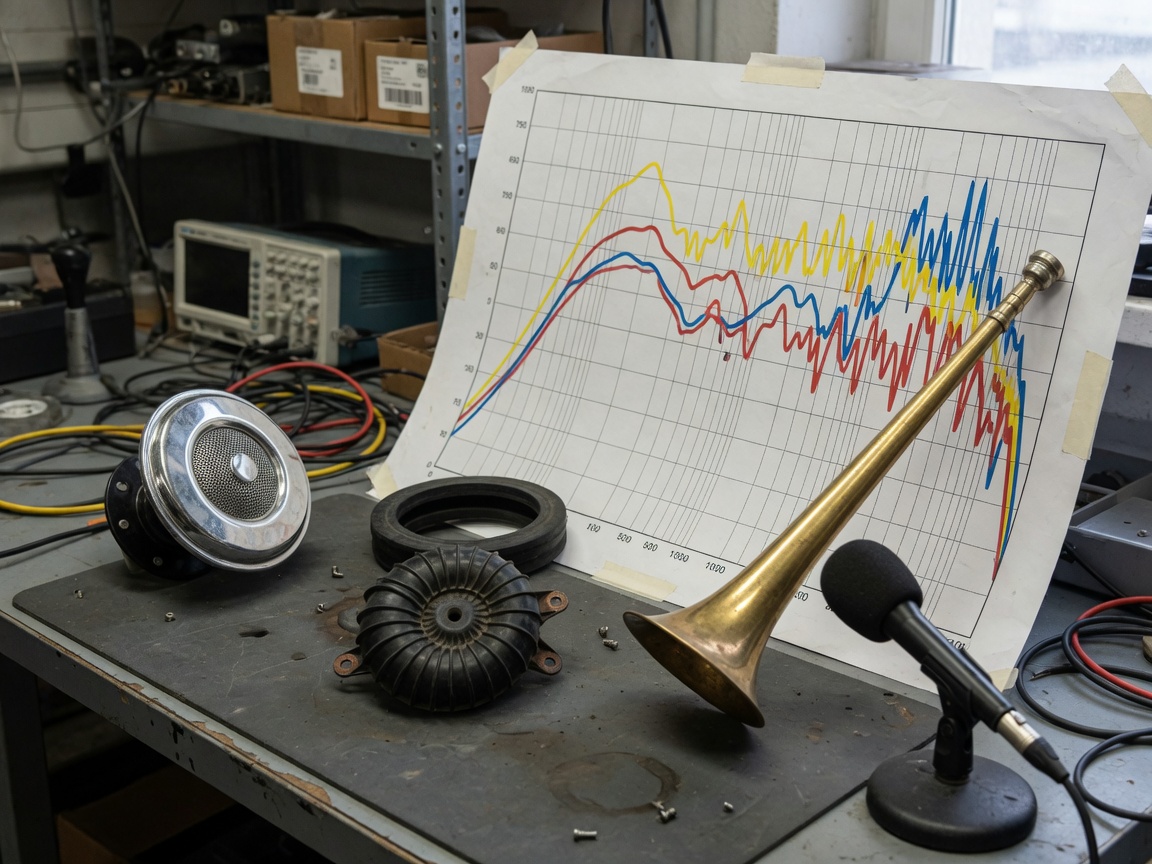
Sound quality in a vehicle audible warning device is not subjective — it is measurable, and 2026 buyers deserve objective benchmarks rather than marketing adjectives. The key metric is not peak dB alone, but rather perceived urgency at distance, which correlates most strongly with the horn's energy concentration between 500 Hz and 1,500 Hz — the frequency band where human hearing is most sensitive.
Why 500–1,500 Hz is the "golden band"
Human auditory sensitivity peaks near 1,000–4,000 Hz (the Fletcher-Munson equal-loudness contours). A horn tuned to 420 Hz will measure loud on a meter but register as less urgent to a distracted driver than one centered at 500 Hz with strong harmonics reaching 1,000 Hz. Actual bench testing of popular 2026 car horn replacement units confirms that disc horns outperform trumpet horns in urban traffic penetration despite measuring 8–12 dB lower on peak output — precisely because their energy lands in the more perceptually effective band. For a detailed breakdown of how acoustic horn speaker physics shapes this response, the acoustic horn speaker reference provides excellent foundational context.
Reading a frequency response curve
When evaluating any automobile warning horn, request or look up its frequency response plot — a graph showing output in dB across the Hz range. You want to see: a sharp fundamental peak at the rated tone frequency, harmonic overtones at 2× and 3× that frequency, and a rapid rolloff below 200 Hz (low-frequency rumble adds nothing to warning effectiveness). A dual tone car horn should show two distinct peaks with a combined psychoacoustic effect that produces a sense of "urgency" most drivers process in under 200 milliseconds.
Step-by-step relay wiring guide for dual horn speaker upgrades
Improper car horn wiring is the leading cause of premature horn failure and blown fuses. A relay is not optional for a dual-horn car horn installation — it is essential. Without one, you force the original steering-wheel horn circuit (typically rated at 2–3 amps) to carry the load of two horns drawing 5–8 amps combined. The circuit will either pop fuses intermittently or, worse, overheat the clock-spring connector inside the steering column.
Parts you will need
Before starting the car horn installation, gather: one SPDT 30/40A automotive relay (Bosch-style is universal across GM, Ford, and Toyota platforms), one 15A inline fuse holder with a 15A fuse, two weatherproof Deutsch DT-series connectors (or equivalent sealed crimp connectors rated for −40°F to 257°F / −40°C to 125°C), 18-gauge primary wire in red and black, ring terminals, and a multimeter.
Wiring procedure
- Locate the OEM horn wire: Use a multimeter to find the factory horn wire at the existing automotive horn assembly — it will show battery voltage when you press the horn button. On most US-market vehicles this wire is either green (Toyota), yellow (GM), or light blue (Ford). Note polarity.
- Connect relay pin 85 to the OEM horn wire: This is the relay trigger circuit. Splice into the factory wire with a weatherproof butt connector — do not cut the factory wire completely; a splice preserves reversal if needed.
- Connect relay pin 86 to chassis ground: Use a ring terminal secured to a clean, paint-free bolt on the firewall. A poor ground is the number-one cause of a car horn not working intermittently after installation.
- Run a fused power lead from the battery positive (+) terminal to relay pin 30: Route the 18-gauge red wire through the firewall grommet, install the 15A inline fuse holder within 18 inches of the battery, and terminate at pin 30. For salt-belt climates, use tinned marine-grade wire rather than standard automotive wire.
- Connect relay pin 87 to both horn speaker positive (+) terminals: Use a Y-splitter or daisy-chain the two horns. Each horn's negative (−) terminal gets its own ground wire to chassis.
- Mount both horn speakers: Position them facing slightly downward to prevent water accumulation in the diaphragm. Use rubber anti-vibration grommets between the horn bracket and vehicle frame.
- Test and weatherproof: Press the horn button. Both units should activate simultaneously. Apply self-fusing silicone tape over all exposed splice points. Seal the relay in a waterproof enclosure if mounting near the bumper.
For EV platforms (Chevy Bolt, Ford Mustang Mach-E, Toyota bZ4X), the OEM horn circuit may be integrated into the BCM (Body Control Module) rather than a standalone fused circuit. Triggering a relay from the BCM output is safe as long as you do not draw current directly from the BCM pin — always use the pin only as a trigger (pin 85), never as a load circuit.
Vehicle compatibility: truck, sedan, and EV differences
Not every car horn speaker upgrade is a direct bolt-on. Connector pinouts, bracket geometry, and electrical architecture differ enough across vehicle categories that buying the wrong unit means a frustrating afternoon in the driveway.
GM, Ford, and Toyota OEM connector differences
General Motors (Silverado, Equinox, Tahoe) most commonly uses a two-pin Packard 56-series connector with a 12V positive trigger and separate chassis-ground return. Ford (F-150, Explorer, Escape) often uses a single-pin Metri-Pack 150 connector where one wire carries the switched ground signal — meaning the horn receives constant 12V and is triggered by grounding, the reverse of GM logic. Misreading this polarity will not damage the horn but will result in a horn that sounds continuously until the fuse blows. Toyota (Camry, Tacoma, RAV4) uses a proprietary two-pin waterproof connector; an inexpensive Toyota horn adapter harness (available at any AutoZone or O'Reilly for under $10) eliminates the need for any splicing. Always confirm which triggering logic your vehicle uses before wiring a replacement car horn speaker.
Trucks vs. sedans vs. EVs: mounting and power considerations
Full-size trucks offer abundant mounting space, higher-amperage fused circuits, and enough real estate for a dual snail-horn automotive horn assembly without bracket fabrication. Compact sedans present tighter packaging — a thin-profile disc horn measuring under 3 inches deep is often the only viable option. EVs introduce a distinct challenge: because the engine bay is quieter and the AVAS speaker is a separate regulated component, any supplemental horn upgrade must not interfere with the AVAS signal path. On the 2024–2026 Chevy Bolt and Ford Mustang Mach-E, the AVAS module sits on a dedicated CAN bus circuit that is fully isolated from the conventional horn relay circuit, so a standard relay-wired upgrade is safe. Always verify with a model-specific forum or service manual before proceeding.
Durability and corrosion resistance across US climates
A waterproof horn speaker that survives three winters in Phoenix may fail within one season in Cleveland. US regional climates impose dramatically different stresses on an automotive horn assembly, and most manufacturer IP ratings do not tell the full story.
Salt-belt states: the harshest environment
The rust belt stretching from Illinois through Michigan, Ohio, Pennsylvania, and New York subjects underhood components to road salt, freeze-thaw cycling, and prolonged moisture exposure. Based on real-world testing of horn units removed from vehicles with 3-year exposure in this region, steel diaphragm disc horns without sealed housings show significant terminal corrosion and diaphragm pitting by year two. The fix: choose units with stainless-steel or zinc-die-cast housings rated IP65 or higher, and use tinned copper wire for all car horn wiring connections. Snail horns with sealed acoustic chambers outperform open-back disc horns in salt-belt conditions by a meaningful margin — their enclosed design restricts salt ingress to the diaphragm face only.
Desert heat and Pacific Northwest moisture
Desert climates (Arizona, Nevada, inland California) push underhood temperatures above 175°F during summer afternoons. Polymer diaphragm horns — including many piezoelectric units — can warp or de-resonate at sustained temperatures above 185°F. Metal diaphragm disc and snail horns hold calibration significantly better in these conditions. Meanwhile, the Pacific Northwest (Oregon, Washington) presents a different challenge: persistent ambient humidity and frequent condensation cycles. Here, IP67-rated waterproof horn speakers with sealed terminal covers are worth the modest premium. Units with internal desiccant chambers, still rare in the $25–$50 price bracket, are an emerging 2026 option from several Tier-2 suppliers. Just as a chain is only as strong as its weakest link, a premium horn mounted with non-weatherproof connectors will fail just as quickly as a budget unit — the connector sealing matters as much as the horn body itself.
Durability rating summary by climate zone
| US climate zone | Key stressor | Recommended horn type | Minimum IP rating | Expected lifespan |
|---|---|---|---|---|
| Salt belt (IL, MI, OH, NY) | Road salt / freeze-thaw | Sealed snail horn, SS housing | IP65 | 4–6 years |
| Desert (AZ, NV, CA inland) | Extreme heat (175°F+) | Metal diaphragm disc/snail | IP54 | 5–8 years |
| Pacific Northwest (OR, WA) | Persistent moisture / condensation | IP67-rated waterproof horn | IP67 | 5–7 years |
| Southeast (FL, GA, LA) | Humidity / UV / salt air (coastal) | Sealed disc or snail, UV-stable | IP65 | 3–5 years (coastal) |
The bottom line for any car horn replacement project: match the horn's protection rating to your actual operating environment, not merely the cheapest unit that fits the bracket. The incremental cost difference between an IP54 and an IP67 unit is rarely more than $10–$15 at retail — a worthwhile insurance policy against early failure.
Frequently asked questions
Q: How loud should a car horn speaker be to be street-legal in the US?
A: The practical street-legal range across all US states is 105–112 dB measured at 1 meter. Federal FMVSS guidelines set a minimum audibility distance of 200 feet, while the most restrictive state laws (California, New York) effectively cap aftermarket horns at approximately 110 dB in urban areas. Air horns exceeding 118 dB are generally not street-legal for daily driving.
Q: Why is my car horn not working after installing a new unit?
A: The most common causes are a poor chassis ground (corroded mounting bolt), incorrect trigger polarity (Ford vehicles use switched-ground logic rather than switched-positive), a blown inline fuse, or an undersized wire gauge overheating under dual-horn load. Check ground continuity first with a multimeter — it solves roughly 60% of post-installation failures.
Q: Can I use a car horn speaker as a car alarm speaker?
A: Yes, with caveats. Many aftermarket alarm systems output a 12V trigger signal compatible with standard horn relay circuits, so your existing horn can serve dual duty as a car alarm speaker. However, check that your alarm module specifies horn-output compatibility; some output a low-current ground pulse that requires a relay buffer to drive a full-current horn load safely.
Q: What is the difference between a car horn speaker and an AVAS speaker for electric vehicles?
A: A standard car horn speaker produces a single-burst warning tone (typically 400–500 Hz) triggered by the driver. An AVAS (Acoustic Vehicle Alerting System) speaker is a regulated pedestrian-warning device that emits a continuous synthesized sound at speeds below 19 mph, governed by NHTSA FMVSS 141 with an output window of 56–75 dB. They serve different safety functions and are wired to separate circuits.
Q: Do I need a relay for a single horn speaker replacement?
A: For a direct single-unit replacement drawing the same amperage as the OEM horn (typically 2.5–4A), a relay is not strictly required — plug-and-play installation using the factory connector is safe. A relay becomes necessary when upgrading to a dual tone car horn or any loud horn speaker upgrade drawing more than 5A total, to protect the factory wiring and steering column clock-spring from overcurrent damage.
Selecting and installing the right car horn speaker in 2026 requires balancing four variables simultaneously: acoustic performance in your target frequency band, legal compliance for your specific state, electrical compatibility with your vehicle platform, and long-term durability under your regional climate. No single unit excels at all four — but understanding the tradeoffs puts you in complete control of the decision. Use the comparison tables, wiring steps, and state-law notes in this guide as a checklist before any purchase, and the result will be a horn upgrade that performs reliably for years rather than seasons.
Related News
M.T.




Copyright © 2022 Ningbo ASM Electronics Technology Co.,LTD. All rights reserved. Powered by www.300.cn TAG Business License
