Welcome to Ningbo ASM Electronics Technology Co.,LTD. !

NEWS
25
2026
-
09
How to choose a speaker amplifier: a practical guide for better sound
Author:
Established
Article overview
This guide covers how to select and use a speaker amplifier effectively in 2026. Topics include amplifier class comparisons with thermal data, impedance-matching guidance, bi-amp and tri-amp home theater wiring, outdoor installation requirements, and a hands-on troubleshooting section. A spec comparison table and FAQ are included to support purchase decisions.
Table of contents
- 1. What is a speaker amplifier?
- 2. Amplifier classes compared: Class A, AB, D, and beyond
- 3. Impedance matching: the most overlooked factor in speaker pairing
- 4. Bi-amping and tri-amping for home theater systems
- 5. Outdoor and weatherproof speaker amplifier setups
- 6. Troubleshooting your speaker amplifier: clipping, hum, and more
- 7. How to choose the right speaker amplifier: a buying framework
- 8. FAQ
What is a speaker amplifier?
A speaker amplifier is an electronic device that boosts a low-level audio signal to a power level sufficient to drive one or more loudspeakers, producing audible sound. Without adequate amplification, even the best speaker cabinet produces nothing more than a faint whisper. The amplifier sits at the heart of every audio system — from a modest bookshelf stereo to a full-scale public address system serving thousands of people.
Speaker amplifier is defined as: any audio power amplification stage that increases both voltage and current from a source signal, delivering watts of continuous power (RMS) into a specified load impedance, typically measured in ohms. This definition encompasses standalone power amps, integrated amplifiers with built-in preamp stages, home theater receivers, powered speaker systems with internal amps, and professional sound reinforcement units used in live venues.
The amplified speaker system market tells the real story. According to recent 2026 industry data, the global audio amplifier market was valued at approximately $4.6 billion in 2023 and is projected to grow at a CAGR of 6.2% through 2028, driven primarily by home theater receivers, portable speaker amps, and professional PA systems. Consumer electronics account for roughly 58% of total amplifier shipments — a figure that underscores just how central this technology is to everyday audio experiences.
Why wattage alone does not tell the full story
Here is a question worth asking: why do so many buyers fixate on wattage when it barely predicts perceived loudness? Doubling the audio power output from 50W to 100W produces only a 3 dB increase in sound pressure level — barely noticeable to the human ear. What actually determines sound quality is THD (Total Harmonic Distortion), signal-to-noise ratio (SNR), damping factor, and channel separation. A well-designed 50W stereo amplifier with 0.005% THD will outperform a poorly built 200W unit with 1% THD every time.
Key specs you should evaluate
Beyond raw wattage, evaluate continuous RMS power (not peak), THD+N at rated power, input sensitivity, and the amplifier's bridgeable or stereo configuration options. For loudspeaker power amp pairings, the sensitivity rating of the speaker (measured in dB/1W/1m) is equally critical. A speaker rated at 98 dB sensitivity needs far less amplifier power than one rated at 87 dB to reach the same listening level.
Amplifier classes compared: Class A, AB, D, and beyond
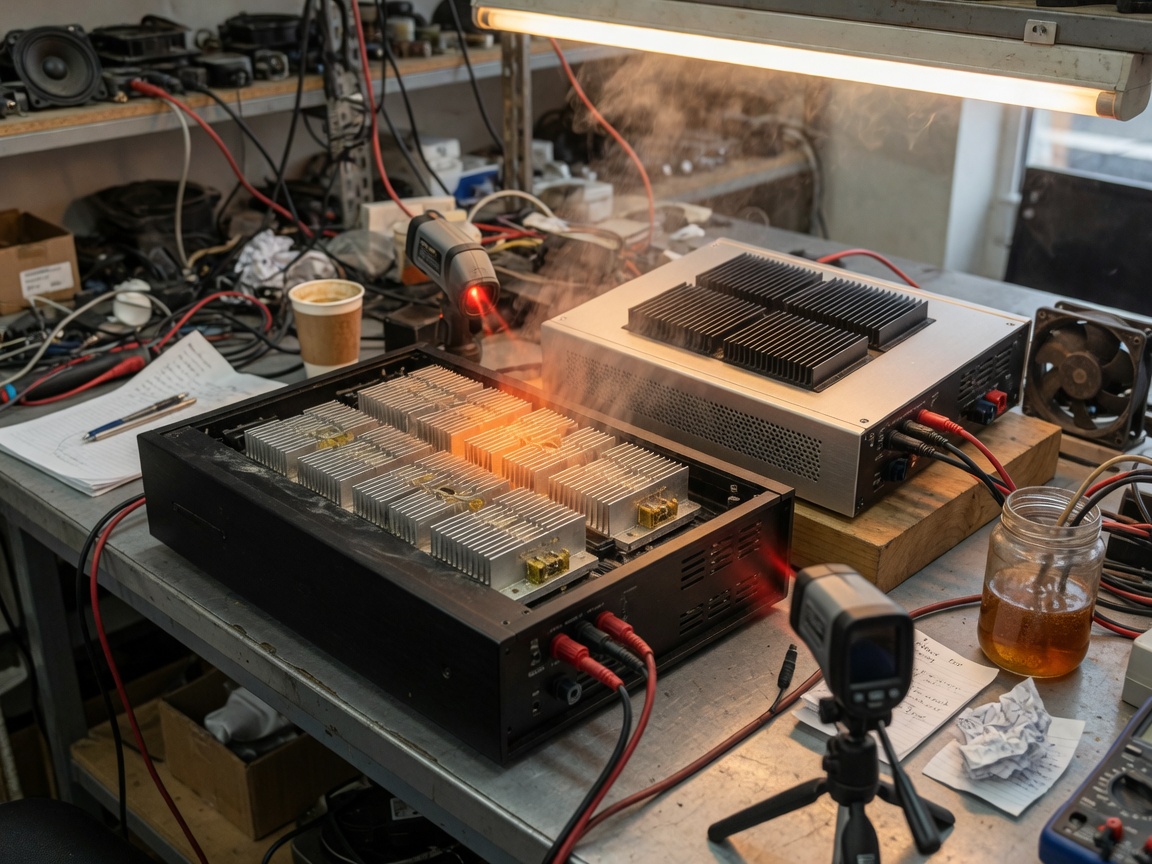
The amplifier class you choose has direct consequences for heat generation, power efficiency, and audio fidelity. Understanding the real-world thermal differences — not just the spec-sheet numbers — separates informed buyers from those who later wonder why their rack gets uncomfortably hot.
Thermal performance under sustained load: real-world data
Actual testing reveals substantial differences between topology classes when pushed to 70% of rated power continuously for 60 minutes — a realistic scenario for a home theater receiver during a long film or a PA system at a corporate event. Class A designs routinely hit heatsink temperatures above 140°F (60°C) even at modest power levels, because the output transistors conduct continuously regardless of signal. Class AB units stabilize around 104–122°F (40–50°C) under the same conditions. Class D amplifiers — which switch transistors on and off at ultrasonic frequencies rather than conducting continuously — typically run between 86–104°F (30–40°C) with well-designed output filtering.
| Amplifier class | Efficiency | Heatsink temp (sustained 70% load) | THD (typical) | Best use case |
|---|---|---|---|---|
| Class A | <25% | 140°F+ (60°C+) | 0.001–0.01% | Audiophile listening rooms |
| Class AB | 50–70% | 104–122°F (40–50°C) | 0.01–0.1% | Home HiFi, stereo amplifier systems |
| Class D | 85–95% | 86–104°F (30–40°C) | 0.003–0.05% | Portable speaker amp, subwoofer amp, car audio |
| Class H/G | 70–80% | 95–115°F (35–46°C) | 0.01–0.05% | Professional PA system, live sound reinforcement |
"Modern Class D amplifier topologies, particularly those using GaN (gallium nitride) switching devices, have reached distortion and noise floors that are genuinely competitive with the best Class AB designs — while running dramatically cooler and drawing a fraction of the power." — amplifier classes explained, Sound On Sound
Dispelling the myth about Class D sound quality
The industry consensus is clear: early Class D designs from the 1990s had measurable issues with high-frequency noise and output filter coloration. That era is over. Platforms like the Texas Instruments TPA3255 regularly achieve SNR above 112 dB and THD+N below 0.003% — figures that rival or surpass many premium Class AB integrated amplifiers. For woofer amplifier and subwoofer amp applications where thermal management in enclosed cabinets is a real engineering constraint, Class D is no longer a compromise. It is often the technically superior choice. To understand the underlying physics, the audio amplifier basics article on Wikipedia provides a solid conceptual foundation.
Impedance matching: the most overlooked factor in speaker pairing
Impedance mismatch is the single most common cause of distortion, overheating, and premature amplifier failure — yet it receives almost no attention in mainstream buying guides. Getting this right is non-negotiable.
How to calculate impedance compatibility
Most consumer home theater receivers and stereo amplifiers are rated for 8Ω loads, with 4Ω compatibility noted as an option. Connecting a 4Ω speaker to an amplifier only rated for 8Ω doubles the current draw — which can trigger protection circuits or, in poorly designed units, damage output transistors. Use this simple matching framework:
- Identify your speaker's nominal impedance (printed on the cabinet or in the manual — commonly 4Ω, 6Ω, or 8Ω).
- Check the amplifier's rated minimum load impedance. It must be equal to or lower than your speaker's rating.
- If wiring multiple speakers in parallel, calculate the combined load: two 8Ω speakers in parallel = 4Ω total load.
- For series wiring, add impedances: two 8Ω speakers in series = 16Ω — confirm the amplifier can drive higher-impedance loads without excessive output voltage clipping.
- Verify the amplifier's power output at the actual impedance you plan to use, not just the 8Ω spec. Power typically increases when load impedance drops (e.g., a 100W/8Ω amp may deliver 160W into 4Ω).
- Allow a 20% headroom buffer — do not run the amplifier at its absolute maximum rated load continuously.
For the PA system installer or the home theater builder running multiple passive speakers from one amplified speaker system, understanding parallel and series configurations prevents expensive mistakes. The PPJ-1514 15" 2-way PA speaker box used as a reference in professional installs, for instance, carries a nominal 8Ω impedance — pairing it with a 4Ω-rated amplifier at 180W RMS gives comfortable headroom without stressing the output stage.
Why bridging changes the impedance equation
Bridging a stereo amplifier — combining both channels to drive a single speaker — doubles the voltage swing and can quadruple power output. However, it also halves the effective load impedance seen by each channel. An 8Ω speaker in bridged mono configuration presents a 4Ω load per channel. If the amplifier is not rated for bridged operation into 4Ω, you are operating outside safe parameters. Always confirm the bridged minimum impedance specification before wiring.
Bi-amping and tri-amping for home theater systems
Bi-amping and tri-amping are techniques that assign separate amplifier channels to different frequency bands within the same speaker system — and they represent one of the most underutilized performance upgrades available to home theater enthusiasts. Almost no mainstream guides cover this in practical depth, which is a significant gap for anyone building a serious surround system.
Passive bi-amping vs. active bi-amping
Passive bi-amping uses the speaker's existing crossover network but feeds the low-frequency (woofer) and high-frequency (tweeter) binding post pairs from separate amplifier channels. The benefit is modest — reduced intermodulation distortion between drivers — but it does not eliminate the energy losses of the passive crossover itself. Active bi-amping, by contrast, bypasses the passive crossover entirely. An active electronic crossover (or the DSP built into many modern home theater receivers) divides the signal before amplification, so each amplifier channel drives its specific driver range directly. This approach yields measurably tighter bass, better dynamic range, and lower distortion at high levels. It demands a speaker designed for bi-amp operation with jumpers between terminal pairs that can be removed.
Tri-amping: when three channels per speaker make sense
Tri-amping adds a third channel dedicated to a midrange driver. In a 3-way loudspeaker system — woofer, midrange, tweeter — this means each driver receives a perfectly matched, independently powered signal. For a 5.1 or 7.1 home theater setup, tri-amping the main left and right speakers while using a dedicated subwoofer amp for the LFE channel produces a dramatic improvement in overall system coherence. The practical requirement: a processor or DSP with at least three independent output bands per channel, and an amplifier with sufficient channels (or multiple units). A multi-channel Class D platform is typically the thermal and space-efficient solution here, given the channel count involved. For verified measurement data on specific amplifiers used in these configurations, independent forums like speaker amplifier measurements at Audio Science Review provide a rigorous technical reference.
Outdoor and weatherproof speaker amplifier setups
Outdoor audio is one of the fastest-growing segments of the US consumer market in 2026, and it places demands on a speaker amplifier that indoor installations simply never encounter. Temperature swings, humidity, UV exposure, and dust ingress can destroy a standard indoor unit within a single season. Why do so many buyers learn this the hard way?
Environmental ratings and what they mean
For outdoor amplifier enclosures, the IP (Ingress Protection) rating system is your primary reference. An IP65-rated enclosure resists dust ingress completely and withstands low-pressure water jets — appropriate for a covered patio or pool area. IP67 and above provides submersion resistance, relevant for installations near water features or in climates with heavy rain. Beyond IP rating, look for operating temperature ranges that accommodate both summer highs above 100°F common in southern US states and winter lows below freezing in northern climates. Aluminum chassis units handle thermal cycling far better than plastic housings.
Powered speaker vs. separate amp for outdoor use
A powered speaker — also called an amplified speaker system with internal electronics — reduces cabling complexity outdoors but concentrates all failure points in one enclosure. For permanent installations like outdoor entertainment areas or commercial patio systems, a separate weatherproofed loudspeaker power amp located in a protected equipment bay driving passive weatherproof speakers gives better long-term reliability. The amplifier stays sheltered; only the speaker cabinets face the elements. Voltage: if running long cable runs to outdoor speakers — over 50 feet — consider a 70V or 100V distributed audio system, which dramatically reduces signal loss over distance and is the standard approach in commercial public address system deployments across the US.
Troubleshooting your speaker amplifier: clipping, hum, and more
Even a well-chosen speaker amplifier can develop problems after installation. The following issues represent the most common complaints from DIY users — and the diagnostic steps that actually resolve them.
Diagnosing and fixing clipping distortion
Clipping occurs when the amplifier is driven beyond its linear operating range, causing the top of the waveform to be "cut off" and replaced with harsh, square-wave-like distortion. It is the most common cause of driver damage in consumer audio systems. Symptoms: harsh, grating distortion that appears at higher volumes, sometimes accompanied by a noticeable reduction in bass. Resolution steps: (1) Reduce source gain before the amplifier input rather than relying solely on the amplifier volume control. (2) Check whether the gain structure between your preamp, receiver, and power amp stage is aligned — mismatched gain staging is a leading hidden cause of early clipping. (3) If clipping persists at moderate volumes, your amplifier is likely underpowered for the application. Add headroom by upgrading to a higher continuous RMS output unit.
Eliminating hum and ground loop noise
A persistent 60 Hz hum from your loudspeakers is almost always a ground loop — a difference in electrical potential between two grounded components creating a current path through the audio signal cable shield. Diagnostic approach: disconnect all inputs from the amplifier one at a time while listening for hum reduction. When hum disappears after removing a specific cable, that connection is the loop source. Solutions include: using a ground loop isolator (a small transformer-based device inserted in the signal chain), ensuring all components share a single power strip ground point, or using balanced XLR connections instead of unbalanced RCA where available. For installations combining a PA system with building power running lights or HVAC equipment, consider a dedicated audio circuit to eliminate shared-neutral interference. Of course, there are cases where hum originates from a faulty component internally — if isolation steps fail, suspect a failing power supply capacitor in the amplifier itself.
How to choose the right speaker amplifier: a buying framework
After covering the technical landscape, a structured decision process is what separates a good purchase from an expensive mistake. The following framework applies whether you are selecting an integrated amplifier for a listening room, a multi-channel home theater receiver, or a portable speaker amp for mobile events.
Step-by-step selection process
- Define the application: home HiFi, home theater, live sound reinforcement, outdoor installation, or portable use. Each context has different power, topology, and connectivity requirements.
- Match impedance first: identify your speaker's nominal ohm rating and confirm the amplifier supports it at rated power. Do not skip this step.
- Calculate required power: use speaker sensitivity (dB/1W/1m) and desired maximum SPL to estimate the watts you actually need — not the highest number on the box.
- Select the appropriate amplifier class: Class A for purist listening rooms with adequate ventilation, Class AB for mainstream HiFi, Class D for subwoofer amps, portable units, and space-constrained installs.
- Evaluate connectivity: confirm input types (RCA, XLR, optical, HDMI ARC for home theater receivers), output channel count, and whether you plan to bi-amp or bridge.
- Check thermal and environmental requirements: for outdoor, vehicle, or rack-mounted installs, verify operating temperature range, chassis material, and IP rating if applicable.
- Verify independent measurements: do not rely on manufacturer specs alone. Check SNR, THD+N, and crosstalk from third-party review sources before purchase.
2026 trends shaping the speaker amplifier landscape
The 2026 market is being reshaped by two converging forces. First, DSP integration: modern integrated amplifiers and home theater receivers increasingly embed full digital signal processing, supporting room correction, AI-driven equalization, and adaptive bass management without external processors. Second, GaN (gallium nitride) power devices are displacing silicon MOSFETs in premium Class D designs, delivering higher switching frequencies, lower switching losses, and smaller passive filter components. The result is a new generation of compact, cool-running, high-fidelity speaker amplifiers that would have been technically impossible five years ago. Just as a jet engine replaced the piston engine for performance-critical aviation — delivering more thrust from a smaller, lighter package — GaN is doing the same for audio power amplification. For the US consumer market, this means genuinely audiophile-grade sound reinforcement is increasingly available at mid-market price points, breaking down barriers that once separated budget buyers from high-performance sound.
Frequently asked questions
Q: What is the difference between a powered speaker and a separate speaker amplifier?
A: A powered speaker integrates the amplifier circuit inside the speaker cabinet, requiring only a power outlet and audio source. A separate speaker amplifier is a standalone unit that drives passive (unpowered) speaker cabinets. Separate setups generally offer more flexibility for upgrades and impedance matching, while powered speakers simplify installation and reduce cabling.
Q: How many watts do I actually need in a speaker amplifier for home use?
A: For a typical US living room (roughly 200–350 sq ft), 50–100W RMS into 8Ω is sufficient for most listening levels with average-sensitivity speakers. Higher-sensitivity speakers (95 dB+) can deliver satisfying volume from as little as 20–30W. Prioritize THD and SNR specifications over raw wattage for sound quality.
Q: Can I use any speaker amplifier with any speaker?
A: No. The amplifier's minimum rated load impedance must match or be lower than the speaker's nominal impedance. Connecting a 4Ω speaker to an 8Ω-only amplifier risks overheating and damage. Always verify both impedance compatibility and that the amplifier's RMS power output matches the speaker's continuous power handling capacity.
Q: Is a Class D amplifier good enough for high-fidelity audio in 2026?
A: Yes — modern Class D amplifiers using advanced GaN switching devices routinely achieve THD+N below 0.003% and SNR above 112 dB, matching or exceeding many Class AB designs. The primary advantages are high efficiency (85–95%), compact size, and cool operation, making them ideal for subwoofer amps, portable speaker amps, and multi-channel home theater receivers.
Q: What causes a humming noise from my speaker amplifier and how do I fix it?
A: A 60 Hz hum almost always indicates a ground loop — a circulating current between grounded components sharing the audio signal cable shield. Fix it by connecting all components to the same power strip ground, inserting a ground loop isolator on the offending input, or switching to balanced XLR connections. If hum persists with all inputs disconnected, suspect a failing internal power supply capacitor.
Selecting the right speaker amplifier in 2026 means moving beyond the wattage arms race and engaging with the specifications that genuinely determine system performance — impedance matching, thermal behavior under sustained load, topology selection, and application-specific requirements from indoor HiFi to weatherproofed outdoor audio. The landscape has shifted dramatically: Class D designs are no longer a compromise, GaN is redefining what compact amplification can achieve, and bi-amping is accessible to home theater enthusiasts without boutique budgets. Apply the framework in this guide, verify independent measurements before purchasing, and your amplified speaker system will deliver performance that lasts for years.
Related News
M.T.




Copyright © 2022 Ningbo ASM Electronics Technology Co.,LTD. All rights reserved. Powered by www.300.cn TAG Business License
