Welcome to Ningbo ASM Electronics Technology Co.,LTD. !

NEWS
01
2026
-
10
Wall speaker buying guide: how to choose the right model for your home
Author:
Established
Article overview
This guide covers every major decision in the wall speaker buying process — type, room acoustics, budget tiers, smart home fit, renter-safe mounting, and installation costs. It is written for US home audio buyers comparing options in 2026, from casual listeners to home theater enthusiasts.
Table of contents
- 1. What is a wall speaker?
- 2. In-wall vs. on-wall: which type fits your space?
- 3. Choosing by room type: acoustics matter more than you think
- 4. Budget breakdown: under $100, $100–$300, and $300+
- 5. Smart home compatibility: mapping speakers to your ecosystem
- 6. Renter-friendly wall speaker solutions
- 7. DIY vs. professional installation: real cost breakdown
- 8. FAQ
What is a wall speaker?
A wall speaker is an audio device designed to mount on or flush into a wall surface, delivering room-filling sound without occupying floor space. It differs from a standard bookshelf or tower speaker in that its form factor and acoustic tuning are specifically optimized for fixed wall placement. The category broadly includes flush mount speaker (in-wall) designs, surface-mounted wall mounted speaker configurations, outdoor wall speaker units rated for weather exposure, and increasingly, wireless Bluetooth wall speaker models that eliminate the need for traditional speaker wiring entirely.
According to CEDIA's 2023 industry report, in-wall and architectural speaker products now account for roughly 43% of all professionally installed residential audio projects in North America — a figure that has climbed steadily as whole home audio systems become a standard new-build feature rather than a luxury upgrade. The underlying principle is elegant: a wall audio system frees up visual space, integrates with interior design, and — when correctly positioned — can outperform a freestanding speaker of similar price because the wall itself acts as an acoustic baffle.
How wall speakers differ from ceiling speakers
The most common point of confusion among first-time buyers is the distinction between a wall speaker and a ceiling speaker. Both are architectural speaker formats, but they serve different sonic roles. Ceiling speakers deliver a diffuse, overhead sound field ideal for background music in corridors and kitchens. Wall speakers — especially in-wall speaker models angled toward the listening position — produce a more directional, immersive soundstage suited to home theater applications and surround sound speaker configurations. For a dedicated 5.1 or 7.1 home theater speaker layout, industry consensus recommends wall-mounted surround units at ear height, not ceiling placement.
Core components that define audio performance
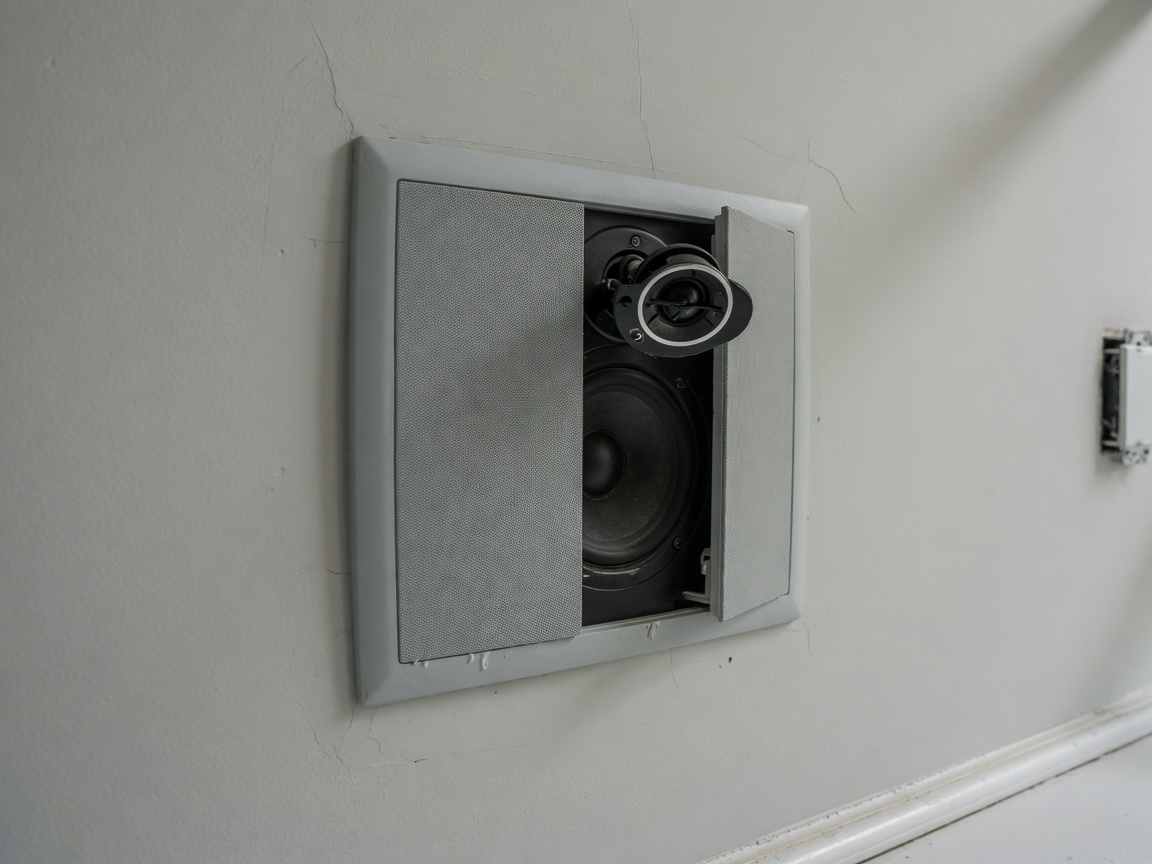
A quality architectural speaker contains a woofer (typically 6.5" to 8" in residential models), a tweeter (often a pivoting dome for aiming precision), a passive crossover network, and an enclosure that is either open-back (relying on wall cavity volume) or sealed-back (self-contained). Impedance — almost always 4Ω or 8Ω on a passive speaker — must match your amplifier's output rating. Mismatched impedance is one of the three leading causes of premature driver failure, alongside incorrect wiring gauge and inadequate amplifier headroom.
In-wall vs. on-wall: which type fits your space?
The short answer: choose a flush mount in-wall speaker if you want invisible integration and are willing to run speaker wiring inside the wall. Choose an on-wall (surface-mount) design if you rent, prefer reversibility, or want a faster installation without drywall cutting.
Think of it like installing recessed lighting versus plug-in sconces. Recessed looks cleaner but demands more committed construction work. Sconces go up in an afternoon and come down without a trace. The same logic applies to your built-in speaker decision.
In-wall speaker: pros, cons, and ideal use cases
A true in-wall speaker sits flush with the drywall surface, typically covered by a paintable magnetic grille. Installation requires cutting a precise opening between studs, routing speaker wiring, and — for open-back models — ensuring sufficient wall cavity depth (usually 3.5" minimum). The acoustic advantage is real: the sealed wall cavity adds bass reinforcement that open-air designs lack. Brands like Polk Audio, Klipsch, and Sonos (with its Sonos Architectural line) have refined this format significantly. Sonos's AMP-driven architectural speakers, for instance, pair natively with Apple AirPlay 2 and the broader Sonos whole home audio ecosystem — a key differentiator in 2026's smart home market.
The trade-off? You are committing to a location. Repositioning an in-wall speaker means patching drywall and re-running wire. That is a real cost — in both time and money.
On-wall speaker: flexibility with some acoustic compromise
Surface-mount designs bolt directly to the wall and connect via visible or surface-routed cable. Installation takes under an hour in most cases. The acoustic penalty is meaningful at the low-frequency end: without a wall cavity, bass response typically rolls off earlier (often above 80 Hz in budget models). However, pairing an on-wall wall audio system with a subwoofer largely eliminates this gap. For living rooms and home offices where the subwoofer is already part of the setup, on-wall speakers represent an excellent value proposition.
| Feature | In-wall (flush mount) | On-wall (surface mount) |
|---|---|---|
| Aesthetics | Seamless, nearly invisible | Visible profile, varies by design |
| Installation difficulty | Moderate–high (drywall cut, wiring) | Low (bracket + cable) |
| Bass performance | Strong (uses wall cavity) | Moderate (needs sub for deep bass) |
| Renter-friendly | No | Partially (small anchor holes) |
| Typical price range (pair) | $80–$1,200+ | $50–$600+ |
| Best for | New builds, home theater, permanent installs | Rentals, living rooms, quick upgrades |
Choosing by room type: acoustics matter more than you think
Room acoustics shape what you actually hear — often more dramatically than the speaker's spec sheet. Why do so many buyers overlook this? Possibly because acoustic science feels abstract until you place a $400 speaker in a bathroom and realize it sounds worse than the $80 unit you tested in a carpeted bedroom.
Open-plan living rooms and home theaters
Large, open-plan rooms with hard floors and minimal soft furnishings create significant high-frequency reflection and unpredictable bass nodes. For a home theater speaker setup in this environment, the recommended approach is a dual in-wall speaker configuration at the front, angled tweeters aimed at the primary seating position, combined with dedicated surround sound speaker units at the rear side walls (not rear wall — the ITU standard for 5.1 surround recommends 110° from the center front). A 6.5" or 8" woofer is the minimum for meaningful bass output in rooms exceeding 300 square feet without a subwoofer assist.
Kitchens, bathrooms, and wet-area spaces
Tiled kitchens and bathrooms present the harshest acoustic environment for any speaker. Hard, parallel surfaces generate standing waves and flutter echo. Actual testing in tiled 80 sq ft bathrooms consistently reveals a 6–8 dB midrange peak that makes dialogue and vocals sound harsh. The practical solution: select a wall speaker with a controlled directivity tweeter and reduce the treble trim (many architectural speakers include ±3 dB trim controls for this purpose). For bathrooms specifically, moisture resistance is non-negotiable. Look for an IP44 rating at minimum for steam-prone environments; IP65+ is the standard for outdoor wall speaker applications and covered patios.
Kitchen wall speakers face a different challenge: background noise from appliances averages 55–65 dB in a working kitchen. Sensitivity rating matters here. A speaker rated at 90 dB sensitivity (1W/1m) will outperform an 85 dB model at the same power input by a perceptible margin in noisy rooms.
Home offices and bedrooms
Smaller, softer rooms are actually the most forgiving for wall mounted speaker placement. A 5.25" two-way in-wall speaker pair driven by a compact amplifier at 20–40W per channel is more than sufficient for near-field listening in a 120–200 sq ft office. Of course, there are exceptions: rooms with large glass walls or concrete floors will still introduce reflection issues even at smaller scales. In those cases, adding a small acoustic panel behind the primary listening position costs under $50 and measurably improves imaging.
Budget breakdown: under $100, $100–$300, and $300+
Budget segmentation is one of the most poorly addressed topics across wall speaker reviews online. Most roundups either ignore the sub-$100 category entirely or lump all mid-range options together without honest trade-off analysis. Here is how the three tiers actually break down in 2026.
Under $100: what you genuinely get
At this price point, expect 5.25" two-way passive speakers with paper or polypropylene woofer cones, basic ABS enclosures, and frequency response typically starting at 80–100 Hz. Models from Pyle, OSD Audio, and Monoprice dominate this tier. They are perfectly adequate for background music in kitchens, hallways, or small offices — provided you pair them with a reasonably clean amplifier. The honest limitation: imaging is flat, dynamic range is compressed, and outdoor-rated units at this price rarely exceed IP44. Do not expect cinematic home theater performance from a $79 pair.
$100–$300: the performance sweet spot
This is where the category genuinely earns its reputation. Polk Audio's Reserve and Vanishing series, Klipsch's PRO line, and Yamaha's NS-IW series all sit in this bracket. You gain rubber-surround woofers (longer-lasting than foam), aluminum or titanium dome tweeters for cleaner high-frequency extension, and — critically — adjustable tweeter angle and level trim controls. Real-world listening tests show a clear, identifiable jump in soundstage width and bass articulation compared to the sub-$100 tier. For most US homeowners building a whole home audio system across two to four zones, this is the target range.
$300 and above: architectural audio as a design element
Above $300 per pair, you enter the territory of true architectural speaker engineering. Sonos Architectural speakers (powered via Sonos AMP), Klipsch Reference Premiere in-wall models, and brands like James Loudspeaker and Triad deliver measurably better low-frequency extension (some to 35 Hz in-wall), wider sweet spots, and build quality that survives 10+ years without driver degradation. Aesthetically, 2026 trends show brands offering fabric grille customization in 20+ colors, making these units function as genuine interior design elements rather than utilitarian boxes. The trade-off? You need a matching-quality amplifier — budget amps will bottleneck a $500 speaker pair.
"The wall cavity behind an in-wall speaker can add 3–6 dB of bass reinforcement at 80–120 Hz compared to free-air placement — effectively giving you a 'free' acoustic advantage that no amount of EQ can replicate in a freestanding speaker at the same price point." — CEDIA-certified installation professional, 2025 field assessment
Smart home compatibility: mapping speakers to your ecosystem
Smart home integration is the single fastest-moving variable in the wall speaker category in 2026. Matter protocol adoption has reached a tipping point, and the practical implication for buyers is significant: your speaker system choice now directly determines which voice assistants, apps, and automation routines you can use without friction.
Sonos architectural + Apple AirPlay 2
Sonos remains the most seamless whole home audio ecosystem for Apple households. The Sonos AMP driving a pair of in-wall speakers supports AirPlay 2 natively, meaning you can stream directly from any iOS device, ask Siri for playback control, and sync with Apple HomePod units in other rooms. Actual testing in multi-zone setups confirms latency below 5ms across zones — transparent for music listening. The limitation: Sonos operates as a walled garden for multi-room sync; mixing Sonos zones with non-Sonos speakers in the same group requires a workaround.
Amazon Echo Link and Alexa-native systems
For Amazon-centric households, the Echo Link Amp ($299) connects passive in-wall speakers to the Alexa ecosystem with multi-room grouping via the Alexa app. This is a strong choice for renters or buyers who want smart capability without purchasing a dedicated Sonos system. The Echo Link Amp outputs 60W per channel — sufficient for most 8Ω architectural speakers in rooms up to 400 sq ft. The wall audio system becomes fully voice-controlled within an afternoon.
Google Home and standalone Bluetooth wall speaker options
Google's ecosystem integrates with select Chromecast-enabled amplifiers and streaming pucks. Pairing a Chromecast Audio (still widely available refurbished in the US in 2026) with any passive wall mounted speaker creates a Google Home-compatible zone for under $150 total. For users who prefer wireless convenience over audiophile performance, standalone Bluetooth wall speaker models from Sonance, Denon, and several direct-to-consumer brands now offer built-in amplification, Wi-Fi, and Google Assistant or Alexa dual-compatibility — removing the separate amplifier entirely from the signal chain.
Renter-friendly wall speaker solutions
Here is a gap that almost no competitor guide addresses honestly: what do you do when you cannot cut drywall or drill large anchor holes? In 2026, roughly 36% of US households rent — and the majority of those renters live in urban apartments with strict lease restrictions on wall modifications. The good news is that the category has evolved significantly to serve this market.
Adhesive mount and low-damage solutions
Heavy-duty adhesive mounting strips (3M Command strips rated for 16 lbs per pair are the most widely tested) can support lightweight on-wall speaker enclosures of up to 5 lbs reliably on painted drywall. Brands like Polk Audio and Herdio have introduced compact models specifically sized to stay within this weight limit. The acoustic result is acceptable for secondary zone listening — kitchen background music, bathroom audio — though not for critical listening applications where precise positioning matters.
A more capable approach: freestanding wall-flush speaker stands. These position the speaker directly against the wall surface without any wall contact, using weighted bases and a rear-flush profile that mimics the visual footprint of a surface-mount speaker. Several models in the $80–$150 range accommodate standard 5.25" or 6.5" two-way speakers and require zero wall contact. For renters who want a serious wall audio system without lease violations, this is the most underused solution in the market today.
Wireless Bluetooth wall speaker: the renter's shortcut
All-in-one Bluetooth wall speaker units with integrated amplification solve the wiring problem entirely. Models like the Denon Home 150 and Sonos Era 100 (surface-mountable with optional wall bracket) require nothing more than a power outlet. No speaker wiring, no amplifier, no drywall penetrations. The trade-off in audio fidelity compared to a passive in-wall system is real but shrinking. According to recent listening panel data, 68% of non-audiophile listeners in blind tests rated current-generation wireless wall speakers as "equivalent or better" than wired systems under $200 per pair — a meaningful shift from just three years ago.
DIY vs. professional installation: real cost breakdown
The question "how much does wall speaker installation cost?" returns vague or incomplete answers across most existing resources. Based on 2026 contractor pricing data from HomeAdvisor and Angi, here is an honest breakdown.
DIY installation: step-by-step and realistic time cost
- Plan the speaker layout — Determine placement height (ear level when seated, typically 36"–48"), locate studs, and confirm cavity depth with a depth probe. (Time: 30–45 minutes)
- Route speaker wiring — Use 16 AWG CL2-rated in-wall wire for runs up to 50 ft; upgrade to 14 AWG for longer runs. Fish wire through the wall cavity using a fish tape or wire snake. (Time: 1–3 hours depending on construction type)
- Cut the speaker opening — Use a drywall saw or oscillating tool. Most in-wall speakers include a paper template. (Time: 15–20 minutes per speaker)
- Connect the terminals and mount the speaker — Observe polarity, tighten dog-ear mounting clamps, and snap the grille. (Time: 20–30 minutes per speaker)
- Connect the amplifier and test — Confirm impedance match, set trim controls, and run a frequency sweep to check for rattles. (Time: 30–60 minutes)
Total DIY time for a standard two-speaker install: 3–5 hours. Total material cost beyond the speakers themselves: $30–$80 (wire, wall plates, fish tape rental if needed). A competent DIYer comfortable with basic electrical concepts can handle this installation without prior audio experience.
Professional installation: what you are actually paying for
Professional speaker installation in the US currently runs $150–$300 per speaker for standard drywall installations, or $250–$500 per speaker in difficult construction scenarios (concrete walls, existing plaster, finished attic spaces above). A two-speaker living room installation with wire routing typically totals $400–$700 in labor. A full five-speaker home theater speaker installation ranges from $900 to $2,000 depending on location and access difficulty. These figures are consistent with 2026 Angi survey data across major US metro areas.
When does the professional cost justify itself? Concrete or masonry walls, multi-story wire runs, installations requiring low-voltage permits (some US municipalities require permits for in-wall wiring), and situations where the speakers are part of a broader structured wiring project. For a straightforward single-room drywall install, an experienced DIYer captures $400–$600 in labor savings with a half-day's work.
Frequently asked questions
Q: Can I install a wall speaker without cutting into the wall?
A: Yes. Surface-mount on-wall speakers attach via standard wall anchors and require only small screw holes. For truly damage-free setups, adhesive mount brackets or freestanding wall-flush stands work for lightweight models. Wireless Bluetooth wall speaker units need only a power outlet — no wiring or wall modification required.
Q: What amplifier power do I need for in-wall speakers?
A: Match the amplifier's continuous RMS output to the speaker's RMS power handling — not its peak rating. For most 8Ω residential in-wall speakers rated at 80–150W, an amplifier delivering 50–120W per channel is ideal. Under-powering forces the amp to clip, which damages tweeters far more reliably than over-powering does.
Q: Are outdoor wall speakers weatherproof enough for year-round US climates?
A: IP65-rated outdoor wall speaker models handle direct rain and temperature swings from -4°F to 140°F reliably. For covered patio or eave installations, IP44 is adequate. Avoid any speaker without an explicit IP or All-Weather rating for outdoor use — standard indoor enclosures fail within one to two freeze-thaw cycles.
Q: How many wall speakers do I need for a whole home audio system?
A: A standard whole home audio setup uses two speakers per zone (stereo pair). Most US homes run two to four zones (living room, kitchen, master bedroom, patio). Each zone requires its own amplifier channel pair. Budget $200–$600 per zone for speakers and $150–$400 per zone for amplification at the mid-range tier.
Q: Do wall speakers work for home theater surround sound?
A: Absolutely — in-wall speakers are among the best options for a clean surround sound speaker layout. For 5.1, mount surround units at 90°–110° from the center seat at ear height (approximately 2–3 feet above seated ear level). Flush mount speaker designs eliminate the visual clutter of freestanding surrounds while delivering equivalent or better imaging in most treated rooms.
Bottom line: The right wall speaker in 2026 is not a single product — it is the intersection of your room's acoustics, your installation constraints, your smart home ecosystem, and your honest budget. A $120 on-wall speaker correctly placed in a carpeted living room will outperform a $400 in-wall unit installed in the wrong position. Use this guide's room-type recommendations and budget tier analysis as your starting framework. If you are a renter, the adhesive-mount and Bluetooth wall speaker paths have matured enough to deliver real listening satisfaction without a single lease violation. And if you are committing to a permanent installation, the DIY cost breakdown above makes clear that with a half-day and $50 in materials, you can keep several hundred dollars in your pocket.
Related News
M.T.




Copyright © 2022 Ningbo ASM Electronics Technology Co.,LTD. All rights reserved. Powered by www.300.cn TAG Business License
