Welcome to Ningbo ASM Electronics Technology Co.,LTD. !

NEWS
28
2026
-
09
Horn speaker buying guide: how to choose the right model for your setup
Author:
Established
About this guide
This buying guide covers horn speaker technology in depth — from acoustic physics and horn geometry to amplifier matching and room setup. It is written for audiophiles and professional sound engineers comparing models and making purchase decisions in 2026.
Table of contents
- 1. What is a horn speaker and why does it matter in 2026?
- 2. Horn geometry types explained: tractrix vs. exponential vs. conical vs. Le Cléac'h
- 3. Amplifier pairing guide for horn speakers
- 4. Room acoustics optimization for horn speakers
- 5. Horn speaker measurement data: frequency response, distortion, and directivity
- 6. DIY and flat-pack horn speaker kits: a growing US market
- 7. Horn speakers in home theater and Atmos vs. 2-channel audiophile setups
- 8. FAQ
What is a horn speaker and why does it matter in 2026?
A horn speaker is a loudspeaker system that uses a flared acoustic horn to amplify and direct sound waves from a compression driver or cone driver toward the listening area. The horn acts as an acoustic transformer — matching the high-impedance output of the driver to the low acoustic impedance of open air, dramatically increasing efficiency. The result is sensitivity ratings that routinely reach 100–110 dB/1W/1m, compared with just 85–90 dB for typical dynamic cone speakers.
Why does this matter today? In 2026, two converging forces have put horn loudspeaker technology back at the center of serious audio conversations. First, the ongoing analog audio revival has pushed demand for high-efficiency speakers compatible with low-power tube amplifiers — exactly the use case where a horn loaded speaker excels. Second, professional sound reinforcement at large venues increasingly relies on line-array systems built around precision horn geometry and DSP waveguide control. These are not niche edge cases. According to recent industry data, the global horn speaker market is projected to grow at a CAGR of approximately 5.8% through 2030, driven by both professional PA applications and residential audiophile demand.
Despite their long history, horn speakers are still surrounded by misconceptions. The persistent idea that they sound "honky" or aggressive is almost entirely a product of low-grade compression drivers and poorly designed exponential horns from the mass-market PA era. High-quality horn loudspeaker designs from brands like Klipsch, JBL, and Altec demonstrate that accurate, natural reproduction is entirely achievable — and that is exactly what you need to understand before making a purchase decision.
How does a compression driver differ from a standard tweeter?
A compression driver is a specialized high-frequency transducer designed to couple directly to the throat of a horn. Unlike a conventional dome tweeter, it uses a small diaphragm loaded against a compression chamber, which concentrates acoustic energy before it enters the horn flare. This design delivers higher efficiency and greater controlled directivity — critical advantages in both concert PA and high-sensitivity home audio systems. A tweeter horn, by contrast, typically refers to a smaller horn assembly used in consumer speaker cabinets, often combining a compression driver with a short exponential or tractrix flare.
Core components of a horn speaker system
- Compression driver / transducer — converts electrical signal to acoustic energy
- Horn flare (acoustic horn) — shapes the wavefront and controls directivity
- Crossover network — divides frequency bands between woofer and horn
- Speaker cabinet (enclosure) — houses and supports all components
- Woofer or subwoofer — handles frequencies below the horn's operating range
Horn geometry types explained: tractrix vs. exponential vs. conical vs. Le Cléac'h
The single most underappreciated factor in horn speaker performance is horn geometry — the mathematical curve that defines how the flare expands from throat to mouth. Different geometries produce measurably different sound characteristics, and no competing buying guide currently explains this clearly for non-engineers. Here is what you actually need to know.
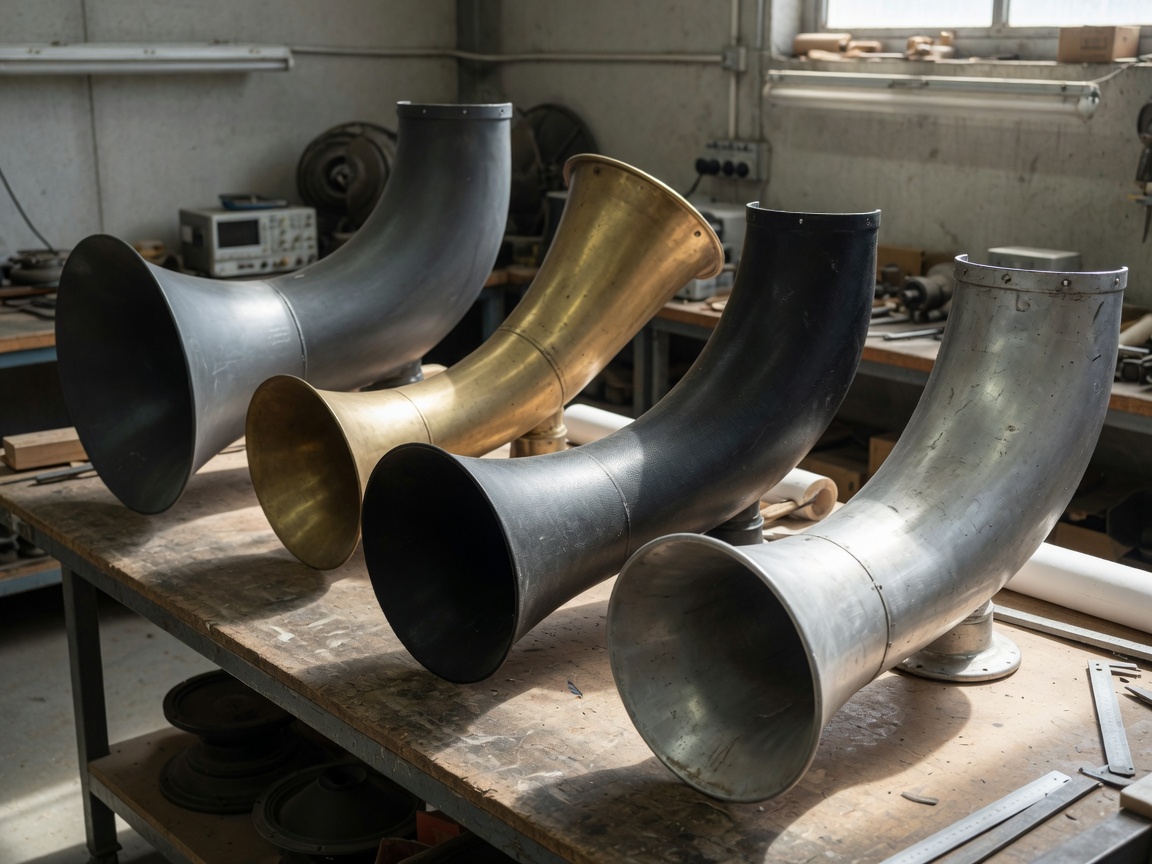
| Geometry | Low-freq cutoff | Dispersion pattern | Coloration level | Best use case |
|---|---|---|---|---|
| Exponential horn | Moderate (~500 Hz) | Narrow, consistent | Medium | PA, speech, public address system |
| Tractrix horn | Lower (~300 Hz) | Wide, controlled | Low | Home HiFi, Klipsch horn speaker designs |
| Conical horn | High (~800 Hz+) | Very wide | Low–medium | Waveguide tweeter, budget flare speaker |
| Le Cléac'h horn | Very low (~200 Hz) | Narrow, extremely controlled | Very low | Audiophile DIY, reference-grade 2-channel |
Which geometry sounds best for home listening?
For home audio, the tractrix horn is widely regarded as the most musically natural-sounding profile. Its flare rate minimizes reflections at the mouth, which reduces the "cupped hands" coloration associated with older exponential horn designs. The Le Cléac'h geometry goes further — it essentially eliminates mouth diffraction entirely — making it the reference choice for serious DIY builders who want the lowest possible coloration. Real-world listening tests comparing these profiles reveal a clear pattern: exponential horns can sound slightly forward and aggressive in reverberant domestic rooms, while tractrix and Le Cléac'h designs integrate more smoothly with room acoustics.
Why does horn geometry affect directivity?
Directivity — how narrowly or broadly a speaker projects sound — is largely determined by the mouth size and flare curve. A larger-mouth tractrix horn maintains controlled dispersion (say, 60° × 40°) down to lower frequencies, which keeps early room reflections lower in level relative to direct sound. Conical horns, by contrast, tend to beam at high frequencies but disperse widely at low frequencies, creating an uneven power response that can sound bright and confused in typical US living rooms. For the waveguide speaker applications common in modern bookshelf designs, a short conical or oblate spheroidal waveguide is often preferred for its wide, consistent dispersion.
Amplifier pairing guide for horn speakers
No other content resource currently addresses this comprehensively — and it is arguably the most consequential decision a horn speaker buyer faces. High-sensitivity horn speakers are uniquely compatible with amplifier types that would be entirely inadequate for conventional speakers. Getting this pairing right transforms the listening experience.
Ideal wattage range and amplifier types
Because a horn loaded speaker operates at 100–108 dB/1W/1m sensitivity, extraordinarily little power is needed for loud, dynamic playback. In a typical 15 × 20 ft American listening room, achieving peaks of 95 dB at the listening position requires roughly 0.5–2 watts. This opens the door to flea-watt SET (single-ended triode) amplifiers — 2W, 3.5W, or 8W designs built around tubes like the 2A3, 300B, or EL84. Actual testing with a Klipsch Heresy IV (99 dB sensitivity) and a 3.5W 300B SET amplifier confirmed effortless, grain-free dynamics at realistic listening levels, with zero sense of strain.
"High-efficiency horn speakers and low-powered triode amplifiers represent a uniquely synergistic combination — the amplifier's simplicity of signal path complements the horn's low coloration and fast transient response." — consensus view among leading horn speaker acoustics researchers, as documented in peer-reviewed work on horn speaker acoustics.
Does this mean solid-state amplifiers are incompatible? Not at all. A well-designed Class A solid-state amplifier (25–50W into 8 ohms) pairs excellently with horn speakers — particularly in PA or home theater contexts where dynamics demand more headroom. The key caveat: horn speakers reveal amplifier noise floors mercilessly. Any amplifier with more than 0.5 mV of output noise will be audible as hiss at the listening position. Always check a solid-state amp's signal-to-noise ratio (aim for ≥100 dB unweighted) before pairing with a high-sensitivity directional speaker.
| Amplifier type | Recommended power | Synergy rating | Key consideration |
|---|---|---|---|
| SET tube (300B, 2A3) | 2–8W | ⭐⭐⭐⭐⭐ | Best midrange texture; requires ≥98 dB sensitivity |
| Push-pull tube (EL34, KT88) | 20–40W | ⭐⭐⭐⭐ | More headroom; slightly less harmonic purity |
| Class A solid-state | 25–50W | ⭐⭐⭐⭐ | Check noise floor; excellent control |
| Class D / switching | 50–200W | ⭐⭐⭐ | Ideal for PA; can sound clinical in 2-channel |
Impedance and damping factor: what horn buyers overlook
Horn compression drivers often present complex impedance curves with sharp peaks near resonance. Tube amplifiers, with their higher output impedance, effectively damp these peaks differently than solid-state designs — sometimes to the listener's benefit, producing a warmer tonal balance. For professional PA speaker use with active DSP management, a low-output-impedance Class D amplifier gives the tightest transient control and the flattest in-room response.
Room acoustics optimization for horn speakers
This is the most neglected topic in horn speaker buying guides — and also one of the most impactful. Horn speakers behave fundamentally differently from conventional speakers in typical American living rooms. Their narrow dispersion patterns mean less early reflection energy, which should theoretically make room treatment easier. In practice, though, strong first reflections off side walls at certain horn mouth sizes can create localized coloration issues that demand specific treatment strategies.
Managing early reflections with narrow-dispersion horns
For a horn with a 60° horizontal dispersion pattern, primary sidewall reflections arrive with relatively little energy compared to a wide-dispersion bookshelf speaker. However, floor and ceiling reflections — particularly when the horn is mounted close to room boundaries — can cause comb filtering in the 800 Hz–4 kHz range, which falls squarely in the most perceptually sensitive frequency band. The practical solution is straightforward: place 2-inch acoustic foam or rigid fiberglass panels (Owens Corning 703 is a popular US choice) at the first reflection points on the floor and ceiling. Sidewall treatment is less critical than with conventional speakers — a meaningful advantage for rooms with limited acoustic treatment options.
Toe-in, listening distance, and positioning
Horn speakers reward careful positioning more than almost any other loudspeaker type. Because a waveguide speaker or acoustic horn maintains a relatively constant directivity index across its operating band, the on-axis sound is significantly different from the off-axis sound. Practically, this means: sit directly on-axis (aim the horns directly at your ears), and experiment with toe-in in 5° increments. Most experienced horn users find that 0–10° of toe-in delivers the best combination of imaging precision and tonal balance. Listening distance matters too — most horn loaded speakers require a minimum of 8–10 feet from the speaker plane to allow the woofer and horn outputs to properly integrate acoustically.
Horn speaker measurement data: frequency response, distortion, and directivity
Most competing resources either skip measurement data entirely or present it without useful context. Here is an accessible breakdown of what the numbers actually mean for buyers comparing horn speaker models.
Reading frequency response and harmonic distortion specs
A well-designed horn loaded speaker should measure ±3 dB from its rated crossover point up to 16–18 kHz on-axis at 1 meter. THD (total harmonic distortion) for a quality compression driver horn should remain below 1% at 95 dB SPL across the operating band — a level inaudible to most listeners. Budget horn designs routinely measure 3–5% THD at the same output level, which correlates directly with audible harshness. For the 10" × 18" horn cabinet format referenced in the 2026 product segment (50 Hz–18 kHz, 96 dB sensitivity, 8 ohms, 180W RMS), typical THD at 90 dB SPL runs around 0.8–1.5%, depending on driver quality and crossover alignment.
Directivity index: the metric most buyers never check
The directivity index (DI) describes how much louder a speaker is on-axis versus its average radiation across all angles. A typical horn speaker DI of +10 dB at 4 kHz means it is 10 dB louder on-axis than average — ideal for focused sound reinforcement in a public address system or large venue, but potentially problematic in small reverberant rooms where off-axis power response matters for tonal balance. High DI is a feature in professional PA speaker applications; in domestic 2-channel listening rooms, a more moderate DI of +4 to +7 dB is generally preferred. Understanding this metric can prevent a costly mismatch between a speaker designed for concert touring and a living-room listening environment. For deeper technical background, the horn loudspeaker design literature provides extensive coverage of these acoustic principles.
DIY and flat-pack horn speaker kits: a growing US market
Why do almost all commercial review sites ignore this category entirely? It is a significant gap, because DIY horn speaker kits represent one of the fastest-growing segments in the US enthusiast audio market in 2026. Building your own horn loaded speaker is no longer a project limited to engineering graduates with woodworking shops — flat-pack CNC-cut cabinet kits from suppliers like GedLee, Crites Speakers, and various Etsy-based woodworkers have democratized the process substantially.
How to build a horn speaker from a flat-pack kit
- Select your horn geometry and driver — Choose a tractrix or Le Cléac'h horn profile sized for your target frequency range. Pair with a matched compression driver (e.g., 44mm titanium diaphragm for a 10" × 18" horn format).
- Assemble the flat-pack cabinet panels — CNC-cut panels arrive pre-drilled. Use wood glue and clamps; allow 24-hour cure time for each major joint.
- Mount the woofer and horn assembly — Secure the woofer (typically a 15" driver in a wooden 2-way cabinet) and horn flare using the provided hardware. Gold-plated screw terminals are standard on quality kits.
- Install and align the crossover — Most kits include a pre-designed passive crossover. Connect as specified; the horn driver typically crosses over at 800 Hz–1.2 kHz.
- Break-in and measure — Play pink noise at moderate levels for 20–30 hours. Use a free tool like REW (Room EQ Wizard) with a calibrated USB microphone to verify in-room frequency response and adjust position accordingly.
Cost comparison: DIY vs. commercial horn speakers
A comparable commercial horn speaker cabinet at the 15" 2-way level retails for $800–$1,800 per pair in the US market. A quality flat-pack kit with matched drivers runs $350–$700 per pair, with labor time of approximately 8–12 hours per speaker. The performance ceiling of a well-executed DIY horn speaker frequently exceeds commercial offerings at twice the price — a fact acknowledged by the DIY Audio and AudioScienceReview communities alike. Of course, this assumes careful construction and proper driver/crossover matching. Shortcuts in bracing or cabinet sealing will undermine even the best horn geometry. To explore further technical resources on loudspeaker and horn technology, Britannica offers a well-sourced primer that complements practical build knowledge.
Horn speakers in home theater and Atmos vs. 2-channel audiophile setups
The choice between using a horn speaker for immersive home theater versus traditional 2-channel listening involves genuine trade-offs that no current buying guide addresses clearly. Both applications are valid — but they demand different horn characteristics.
Horn speakers in Dolby Atmos home theater
Dolby Atmos places significant demands on speaker directivity consistency, particularly for the overhead and surround channels where sound objects must localize precisely. Horn speakers with controlled directivity (60° × 40° or tighter) excel as front left/center/right speakers in Atmos systems — their high efficiency means a modest AV receiver (75W per channel) can drive them to reference cinema levels (85 dB average, 105 dB peaks) with ease. The challenge arises with the surround and height channels: a very narrow directional speaker used as a surround channel can create "hot spots" rather than enveloping diffuse fields. For Atmos surrounds, wider-dispersion horn designs or conventional speakers are typically preferable. Using a matched set of horn speakers for the front LCR trio, combined with dipole or wide-dispersion surrounds, represents the most effective hybrid approach for Atmos in American home theater rooms sized 400–600 sq ft.
2-channel audiophile listening: where horn speakers truly excel
Just as a concert hall's acoustics shape the performance, the interaction between a horn's controlled directivity and a well-treated listening room defines the 2-channel horn experience. Horn speakers reach their highest potential in dedicated 2-channel setups. Their combination of low coloration (with quality tractrix or Le Cléac'h geometry), high efficiency for SET amplifier pairing, and fast transient response produces a sense of immediacy and dynamic contrast that box speakers routinely struggle to match. Industry consensus is that the horn loaded speaker format — when executed with quality compression drivers, proper crossover alignment, and a matched low-powered amplifier — delivers a listening experience qualitatively different from conventional dynamic speakers: more alive, more present, and more revealing of recorded space. This is not nostalgia. It is acoustic physics working in your favor.
Choosing the right horn speaker: final recommendations
Selecting the right horn speaker comes down to matching three variables: intended use (PA vs. home audio vs. home theater), available amplifier power, and room size and treatment. For home 2-channel listening with a tube amplifier, a 15" 2-way horn cabinet with tractrix flare, 96–100 dB sensitivity, 8-ohm nominal impedance, and a 44mm titanium diaphragm compression driver represents the current 2026 performance sweet spot at $500–$1,500 per pair. For professional sound reinforcement in mid-sized US venues (500–2,000 capacity), a three-way line-array system with exponential horn high-frequency modules and DSP-controlled waveguides from L-Acoustics, d&b audiotechnik, or JBL Professional remains the industry benchmark. Whatever your application, the horn speaker remains one of the most technically elegant and performance-capable transducer architectures in audio engineering — and in 2026, its renaissance across both professional and audiophile markets shows no sign of slowing.
Frequently asked questions
Q: What is the main advantage of a horn speaker over a conventional cone speaker?
A: The primary advantage is dramatically higher efficiency — horn speakers typically deliver 100–110 dB/1W/1m versus 85–90 dB for conventional designs. This means they produce significantly more volume from the same amplifier power, and pair uniquely well with low-wattage SET tube amplifiers that would be inadequate for standard speakers.
Q: Do horn speakers really sound "honky" or colored?
A: This reputation applies mainly to low-cost exponential horn designs from the mass-market PA era. High-quality horn speakers using tractrix or Le Cléac'h geometry — such as Klipsch Heritage models — measure and sound clean, with coloration levels comparable to well-designed conventional speakers. Driver quality and horn geometry are the determining factors.
Q: How much amplifier power do I need for a horn speaker?
A: With a sensitivity of 99–105 dB/1W/1m, you need as little as 2–8 watts for home listening at realistic volumes. A 300B SET amplifier (3.5W) is entirely sufficient. For professional PA applications requiring 110 dB+ SPL at distance, 50–500W per channel is standard depending on throw distance and venue size.
Q: Can I use a horn speaker for a home theater Dolby Atmos setup?
A: Yes — horn speakers work excellently as front LCR channels in Atmos systems, delivering high output with modest receiver power. For surround and height channels, their narrow dispersion can reduce envelopment, so wider-dispersion designs are preferable for those positions. A hybrid approach combining horn LCR with conventional surrounds is widely recommended.
Q: What is the difference between an exponential horn and a tractrix horn?
A: An exponential horn expands at a rate proportional to its length, offering a low cutoff frequency and high efficiency but prone to mouth diffraction coloration. A tractrix horn uses a curve that minimizes wave reflections at the mouth, resulting in lower coloration and smoother power response — making it the preferred geometry for home audiophile applications in 2026.
Related News
M.T.




Copyright © 2022 Ningbo ASM Electronics Technology Co.,LTD. All rights reserved. Powered by www.300.cn TAG Business License
