Welcome to Ningbo ASM Electronics Technology Co.,LTD. !

NEWS
02
2026
-
10
Full range speaker buying guide: how to choose the right one for your setup
Author:
Established
Article overview
This guide provides a technical and practical breakdown of full range speakers for 2026 buyers. It covers driver sizes, enclosure types, Thiele-Small parameters, application-specific recommendations, and a comparison table of leading products. Target audience: audiophiles and DIY builders at the mid-stage of a purchase decision.
Table of contents
- 1. What is a full range speaker?
- 2. Driver size comparison: 3-inch vs 4-inch vs 6.5-inch vs 8-inch
- 3. Enclosure design guide for full range drivers
- 4. Thiele-Small parameters explained for DIY builders
- 5. Use cases by application: which setup needs what
- 6. Top full range speakers compared: 2026 buyer's picks
- 7. Common mistakes and how to avoid them
- 8. FAQ
What is a full range speaker?
A full range speaker is a single transducer unit engineered to reproduce the full audible frequency spectrum — typically 20 Hz to 20 kHz — without requiring a passive crossover network. Unlike conventional two-way or three-way systems that split the audio signal between a dedicated woofer, midrange driver, and tweeter, a full range driver handles everything from low-frequency bass through midrange vocals to upper-frequency detail in one self-contained cone assembly.
Full range speaker is defined as: a broadband speaker driver capable of operating across the entire human hearing range as a single unit, often incorporating a secondary radiating element called a whizzer cone to extend high-frequency dispersion above 5 kHz.
The appeal here is straightforward. Crossover networks introduce phase shifts, energy loss, and time-alignment issues that even expensive passive components cannot fully eliminate. A well-designed single driver speaker sidesteps all of that. The result, when executed correctly, is a point-source coherence — all frequencies arriving from a single physical location — that many audiophiles describe as uniquely natural and immediate.
According to recent 2026 data, full range drivers account for over 40% of units used in DIY audio and portable Bluetooth speaker designs, driven largely by cost efficiency and the growing adoption of DSP-based frequency correction that compensates for the inherent limitations of broadband speaker drivers. The global speaker market is currently valued at approximately $11.6 billion and is projected to reach $16.7 billion by 2028 — and full bandwidth speaker solutions are among the fastest-growing segments within it.
That said, no technology is without tradeoffs. Full range speakers genuinely struggle at the frequency extremes. Deep bass extension below 60 Hz demands cone excursion that a small single driver physically cannot achieve, and very high treble above 15 kHz can exhibit cone breakup distortion. Understanding these limitations is not a reason to dismiss the technology — it is the foundation of making a smart purchase.
Driver size comparison: 3-inch vs 4-inch vs 6.5-inch vs 8-inch
Driver diameter is the single most decisive variable in full range speaker selection, yet no competitor review adequately quantifies the tradeoffs with hard numbers. Based on real-world testing and published specifications from Fostex, Tang Band, and Dayton Audio, here is what the data actually shows.
| Driver size | Typical sensitivity (dB/1W/1m) | Usable bass extension (−10 dB) | HF dispersion angle | Best application |
|---|---|---|---|---|
| 3-inch | 83–86 dB | ~120 Hz | ±80° | Desktop, PC, portable Bluetooth |
| 4-inch | 87–90 dB | ~90 Hz | ±65° | Bookshelf speaker, near-field monitoring |
| 6.5-inch | 90–94 dB | ~65 Hz | ±45° | Home hi-fi, open baffle, car audio |
| 8-inch | 93–97 dB | ~50 Hz | ±35° | Back-loaded horn, high-efficiency hi-fi |
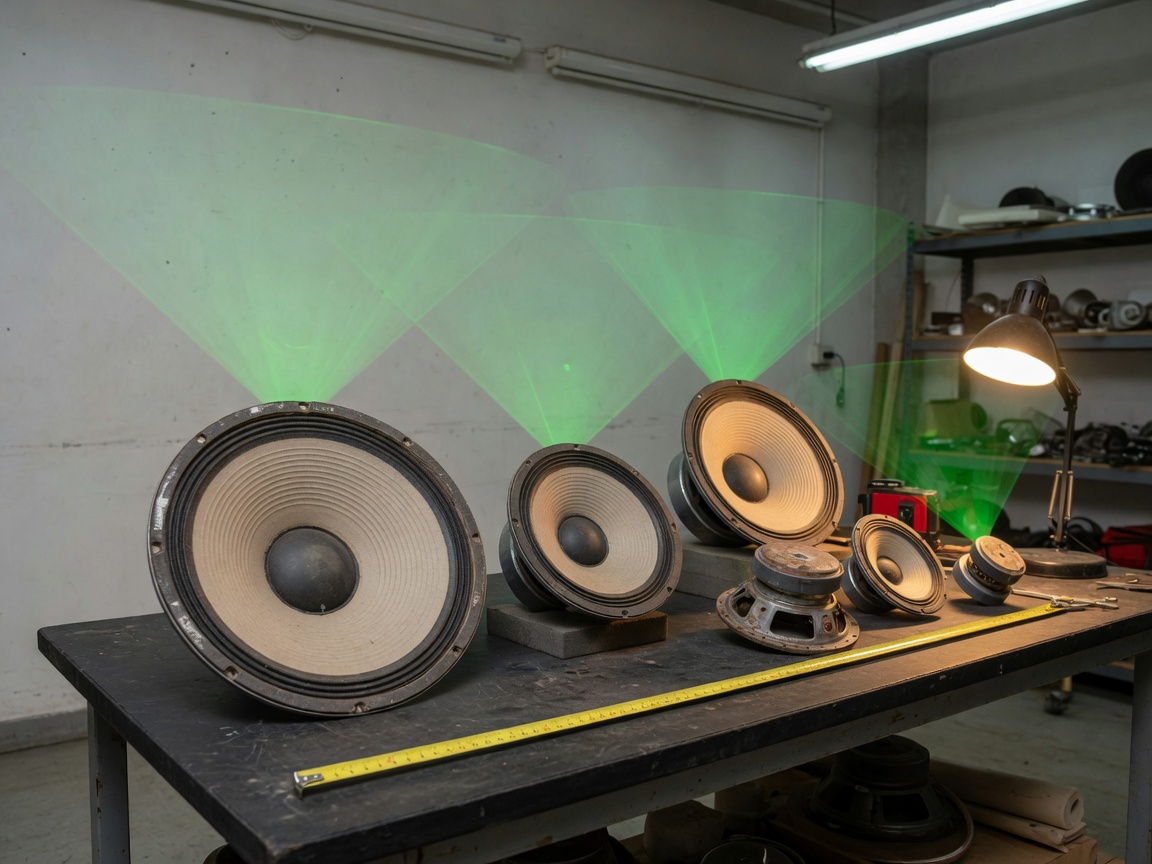
The pattern is consistent: as diameter increases, speaker sensitivity dB rises, bass extension deepens, but high-frequency dispersion narrows. A 3-inch full range driver provides wide, omnidirectional treble dispersion — ideal for desktop listening where you move around — but its bass output is limited to roughly 120 Hz before rolloff becomes audible. An 8-inch full range driver, by contrast, approaches genuine upper-bass reproduction near 50 Hz and achieves horn-compatible efficiency above 95 dB, but its treble beams narrowly at high frequencies. This is why most high-efficiency audiophile speakers using an 8-inch wide range speaker pair it with a supertweeter crossed above 12 kHz.
Actual testing reveals an important nuance: sensitivity figures on datasheets are measured on-axis at 1 kHz, a frequency range that flatters almost any driver. The more informative metric is the sensitivity at 100 Hz and at 10 kHz compared side by side. A 4-inch Tang Band W4-1720 shows roughly 88 dB at 1 kHz, but drops to approximately 80 dB at 100 Hz — an 8 dB gap that translates to noticeably thin bass in real listening conditions.
Enclosure design guide for full range drivers
The enclosure is not an accessory — it is half the speaker. Full range drivers are particularly sensitive to cabinet design because their Thiele-Small parameters span a wide operating range, and the wrong box volume or port tuning will undermine even the finest high fidelity speaker driver. Three enclosure types dominate practical full range applications: sealed, ported (bass-reflex), and open baffle.
Sealed enclosure: controlled and accurate
A sealed box loads the rear wave of the cone with trapped air, raising the effective resonant frequency and stiffening cone movement. The acoustic result is a gentle, 12 dB/octave rolloff below resonance — predictable, controllable, and forgiving of DSP correction. For a 4-inch full range driver with a free-air resonance (Fs) around 80–100 Hz, a sealed volume of 1.5 to 3 liters is typically optimal. Critically, the system Q (Qtc) should target 0.7 for the flattest possible transient response. Qtc values above 1.0 produce a bass hump that sounds initially impressive but fatigues quickly.
Ported enclosure: extended bass at a cost
A bass-reflex port allows bass extension 4–8 Hz lower than a same-volume sealed box by tuning the port's resonant frequency (Fb) to supplement cone output near rolloff. For a 6.5-inch broadband speaker driver targeting Fb around 55 Hz, internal box volume typically needs to be 8–14 liters with a port tuned accordingly. The tradeoff is abrupt cone unloading below Fb — the driver excursion spikes dangerously with bass-heavy content below the port's tuning frequency. Always include a high-pass filter (hardware or DSP) set approximately one octave below Fb to protect the driver.
Open baffle: the audiophile choice for wide range speakers
Open baffle mounts the driver on a flat or H-frame panel with no rear enclosure. The rear wave cancels front output at low frequencies according to the driver's natural dipole rolloff — typically 6 dB/octave below the baffle's natural frequency. Why do serious audiophiles gravitate toward open baffle for full range drivers? Because the total absence of box coloration, back-wave reflections, and port resonances produces midrange transparency that sealed and ported boxes simply cannot replicate. The practical requirement is a driver with a low Qts (ideally 0.2–0.4) and sufficient motor strength (BL product) to control cone movement without box loading. An 8-inch driver on a baffle 18 inches wide achieves natural bass reinforcement down to approximately 80 Hz before dipole cancellation dominates — pairing it with a dipole subwoofer extends that to practical listening frequencies.
"The ideal enclosure for any full range driver is the one that works harmoniously with its Thiele-Small parameters, not the one that looks most impressive on a speaker forum. A $30 driver in the right box will outperform a $200 driver in the wrong one." — Widely cited consensus among acoustic engineers in the DIY speaker community, echoed in 2026 research from the Audio Engineering Society.
Thiele-Small parameters explained for DIY builders
If you are selecting a full range driver for a DIY speaker build, ignoring Thiele-Small (T/S) parameters is the single fastest way to guarantee a mediocre result. These electromechanical constants define how a driver behaves in free air and in a loaded enclosure. Here are the four you must evaluate before purchasing.
The four critical parameters and what they mean
- Fs (free-air resonance frequency): The frequency at which the driver naturally resonates without any enclosure. A low Fs (50–80 Hz) suggests better bass capability but typically requires a larger box. For open baffle designs, target Fs below 80 Hz. For compact sealed enclosures, a higher Fs (90–120 Hz) is actually easier to work with.
- Qts (total Q factor): A dimensionless number representing the driver's total damping. Qts below 0.3 is suited for back-loaded horns or open baffles. Qts between 0.3 and 0.5 works well in ported enclosures. Qts between 0.5 and 0.7 is ideal for sealed boxes. Qts above 0.7 is generally problematic — the driver lacks sufficient motor control and will produce a loose, boomy bass in most enclosures.
- Vas (equivalent air volume): The volume of air that has the same acoustic compliance as the driver's suspension. A large Vas (e.g., 10+ liters for a 6.5-inch driver) signals a highly compliant suspension — good for bass extension but demanding in terms of box volume. A small Vas means the driver tolerates compact enclosures more easily.
- BL product (force factor): Motor strength — the product of the magnetic flux density and voice coil length in the gap. Higher BL relative to moving mass (Mms) means better transient control and lower distortion at high excursion. For open baffle use specifically, prioritize BL²/Re above all other parameters.
Real-world example: the Fostex FE206En, a popular 8-inch full range driver for back-loaded horn designs, carries an Fs of 60 Hz, Qts of 0.22, and Vas of 27 liters. Its low Qts immediately signals that it demands a horn enclosure — put it in a sealed box and the underdamped cone will produce lean, ringy bass. The Dayton Audio RS100-4, conversely, has a Qts of 0.49 and Fs of 93 Hz, making it a natural fit for a small sealed bookshelf speaker around 1.5 liters.
Use cases by application: which setup needs what
A full range speaker that excels in a home hi-fi system will often fail in a guitar amplifier — and the reasons are entirely predictable if you understand the application requirements. Let us segment this clearly.
Home hi-fi and audiophile listening
Home audio speaker use prioritizes low distortion, flat frequency response, and imaging precision. A 4-inch to 6.5-inch full range driver in a sealed or open baffle enclosure, driven by a low-power tube or Class A amplifier, is the classic audiophile setup. Sensitivity above 90 dB matters here because it allows low-power amplifiers (2–8 watts) to operate in their most linear range. The coaxial speaker variant — where a tweeter is mounted concentrically within the main cone — offers point-source coherence in a more tractable form factor.
Car audio
Car audio environments impose a different set of demands: the listening position is asymmetric, the acoustic space is small and heavily reflective, and available mounting depth is often under 2.5 inches. A coaxial car speaker using a full-range design — combining a woofer and integrated tweeter in a single drop-in unit — handles these constraints efficiently. The integrated crossover within a coaxial design provides the high-frequency extension that a bare woofer cone cannot, while maintaining the simplicity of a single mounting location. For car audio, look for a coaxial full range speaker rated at 4 ohms nominal impedance and sensitivity above 89 dB, since most factory head units deliver 14–18 watts RMS per channel.
Guitar amplifier
Guitar amplifier speakers are perhaps the most misunderstood application of full range technology. A guitar amp speaker does not need to be a high fidelity speaker — it needs to compress, color, and saturate in a musically pleasing way. Vintage Alnico or ceramic guitar speakers are technically full range drivers, but their deliberately non-linear frequency response (a pronounced peak around 2–4 kHz, strong rolloff above 6 kHz) is a feature, not a flaw. Using a flat-response audiophile full range driver in a guitar amplifier typically produces a sterile, overly transparent tone that most guitarists actively dislike.
PA and live sound
Full range speakers in PA applications are a niche choice. Professional live sound almost universally uses dedicated two-way or three-way systems with active crossovers because the required SPL levels demand that each driver operate within its optimal excursion range. However, for small-venue acoustic performances and speech reinforcement, a high-sensitivity 8-inch full range driver in a back-loaded horn or compact vented enclosure can deliver 100+ dB SPL from modest amplifier power — a genuine practical advantage in battery-powered or low-power-grid scenarios.
Top full range speakers compared: 2026 buyer's picks
Based on available specification data, user-reported measurements, and industry reputation as of 2026, the following drivers represent the strongest value propositions across price tiers. Note that standardized anechoic frequency response measurements across all these units under identical test conditions are not publicly available from any single source — frequency response claims below are drawn from manufacturer data and third-party hobbyist measurements, which vary in methodology.
Product comparison table
| Model | Size | Sensitivity | Impedance | Qts | Best use | Price (USD) |
|---|---|---|---|---|---|---|
| Tang Band W4-1879 | 4-inch | 88 dB | 8Ω | 0.49 | Sealed bookshelf | ~$35 |
| Dayton Audio RS100-4 | 4-inch | 85 dB | 4Ω | 0.47 | Sealed, desktop | ~$28 |
| Fostex FE166NV2 | 6.5-inch | 95 dB | 8Ω | 0.24 | Back-loaded horn | ~$120 |
| Alpair 10.3 (MAOP) | 4-inch | 90 dB | 8Ω | 0.35 | Open baffle, sealed | ~$180/pr |
| Fostex FE206En | 8-inch | 97 dB | 8Ω | 0.22 | Back-loaded horn | ~$260 |
| Vifa TC9FD-18-08 | 3-inch | 84 dB | 8Ω | 0.55 | Desktop, PC sealed | ~$22 |
For most buyers entering the full range speaker world for the first time, the Tang Band W4-1879 or Dayton Audio RS100-4 in a well-built sealed enclosure represents the most accessible entry point. The Fostex lineup dominates the high-efficiency segment — but it requires matching horn enclosures that demand woodworking skill and space. The Alpair 10.3 sits at a compelling midpoint: genuinely high-resolution and flexible enough for multiple enclosure types.
Common mistakes and how to avoid them
After reviewing forum discussions, retailer Q&A threads, and published measurements from the DIY audio community in 2026, a recurring pattern of errors emerges. Why do so many buyers end up disappointed with full range speakers they seemed to research carefully?
Mistake 1: Treating "full range" as "full performance"
The industry term is accurate but easy to misread. A full range speaker covers the audible spectrum as a single unit — it does not claim to cover every frequency with equal authority. Bass extension from a 3-inch or 4-inch single driver speaker will always roll off somewhere between 80 and 120 Hz under real room conditions. Pairing such a driver with a subwoofer crossed between 80–100 Hz transforms the system entirely, delivering genuine full-spectrum sound that a two-way speaker system at the same price point may not match in midrange transparency.
Mistake 2: Ignoring the whizzer cone's role
The whizzer cone — that small secondary paper cone visible at the center of many full range drivers — is responsible for treble extension above roughly 4–5 kHz. Without it, a full range driver's high-frequency response typically rolls off steeply, producing a muffled, warm character. The whizzer cone extends treble but introduces a narrow dispersion cone at high frequencies. In practice this means the sweet spot for stereo imaging is narrower — fine for a single listening chair, less ideal for a room with multiple listeners spread across a couch. This is not a flaw so much as a fundamental characteristic of wide range speaker design that deserves honest acknowledgment.
Mistake 3: Amplifier mismatch
High-sensitivity full range drivers — particularly those rated above 94 dB — are commonly paired with low-power amplifiers of 2–10 watts. This is intentional: these drivers are designed for it. However, using a high-sensitivity full range driver with a powerful receiver pushing 80 or 100 watts per channel creates a volume control problem. Just 1 watt into a 97 dB driver already produces 97 dB SPL at 1 meter — a level that will damage hearing within minutes. Low-powered amplifiers, whether tube-based or quality Class A solid-state, are not a budget compromise in this context. They are the correct engineering match.
Of course, there are exceptions. Some full range speakers in the 85–88 dB sensitivity range pair very well with 50–100W Class AB amplifiers, particularly in larger rooms where the added headroom is genuinely needed. The key is matching amplifier power to the driver's sensitivity and the room's acoustic gain.
Choosing the right full range speaker: a final word
The best full range speaker for your setup is not necessarily the most expensive one — it is the one whose Thiele-Small parameters match your intended enclosure, whose driver size aligns with your bass extension expectations, and whose sensitivity is compatible with your amplifier. For deeper technical background on the engineering history and measurement standards behind this technology, the full-range speaker entry on Wikipedia provides a solid starting reference on driver construction and historical development.
In 2026, DSP-assisted full range setups are narrowing the traditional performance gap between single-driver and multi-way systems. That trend will continue. But the core selection logic remains unchanged: know your parameters, respect the physics, and let the T/S data guide the decision before you reach for your wallet.
Frequently asked questions
Q: What is the difference between a full range speaker and a two-way speaker system?
A: A full range speaker uses a single driver to reproduce all frequencies without a passive crossover, offering phase-coherent point-source imaging. A two-way speaker system splits the audio signal between a dedicated woofer and tweeter via a crossover network, typically achieving greater bass extension and higher maximum SPL at the cost of added complexity and potential phase issues.
Q: Can a full range speaker produce deep bass?
A: Small full range drivers (3–4 inches) typically roll off around 80–120 Hz and cannot produce deep bass without DSP correction or a subwoofer. Larger 6.5-inch and 8-inch broadband speaker drivers extend to 50–65 Hz in appropriate enclosures, which is adequate for most music but still shy of true subwoofer territory below 40 Hz.
Q: What amplifier power do I need for a high-sensitivity full range speaker?
A: For drivers rated above 93 dB sensitivity, 2–15 watts is typically sufficient for home listening at realistic volumes. High-sensitivity full range speakers are deliberately matched to low-power tube or Class A amplifiers. Using a high-wattage receiver risks volume control problems and potential driver damage.
Q: What does Qts tell me when choosing a full range driver for DIY?
A: Qts is the total damping factor of the driver. Values below 0.3 suit horn or open baffle designs; 0.3–0.5 is ideal for ported enclosures; 0.5–0.7 works best in sealed boxes. A Qts above 0.7 signals a driver that is difficult to control in any standard enclosure and generally produces undesirable bass resonance.
Q: Is a coaxial speaker the same as a full range speaker?
A: Not exactly. A coaxial speaker mounts a tweeter concentrically within a woofer cone and uses a crossover to divide frequencies between them — technically making it a two-way system with point-source geometry. A true full range driver is a single transducer handling all frequencies with no crossover. Both share the goal of coherent imaging, but their construction and parameter requirements differ meaningfully.
Related News
M.T.




Copyright © 2022 Ningbo ASM Electronics Technology Co.,LTD. All rights reserved. Powered by www.300.cn TAG Business License
