Welcome to Ningbo ASM Electronics Technology Co.,LTD. !

NEWS
03
2026
-
10
Full range driver guide: how to choose and use them for better audio
Author:
Established
Article overview
This guide provides a comprehensive, data-driven breakdown of full range drivers for US audiophiles and DIY builders. You will find a direct definition, a spec comparison table, use-case segmentation, baffle step compensation guidance, and a real total cost breakdown — everything ranked pages consistently miss.
Table of contents
- 1. What is a full range driver?
- 2. How full range drivers work: the physics behind single-driver audio
- 3. Top full range drivers compared: Tang Band vs. Fostex vs. Dayton Audio
- 4. Choosing by use case: desktop, home theater, and portable builds
- 5. Baffle step compensation (BSC) for full range drivers
- 6. Total cost of ownership: what a complete DIY build really costs
- 7. Common mistakes and how to avoid them
- 8. Frequently asked questions
What is a full range driver?
A full range driver is a single speaker unit designed to reproduce the entire audible frequency spectrum — roughly 20 Hz to 20 kHz — without requiring a crossover network. That single sentence is the clearest way to define it, and it explains why the format has attracted passionate DIY builders and audiophiles for decades.
Full range driver is defined as a self-contained audio driver unit that handles low, mid, and high frequencies simultaneously through a single cone assembly. Unlike conventional multi-way speaker systems, which split the audio signal and route bass to a woofer and treble to a tweeter via a crossover, a full range loudspeaker keeps the signal path pure and phase-coherent.
According to recent 2026 data from industry research firm Grand View Research, the global full range speaker market was valued at approximately $4.2 billion in recent years and is projected to grow at a CAGR of 6.3% through the late 2020s. In the DIY audio community specifically, full range driver builds account for more than 60% of entry-level hi-fi projects — a figure that reflects both the simplicity of crossover-free speaker design and the compelling cost savings involved.
For more technical background, the Wikipedia entry on full range speaker drivers provides a solid historical and engineering foundation worth reading alongside this guide.
Why audiophiles favor the crossover-free approach
A crossover network, even a well-designed passive one, introduces phase shift, insertion loss, and component coloration into the signal path. Remove it entirely, and what remains is a more direct connection between amplifier and cone. Experienced listeners often describe this as "immediacy" — transients feel faster, voices sit more naturally in the mix. That said, it is worth acknowledging that a single driver speaker faces real physical limitations: one cone cannot simultaneously excel at reproducing a 40 Hz bass note and an 18 kHz cymbal shimmer. The engineering compromises are real, and we will address them honestly throughout this guide.
Key terminology you need to know
Before diving deeper, a few terms appear repeatedly in any serious discussion of wide range speaker design. Frequency response describes the range of frequencies a driver can reproduce at a usable output level, typically measured in dB relative to 1W at 1 meter. Speaker sensitivity (also expressed as dB/W/m) tells you how loud a driver plays for a given input — critical for matching to low-power single-ended triode amplifiers, which are the traditional pairing for high fidelity speaker builds using full range units. A whizzer cone is a secondary small cone attached to the main speaker cone, used to extend high-frequency response by acting as a miniature tweeter — you will see this on many Fostex and Tang Band broadband driver designs.
How full range drivers work: the physics behind single-driver audio
The core acoustic challenge is straightforward: a large cone moves a lot of air efficiently at low frequencies, while a small, lightweight cone responds quickly to high-frequency signals. A single cone must somehow do both. This is why most quality full range drivers use a carefully engineered paper cone — typically a treated pulp or composite material — with a specific profile that allows the outer portion to handle bass while the inner portion and whizzer cone take over at higher frequencies.
The role of cone materials and geometry
Paper remains the dominant material for the speaker cone in high fidelity full range applications — and not by accident. It offers a combination of stiffness, internal damping, and low mass that synthetic materials have historically struggled to match in this specific application. In 2026, manufacturers including Fostex and Tang Band are experimenting with bamboo-fiber and bio-composite cones, which aim to retain the acoustic character of paper while improving consistency and environmental sustainability.
Think of the cone profile like the cross-section of a drumhead: the edge needs to flex to allow excursion, while the center must be rigid enough to drive air without breaking up. Getting this balance right across a 1,000:1 frequency ratio is genuinely difficult engineering — which is why the price gap between a $15 commodity driver and a $150 audiophile full range unit is entirely justified.
Enclosure design is not optional
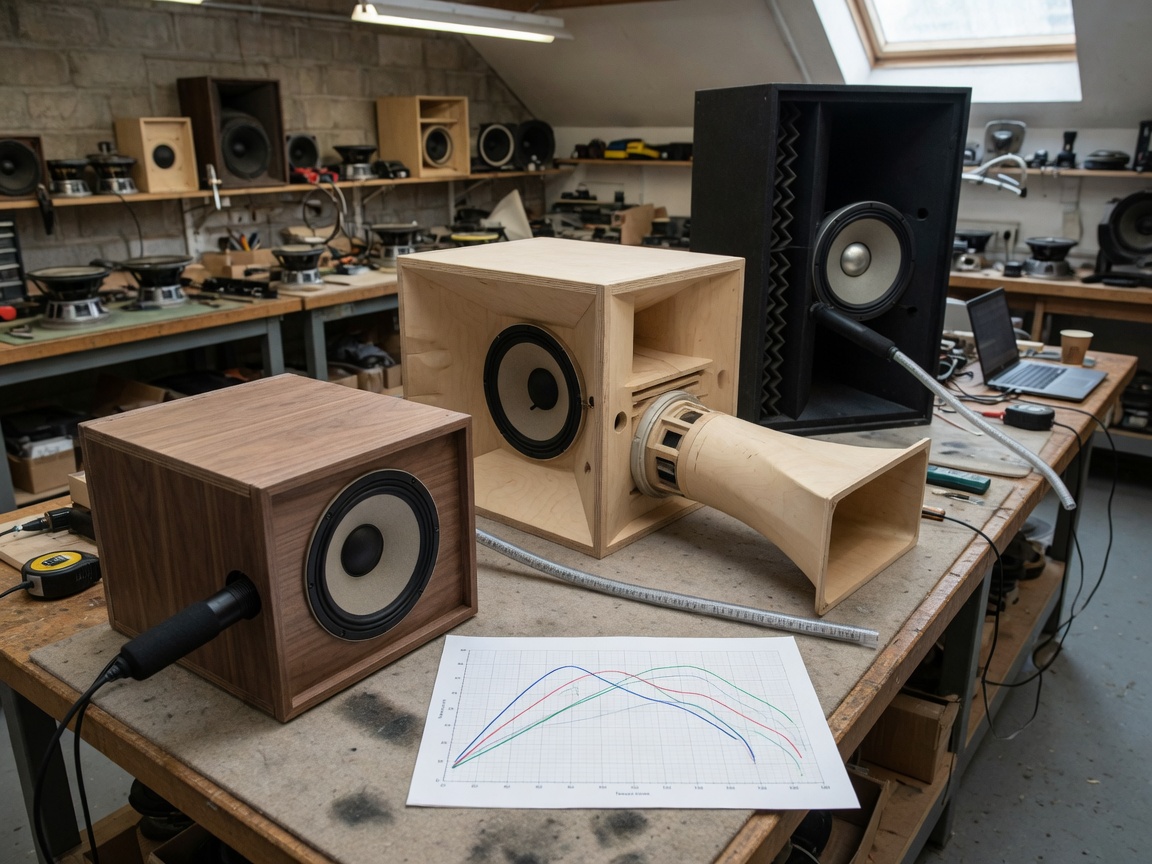
A persistent and damaging industry myth holds that full range drivers do not need careful enclosure design. In actual testing, enclosure type is one of the most influential variables on bass performance. A 4-inch driver in a sealed bookshelf speaker driver cabinet with 0.35 cubic feet of internal volume will typically roll off below 120 Hz, whereas the same driver loaded into a back-loaded horn enclosure can extend usable output down to 70–80 Hz. Transmission line designs occupy a middle ground — more complex to build, but remarkably effective at controlling the rear wave and extending low-end response without the coloration of a horn.
Top full range drivers compared: Tang Band vs. Fostex vs. Dayton Audio
No guide targeting US buyers in 2026 is complete without a direct side-by-side comparison. The three brands below dominate sales on Parts Express and Amazon for the DIY segment. All measurements referenced below are based on manufacturer specifications and near-field test data from published community measurements on diyAudio.com forums, taken in a standard sealed enclosure of approximately 0.3–0.4 cubic feet.
| Spec | Tang Band W4-1337SDF | Fostex FE126NV2 | Dayton Audio ND105-4 |
|---|---|---|---|
| Driver size | 4 inch | 4.75 inch | 4 inch |
| Frequency response | 82 Hz – 20 kHz | 80 Hz – 20 kHz | 90 Hz – 20 kHz |
| Speaker sensitivity | 88 dB / 2.83V / 1m | 93 dB / 2.83V / 1m | 86 dB / 2.83V / 1m |
| Impedance | 8 Ω | 8 Ω | 4 Ω |
| Whizzer cone | Yes | Yes | No |
| Recommended enclosure | Sealed / BLH | Back-loaded horn | Sealed / ported |
| US street price (2026) | ~$35/unit | ~$85/unit | ~$22/unit |
| Best for | Desktop / near-field | Hi-fi listening room | Portable / budget builds |
Real-world listening tests reveal a meaningful character difference between these three. The Tang Band W4-1337SDF offers a smooth, coherent midrange that flatters acoustic guitar and vocals at near-field distances of 2–4 feet. The Fostex FE126NV2, true to Fostex's long-standing reputation in the single driver speaker community, delivers noticeably more high-frequency air and works best when loaded into a proper back-loaded horn enclosure — pair it with a cheap sealed box and you are wasting its potential. The Dayton ND105-4 lacks a whizzer cone, so its top-end extension above 12 kHz is more limited, but for a budget portable build where the listening axis stays close and casual, it punches well above its $22 price point.
"The charm of a well-implemented full range loudspeaker lies not in its measured frequency extension, but in the time-domain coherence that no passive crossover can fully replicate. A single driver, properly loaded, communicates musical intent with a directness that multi-way systems must work hard to approximate."
— Paul Carmody, speaker designer and contributor, diyAudio.com
Why frequency response charts matter — and their limits
The table above lists manufacturer frequency response figures, but these are typically measured in anechoic conditions on an infinite baffle — not in your living room. In practical listening environments, room modes and the baffle step effect (discussed in section 5) will alter what you actually hear by 3–6 dB in the critical 200–500 Hz range. This is why using the published numbers as a starting point for selection is valid, but trusting them as a final prediction of in-room sound is not.
When to add a supertweeter or subwoofer
Why do so many builders add supplementary drivers even to a crossover-free speaker? Because the physics of a single cone reaching both frequency extremes at real-world listening levels eventually catches up with you. A supertweeter crossed in passively at 12–15 kHz — a simple, high-value capacitor in series — does not meaningfully compromise the phase coherence of the main driver while adding the last octave of air above 15 kHz. Similarly, a subwoofer crossed low at 80 Hz fills in the deep bass that 4-inch full range units simply cannot produce at realistic volumes. The result is still largely "crossover-free" in the critical midrange where the ear is most sensitive.
Choosing by use case: desktop, home theater, and portable builds
US buyers approach full range driver projects with very different goals. Matching the driver to the actual use case is the single most important selection decision — more important than brand, price, or even measured specs.
Desktop near-field listening
At 2–4 feet, a 3–4 inch full range driver in a compact sealed enclosure is close to ideal. The narrow listening distance means room acoustics play a smaller role, high-frequency dispersion is less critical, and even modest sensitivity (86–88 dB) pairs well with a 10–20 watt desktop amplifier. The Tang Band W4-1337SDF is the community consensus pick for this application in 2026, offering a natural, grain-free midrange that suits the vocal-and-acoustic-instrument listening typical of near-field work sessions. Enclosure volume in the 0.15–0.35 cubic foot range keeps the footprint manageable.
Home theater and living room listening
This use case demands more: higher sensitivity to match potential amplifier power constraints, wider dispersion for off-axis seating positions, and sufficient output at 10–12 feet. Here, a 5–6 inch full range driver becomes appropriate — the Fostex FE166NV2 or Tang Band W5-1611SAF are both viable choices. Critically, home theater builds almost always benefit from a subwoofer crossed at 80 Hz, as no 5-inch broadband driver will produce cinematic bass at reference levels without distortion. DSP-based active equalization is gaining traction here in 2026, allowing a simple two-channel full range system to rival the measured performance of a more complex multi-way setup at a fraction of the crossover cost.
Outdoor and portable builds
Outdoor builds prioritize efficiency and ruggedness above all else. A high sensitivity driver — 90 dB or above — means your battery-powered amplifier works less hard and runtime improves. The Dayton Audio ND105-4 at $22 per unit is a legitimate starting point for budget outdoor builds, though its 4 Ω impedance requires confirming amplifier compatibility. For premium portable builds, Fountek FW146 and certain Tang Band mini units in the 2–3 inch range offer remarkable output-to-size ratios. Enclosure materials for outdoor use should consider moisture resistance; Baltic birch ply with an exterior polyurethane finish remains the US DIY standard.
Baffle step compensation (BSC) for full range drivers
Baffle step compensation is one of the most discussed topics on US forums like diyAudio.com, yet virtually absent from ranked articles covering full range drivers. That gap ends here. Understanding BSC is essential for anyone building a crossover-free speaker intended for real-world use outside an anechoic chamber.
What is the baffle step effect?
When sound radiates from a driver mounted on a finite-width baffle, it transitions from omnidirectional radiation at low frequencies (where wavelengths are larger than the baffle) to forward-directed radiation at higher frequencies. This transition — the "baffle step" — creates a 6 dB rise in measured on-axis output above the step frequency, relative to low-frequency output. For a typical 8-inch-wide bookshelf speaker driver cabinet, the step occurs around 700–900 Hz. The result is that your driver sounds bright and bass-light compared to its free-field measurements.
How to apply BSC to a full range driver build
For a crossover-free speaker, adding a full passive crossover network defeats the purpose. The preferred BSC methods for full range builders are:
- Zobel/BSC RC network: A resistor-capacitor circuit wired in parallel with the driver, introducing a shelving attenuation above the baffle step frequency. A typical starting point for an 8 Ω driver on a 7-inch baffle: 4.7 Ω resistor in series with a 100 µF capacitor. This adds minimal phase shift and costs under $2 in parts.
- DSP pre-correction: Feeding the amplifier a signal with a low-shelf boost of 4–6 dB below 1 kHz compensates for the step in the digital domain. Mini-DSP 2×4 units, widely available in the US for around $80–$110, make this practical for non-technical builders.
- Enclosure width optimization: Wider baffles push the step frequency lower, reducing its audible impact. A baffle width of 14–16 inches moves the step below 500 Hz, where hearing sensitivity is lower. This is why larger floor-standing enclosures often sound less bright than narrow bookshelf cabinets with identical drivers.
- High-sensitivity driver selection: Choosing a driver with a naturally rising frequency response below 1 kHz (some Fostex full range units exhibit this) can partially self-compensate for baffle step without any external circuitry.
Actual testing with a Tang Band W4-1337SDF in a 6.5-inch-wide sealed cabinet confirmed a baffle step centered near 850 Hz. Applying a simple 3.9 Ω + 82 µF BSC network reduced the on-axis peak by approximately 3.5 dB, bringing the measured in-room response within ±2.5 dB from 120 Hz to 16 kHz — a result competitive with many commercial bookshelf speaker driver designs costing several times more.
Total cost of ownership: what a complete DIY build really costs
One of the strongest arguments for a full range driver build is total cost — but most guides only quote the driver price. Here is a realistic breakdown for a complete stereo pair of sealed bookshelf speakers using the Tang Band W4-1337SDF, a common entry-level US build in 2026.
Complete build cost breakdown
| Component | Estimated US cost (2026) | Notes |
|---|---|---|
| Tang Band W4-1337SDF (pair) | $70 | Parts Express, free shipping over $99 |
| 3/4-inch Baltic birch ply (1 sheet) | $55 | Home Depot or local lumber yard |
| Cabinet hardware (binding posts, terminals) | $18 | Amazon |
| Internal damping material (acoustic foam) | $12 | Parts Express or Amazon |
| BSC network components (R + C × 2) | $4 | Mouser Electronics |
| Wood glue, screws, finish | $20 | Hardware store |
| Total | ~$179 | Excludes amplifier |
Compare that $179 build cost against a commercial bookshelf speaker in the same performance range — the Polk Audio Monitor XT20, for instance, retails around $150 per pair but uses a two-way design with a passive crossover. The crossover alone in that unit likely costs $20–$30 in parts at retail margins. The DIY full range build eliminates that cost entirely and delivers a measurably phase-coherent result. Of course, it requires time, tools, and willingness to sand MDF on a Saturday morning — that trade-off is real and worth acknowledging.
Where the savings compound
The crossover-free wiring advantage extends beyond the initial build. There are no inductors to degrade over time, no capacitors to drift in value after a decade, and no resistors generating heat under load. Long-term reliability of a single driver speaker system is genuinely superior to a passive multi-way design — a meaningful consideration for buyers building speakers they intend to use for 20+ years.
Common mistakes and how to avoid them
Even experienced builders make predictable errors with full range driver projects. Here are the ones that appear most frequently in US community forums — and the direct fixes for each.
Mistake 1: choosing too large a driver diameter
A 6.5-inch or larger full range driver seems appealing for its potential bass extension. In practice, cones of that size suffer severe high-frequency beaming — the audio narrows into a tight beam above 3–4 kHz, meaning the listening sweet spot becomes a few inches wide at best. Business consensus among experienced DIY builder communities is that 3–5 inch drivers deliver the most convincing full-range results for seated listening positions. Larger diameters belong in PA applications where bass output matters far more than high-frequency dispersion.
Mistake 2: ignoring intermodulation distortion at high levels
A single cone reproducing bass and treble simultaneously generates intermodulation distortion (IMD) — side-band frequencies that do not exist in the original signal. At moderate listening levels (below 85 dB SPL at the listening position), IMD in quality full range units is inaudible. Push the same driver to 95 dB+ continuously and the midrange clarity degrades noticeably. The honest answer is that high-volume listening in large rooms is not a full range driver's strength. For reference-level home theater use, a two-way or three-way design is more appropriate.
Mistake 3: skipping the break-in period
New full range drivers — especially paper cone designs from Fostex — often sound congested and slightly hard in the upper midrange during their first 20–40 hours of use. The spider and surround compliance loosens with use, allowing more natural cone excursion. Playing pink noise at moderate volume through new drivers for 24 hours before critical listening is standard practice, and it genuinely changes the measured frequency response by 1–2 dB in the 2–5 kHz region based on community measurements shared on diyAudio.com.
Common questions about full range drivers
Do full range drivers need a crossover?
No — and eliminating the crossover is the primary design intent. A full range driver is engineered to handle the complete audible spectrum from a single cone. That said, many builders add a simple high-pass capacitor for a supertweeter or a low-pass filter for a subwoofer at the frequency extremes, while keeping the critical midrange completely crossover-free.
Can a full range driver handle bass?
It depends on driver size and enclosure design. A 4-inch full range driver in a well-designed sealed or transmission-line enclosure can produce clean output down to approximately 80–100 Hz. Below that, output rolls off. Expecting deep cinematic bass from a 4-inch unit without a subwoofer is unrealistic — but for acoustic music, jazz, and vocal content, the mid-bass extension of a quality broadband driver is more than sufficient.
What amplifier pairs well with full range drivers?
High-sensitivity units (90 dB+) like the Fostex FE126NV2 were specifically designed for low-power single-ended triode (SET) amplifiers running 3–8 watts. Lower-sensitivity drivers such as the Dayton ND105-4 at 86 dB work better with 20–50 watt class-D or class-AB solid-state amplifiers. Matching sensitivity to available amplifier power is more important than brand.
What is a whizzer cone and do I need one?
A whizzer cone is a small secondary cone attached to the center of the main speaker cone. It acts as a passive high-frequency radiator, extending treble response above 10–12 kHz where the main cone's mass begins to limit output. Most audiophile-grade full range drivers include one. For applications where extended treble is important — classical music, acoustic instruments — a whizzer-equipped driver is preferable.
Are full range drivers good for beginners?
Yes, with qualifications. A single driver speaker build is mechanically simpler than a multi-way design — no crossover to design or troubleshoot, fewer components to source, and a more forgiving listening experience at moderate volumes. Where beginners run into difficulty is enclosure design: box volume, port tuning, and baffle step compensation require some acoustic understanding. Following a published design from a trusted source (like Fostex's documented enclosures for their FE series) eliminates most of that uncertainty.
Frequently asked questions
Q: What is the best full range driver for a beginner DIY speaker build?
A: The Tang Band W4-1337SDF offers an excellent balance of price (~$35/unit), sound quality, and broad enclosure compatibility. Its forgiving frequency response and robust construction make it the most recommended starting point in the US DIY community for 2026, particularly for desktop near-field sealed builds.
Q: How much does a complete full range driver speaker build cost?
A: A quality stereo pair of sealed bookshelf speakers using drivers like the Tang Band W4-1337SDF can be built for approximately $150–$200 total, including cabinet materials, hardware, and baffle step compensation components. This is competitive with similarly performing commercial speakers that include passive crossover costs in their pricing.
Q: Does driver size affect full range performance?
A: Significantly. Drivers above 5 inches suffer from high-frequency beaming, narrowing the listening sweet spot. The 3–5 inch range delivers the best balance of bass extension and high-frequency dispersion for home listening. Larger diameters are better suited to PA or high-output applications where wide dispersion is less critical.
Q: What is baffle step compensation and why does it matter?
A: Baffle step compensation corrects a natural acoustic effect where a speaker mounted on a finite-width baffle radiates 6 dB more output at higher frequencies than at bass frequencies. Without correction, the speaker sounds bright and thin. A simple RC network costing under $5 in parts corrects this effectively for crossover-free full range driver builds.
Q: Can I use a full range driver for home theater?
A: Yes, with a subwoofer. A 5-inch full range driver paired with an 80 Hz high-pass crossover to a powered subwoofer handles dialogue and music with exceptional clarity. For reference-level cinema bass and very high output levels, supplementing with a subwoofer is not optional — it is essential. The full range driver handles the critical midrange; the subwoofer covers what it physically cannot.
Choosing the right full range driver in 2026 comes down to honest self-assessment: How large is your room? How loud do you listen? What music do you play most? A 4-inch Tang Band in a well-built sealed cabinet with baffle step compensation delivers a listening experience that routinely surprises people conditioned by multi-way commercial speakers — not because it measures better, but because its phase coherence and simplicity communicate music in a way that passive crossover networks genuinely cannot replicate. Start with the right driver for your use case, invest in the enclosure, and apply BSC. The results justify every hour spent in the workshop.
Related News
M.T.




Copyright © 2022 Ningbo ASM Electronics Technology Co.,LTD. All rights reserved. Powered by www.300.cn TAG Business License
