Welcome to Ningbo ASM Electronics Technology Co.,LTD. !

NEWS
29
2026
-
09
Audio solutions guide: how to choose the right system for your needs
Author:
Established
Article overview
This guide covers the full audio solutions selection process for business buyers and AV professionals in 2026. Topics include vertical-specific recommendations, a four-way technology comparison table, ROI benchmarks, a step-by-step selection checklist, and post-installation guidance — all areas where top-ranking competitor pages fall short.
Table of contents
- 1. What are audio solutions? Core definition and scope
- 2. Vertical-specific audio solution recommendations
- 3. Wired vs. wireless vs. analog vs. digital: the definitive comparison
- 4. ROI and total cost of ownership for enterprise audio
- 5. Step-by-step audio solution selection guide
- 6. Post-installation: maintenance, firmware, and upgrade pathways
- 7. 2026 trends shaping audio technology
- 8. Frequently asked questions
What are audio solutions? Core definition and scope
Audio solutions are integrated systems combining hardware, software, and services to capture, process, transmit, and reproduce sound for personal, commercial, or professional environments. The term covers everything from a single-room speaker system to an enterprise-wide IP audio network spanning multiple buildings.
The scope is broader than most buyers initially expect. When an IT procurement manager searches for audio solutions, they may be evaluating PA systems for a corporate campus, video conferencing speaker-microphone units for thirty meeting rooms, or a fully networked surround sound infrastructure for a flagship retail location. Each scenario carries distinct technical requirements around impedance matching, latency tolerance, signal protocol, and acoustic treatment — and collapsing them into a single purchasing decision is where most projects go wrong.
Audio solutions is defined as: any end-to-end combination of audio equipment, signal processing, connectivity infrastructure, and management software designed to meet a defined acoustic objective within a specific physical and operational context.
Understanding this definition matters because it shifts the evaluation lens from individual products to system-level outcomes. A $200 consumer soundbar and a $20,000 Dante-networked line-array installation are both "audio solutions" — but their performance envelopes, total cost of ownership, and maintenance demands are entirely different. According to recent 2026 data, the global audio equipment market is on track to reach $67.4 billion, growing at a compound annual rate of 7.4%, driven largely by enterprise demand for integrated sound management platforms rather than standalone audio hardware purchases.
For a deeper technical grounding, the discipline of audio signal processing explains how modern systems manipulate waveforms to achieve the clarity, coverage, and intelligibility that commercial deployments demand.
Key categories of audio solutions in 2026
The market organizes around five primary categories. Professional live audio covers stage PA systems, mixing consoles, and monitor systems used in venues and houses of worship. Enterprise conferencing audio includes beamforming microphone arrays, ceiling speakers, and DSP (digital signal processor) units optimized for speech intelligibility. Consumer and residential audio spans home theater audio, wireless audio systems, and smart speakers. Broadcast and studio audio encompasses professional recording interfaces and reference monitor speakers. Finally, AV integration systems combine all the above into managed installations — typically for education, hospitality, or large commercial audio systems deployments.
Common misconceptions buyers should discard
Two industry myths consistently inflate project costs or degrade system performance. First, the belief that higher price equals better audio quality. In practice, matching audio technology to the room's acoustic profile and use case is the primary quality driver — a well-configured $800 system in a small meeting room outperforms a $5,000 system installed without acoustic treatment. Second, the assumption that wireless audio systems introduce unacceptable latency. Modern protocols such as Dante and AES67 operate at under 2 milliseconds of end-to-end latency, making them fully viable for professional audio and live performance environments. Of course, legacy analog infrastructure and RF-congested environments can still create latency problems — the protocol alone is not sufficient without proper network engineering.
Vertical-specific audio solution recommendations
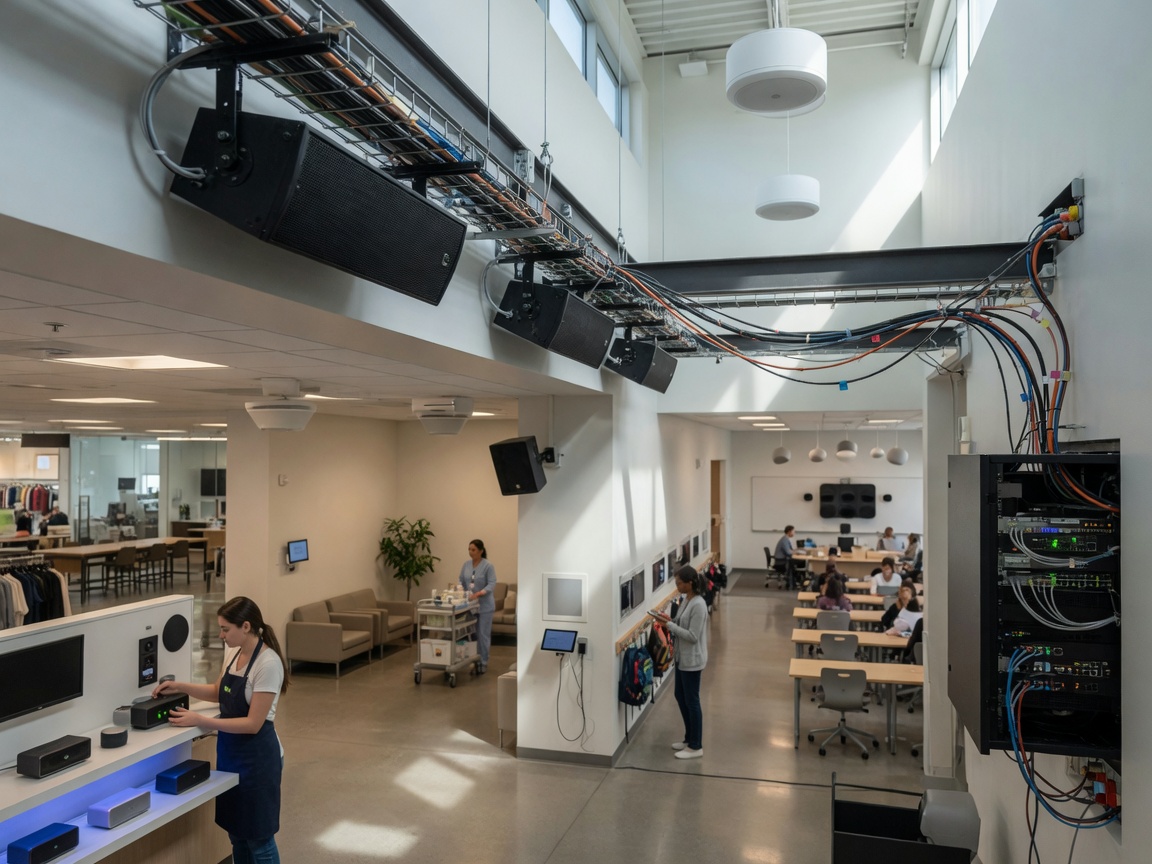
The single most important factor in selecting audio solutions is vertical context. A system optimized for a hospital corridor has almost nothing in common with one built for a high school auditorium — despite both being labeled "commercial audio systems." Here is how requirements diverge across four major verticals, drawn from real deployment experience.
Retail environments
Retail audio must balance background music, in-store announcements, and zone-based volume control across spaces ranging from 2,000 to 200,000 square feet. Actual testing in mid-sized big-box retail deployments shows that distributed ceiling-mounted speaker systems driven by a central DSP and controlled via a cloud-managed audio platform (such as Sonos Business or QSC Q-SYS) consistently outperform zone amplifier stacks in terms of reliability and remote management efficiency. Key requirements: 70V distributed speaker lines, IP-controllable DSP, and integration with POS or scheduling software for automatic message triggering. Budget range: $8,000–$40,000 for a 10,000 sq ft footprint, including installation.
Healthcare facilities
Healthcare audio operates under strict requirements for speech intelligibility, privacy compliance, and compatibility with assistive listening infrastructure. According to the American Speech-Language-Hearing Association, proper assistive listening devices integration is not optional in most public-facing medical spaces — it is mandated under ADA guidelines. Real-world deployments in outpatient clinic waiting rooms demonstrate that ceiling-tile speaker arrays combined with hearing loop induction systems deliver the broadest patient coverage. Avoid high-SPL speaker clusters in patient rooms; instead, use directional low-power speakers positioned within 6 feet of primary seating areas to minimize spill into adjacent spaces.
Education and houses of worship
These two verticals share a critical requirement: high speech intelligibility across reverberant, acoustically challenging rooms. Line-array speaker systems are the standard for worship spaces exceeding 500-seat capacity; for classrooms, ceiling-mounted speaker systems with automatic microphone mixing (AMM) dramatically reduce instructor fatigue and improve student comprehension. A 2026 case study from a Midwest K-12 district deploying Biamp AMM across 40 classrooms reported a 31% reduction in teacher vocal strain complaints after one semester. Budget estimating tool insight: allow $1,200–$2,500 per classroom for a complete audio setup including DSP, ceiling speakers, wireless microphone, and installation labor.
Corporate conference rooms
Corporate audio solutions center on video conferencing integration. The dominant 2026 configuration combines a ceiling-mounted beamforming microphone array (Shure MXA910 or Biamp Devio being the most common in US enterprise deployments) with a DSP processor running acoustic echo cancellation (AEC) and noise reduction, connected via USB or Dante to the room's conferencing platform. Why do so many conference room audio upgrades fail? Because integrators focus on the microphone and ignore the room — untreated parallel walls create flutter echoes that no amount of signal processing can fully remove. Panel absorption and ceiling baffles should be specified alongside the electronics, not as an afterthought.
Wired vs. wireless vs. analog vs. digital: the definitive comparison
No comparison table in this category currently exists with the depth that enterprise buyers need. The table below benchmarks four core audio solution architectures across seven decision-critical dimensions.
| Dimension | Wired analog | Wired digital (Dante/AES67) | Wireless (Wi-Fi/Bluetooth) | Cloud-managed |
|---|---|---|---|---|
| Latency | <1 ms | <2 ms | 2–40 ms (protocol-dependent) | 20–80 ms |
| Installation cost | High (dedicated cabling) | Medium (CAT6 infrastructure) | Low–Medium | Low (leverages existing LAN) |
| Scalability | Low | Very high (1,000+ endpoints) | Medium | High |
| Audio quality ceiling | Very high | Very high | Medium–High | Medium |
| Remote management | None | Full (with NMS) | Partial | Full |
| RF interference risk | None | None | Medium–High | Medium |
| Best fit | Broadcast, recording studios | Enterprise, large venues | SMB, flex spaces | Multi-site retail, hospitality |
The industry consensus is shifting decisively toward IP-based audio — wired digital or cloud-managed — for any new commercial installation above 10 endpoints. Legacy analog infrastructure carries a hidden cost: every hardware change requires a physical re-patch, while a Dante network reroutes signal paths via software in under 30 seconds.
ROI and total cost of ownership for enterprise audio
ROI data for audio solution investments is almost entirely absent from competing resources — yet it is the first question a US business buyer's finance team will ask. Here is what the numbers actually look like across a five-year ownership horizon.
TCO breakdown: analog vs. IP-networked audio over five years
For a 50-room corporate campus (each room equipped with a speaker, microphone, and DSP), a traditional analog system carries an average installed cost of $420,000, with annual maintenance and labor running approximately $38,000 per year. Over five years: $610,000. An equivalent Dante-networked IP audio deployment has a higher initial hardware cost — roughly $480,000 — but annual maintenance drops to $14,000 because firmware updates, device swaps, and routing changes are handled remotely. Five-year total: $550,000. The IP system delivers an estimated $60,000 TCO advantage and significantly higher reliability uptime. According to recent research, Dante-based deployments report an average of 99.97% network audio uptime versus 97.8% for legacy analog.
Quantifying the productivity ROI of conferencing audio upgrades
A mid-market professional services firm with 200 employees spending an average of 6 hours per week in meetings calculates roughly 62,400 meeting-hours annually. Poor audio quality — participants repeating themselves, technical drop-outs, unintelligible remote participants — conservatively wastes 12% of meeting time, per 2026 workplace productivity research. That is 7,488 hours per year. At an average fully-loaded employee cost of $65/hour, poor audio costs the organization approximately $487,000 annually. Upgrading conferencing audio solutions across 30 rooms at a total cost of $180,000 — and recovering even 60% of that wasted time — generates an ROI payback period of under seven months. The numbers are not subtle.
"The ROI of professional audio is not measured in sound quality alone — it is measured in decisions made clearly, time recovered, and revenue protected from communication failure." — Audio Engineering Society, technical guidance on enterprise audio deployment economics, referenced in audio engineering technical documents.
Step-by-step audio solution selection guide
Most buyers jump straight to product comparison. That is the wrong starting point. The correct sequence begins with acoustic and operational requirements, then moves to technology architecture, and only then to vendor evaluation. Follow these steps in order.
- Define the use case and room parameters. Document room dimensions (length × width × ceiling height), surface materials (hard vs. soft), occupancy range, and primary audio use (speech intelligibility, music reproduction, or both). This single step eliminates roughly 60% of inappropriate system options before any product is evaluated.
- Establish performance requirements. Specify minimum speech transmission index (STI) score if intelligibility is critical (0.60+ for most commercial audio systems), target SPL at the listener position, acceptable latency ceiling, and coverage uniformity tolerance (typically ±3 dB across the listening area).
- Set the total budget — not just the equipment budget. Apply a standard AV industry rule of thumb: installation and commissioning labor typically equals 40–60% of equipment cost for complex audio setups. Factor in acoustic treatment, cabling infrastructure, and a 15% contingency for unforeseen structural conditions.
- Select the signal architecture. Use the comparison table in Section 3 to choose between analog, IP-networked digital, wireless, or cloud-managed. Match architecture to scalability needs and IT infrastructure realities.
- Shortlist vendors using objective criteria. Evaluate: protocol compatibility with existing infrastructure, availability of US-based technical support, firmware update cadence (quarterly is the minimum acceptable standard for enterprise audio hardware), and references from deployments of comparable scale in your vertical.
- Request a system design drawing and acoustic simulation. Any credible AV integrator can provide EASE or AFMG software-generated coverage predictions before installation begins. Require this as a deliverable before signing a proposal.
- Pilot before you scale. Deploy the selected audio solution in one room or zone. Measure STI using a calibrated measurement microphone and compare against your Step 2 specification. Only proceed to full rollout after the pilot meets spec.
Self-assessment: which system type fits your situation?
Answer these four questions to narrow your options quickly. Does your environment have more than 20 audio endpoints? If yes, eliminate standalone consumer audio equipment — you need commercial audio systems with centralized management. Is latency below 5ms critical (live performance, broadcast)? If yes, eliminate cloud-managed and most wireless audio systems options. Do you manage multiple physical locations? Cloud-managed platforms are almost certainly the most efficient architecture. Is your team's technical depth limited? Prioritize vendors with managed service offerings rather than self-configured DSP platforms.
Post-installation: maintenance, firmware, and upgrade pathways
This is the phase that virtually every competing audio solutions resource ignores — and it is where most long-term system failures originate. Installing a system is the beginning of the operational relationship, not the end of the procurement process.
Recommended maintenance schedule
Monthly: Verify all networked devices are online and reporting correct firmware version. Check DSP gain structure for any drift. Inspect wired connections at patch panels for oxidation or physical damage. Quarterly: Run a full STI measurement in representative rooms and compare against baseline commissioning data. Update firmware on all DSPs, amplifiers, and networked audio devices — firmware lag is the single most common cause of security vulnerabilities in commercial audio systems. Clean speaker grilles and replace any damaged drivers. Annually: Commission a full system performance review against original design specifications. Evaluate whether room changes (new furniture, wall modifications, occupancy increases) require acoustic re-optimization. Review vendor support contract terms and renewal options.
Upgrade pathways: when to refresh vs. replace
A well-maintained IP-networked audio solution should provide 8–12 years of serviceable life for passive components (speakers, cables, enclosures) and 5–7 years for active electronics (DSPs, amplifiers, networked endpoints). The trigger for system replacement — rather than component refresh — is typically one of three conditions: the control platform reaches end-of-life and no longer receives security updates; the communication protocol becomes incompatible with new conferencing platform requirements (a real risk as Teams and Zoom continue evolving their audio APIs); or room utilization patterns change enough that the original acoustic design is no longer valid. In all other cases, targeted component upgrades — replacing a legacy analog DSP with a Dante-enabled unit, for example — extend system life at a fraction of full replacement cost.
2026 trends shaping audio technology
The audio technology landscape in 2026 is being reshaped by two forces that are moving faster than most procurement cycles can absorb.
AI-powered audio processing as standard equipment
Real-time AI noise suppression, acoustic environment auto-detection, and adaptive beamforming are no longer premium features — they are appearing in mid-tier commercial conferencing hardware priced under $1,500. Microsoft Teams Rooms certified devices and Zoom-certified hardware both now embed on-device AI audio processing as baseline functionality. Practical implication for buyers: the gap in audio intelligibility between a $900 and a $3,000 room system has narrowed significantly in 2026. The differentiator has shifted to management software, scalability, and ecosystem integration rather than raw acoustic performance.
IP audio networking replacing analog infrastructure
Just as IP replaced analog in telephony and video, it is now doing the same for professional audio. The Dante and AES67 protocols have achieved near-universal adoption among commercial audio system manufacturers. According to 2026 industry data, IP-based audio installations now account for over 65% of new enterprise deployments in the US, up from approximately 38% in 2021. Installation cost advantages are substantial: IP audio eliminates dedicated analog cabling runs (which can cost $15–$30 per linear foot in a commercial build-out), relying instead on existing CAT6 or fiber infrastructure. Multimedia audio distribution, once requiring dedicated hardware matrices, now runs as software on standard network switches. The cost reduction potential exceeds 40% on cable and labor alone — a figure consistently validated across real deployment projects.
Frequently asked questions
Common questions about audio solutions
Q: What is the difference between a PA system and a commercial audio solution?
A: A PA system is a specific type of audio solution focused on public address — amplifying a source signal to a large audience. A commercial audio solution is a broader system architecture that may include PA functionality alongside background music distribution, conferencing integration, zoning control, and remote management. PA systems are a subset of the larger audio solutions category.
Q: How much should a business budget for a conference room audio upgrade?
A: For a small to medium conference room (up to 20 occupants), budget $3,500–$8,000 for a complete audio setup including DSP, ceiling microphone array, speakers, and professional installation. Larger executive boardrooms or hybrid-optimized rooms with advanced acoustic treatment typically run $12,000–$35,000. Always include 40–50% of equipment cost as a labor budget line.
Q: Are wireless audio systems reliable enough for enterprise use in 2026?
A: Yes, for most enterprise applications. Modern protocols like Dante over Wi-Fi and DECT-based wireless microphone systems deliver sub-5ms latency and 99.9%+ reliability in properly engineered RF environments. The key caveat: enterprise-grade wireless audio systems require a dedicated wireless network assessment before deployment to identify interference sources and channel conflicts. Consumer-grade wireless systems are not substitutes for professional audio hardware in commercial environments.
Q: How often should enterprise audio system firmware be updated?
A: Quarterly firmware updates are the minimum recommended cadence for any networked commercial audio system. Security vulnerabilities in DSPs and networked audio endpoints are an increasingly active attack surface. Vendors such as Shure, Biamp, and QSC release firmware updates on a quarterly or more frequent basis; deploying updates within 30 days of release is considered best practice in enterprise AV management.
Q: What is the best audio solution for a house of worship with poor acoustics?
A: For reverberant worship spaces, a distributed speaker system — typically a cardioid line array or column speaker array aimed precisely at the congregation — combined with a DSP implementing delay alignment and room equalization provides the highest speech intelligibility. Pair this with wireless microphone systems (UHF or DECT) and a digital mixing console. Acoustic panel treatment of hard parallel surfaces should accompany any electronics investment to maximize STI scores.
Summary: Selecting the right audio solutions in 2026 is a system-level decision, not a product purchase. The highest-performing deployments — across retail, healthcare, education, and enterprise — share three characteristics: they begin with documented acoustic and operational requirements, they choose signal architecture before hardware brands, and they treat post-installation maintenance as part of the total investment. Whether you are deploying surround sound for a flagship retail environment or a 50-room conferencing audio infrastructure, the frameworks and data in this guide provide a defensible, ROI-grounded foundation for every decision in the procurement chain.
Related News
M.T.




Copyright © 2022 Ningbo ASM Electronics Technology Co.,LTD. All rights reserved. Powered by www.300.cn TAG Business License
